
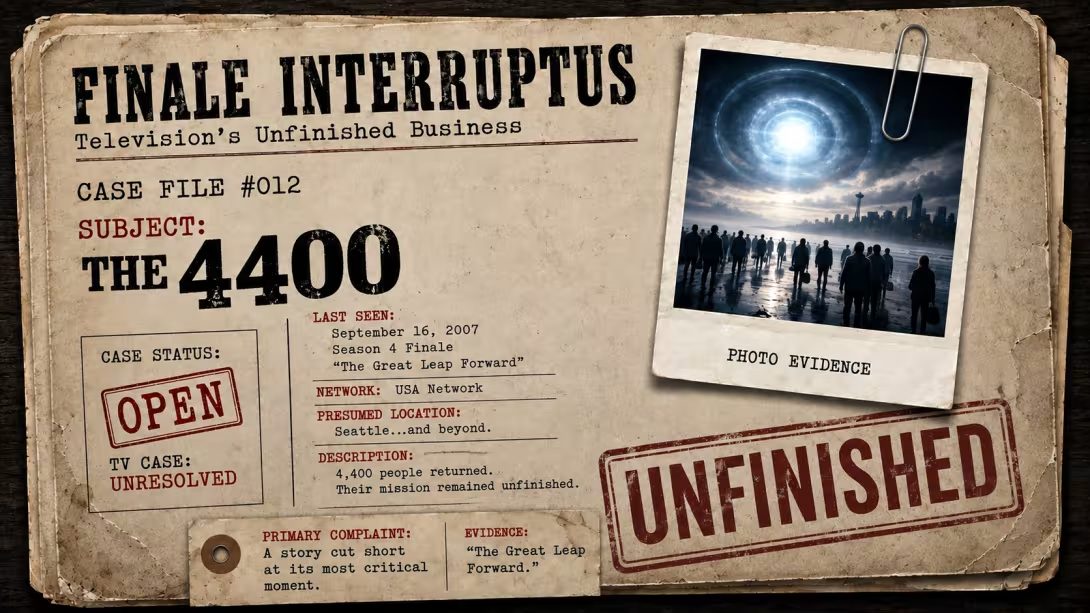
Finale Interruptus: Case File #012 - The 4400
The Return
Imagine disappearing without a trace. Not running away from home, not abandoning your family, and not disappearing into a witness protection program. One moment you're going about your ordinary life, and the next you're simply gone. Your family searches, the police investigate, and eventually the people who love you must confront the possibility that you're never coming back.
Then, years or even decades later, you return. You haven't aged a day. You have no memory of where you've been. The world has moved on without you, and everyone you knew has either grown older, changed beyond recognition, or died.
Now imagine that the same thing has happened to 4,399 other people. That was the irresistible premise of The 4400, the science-fiction drama that premiered on USA Network on July 11, 2004. Created by Scott Peters and René Echevarria, the series began with a mystery that seemed almost tailor-made for the era of serialized television storytelling that also produced programs like The X-Files and, later that year, Lost.
A mysterious ball of light approaches Earth, initially appearing to be a potentially catastrophic celestial object. Instead, it deposits 4,400 people on a beach near Seattle. These individuals vanished from different locations and different periods of history, with disappearances stretching back to the early twentieth century.
For the returnees, virtually no time has passed. For everyone else, the world has changed.
The federal government responds by placing the returnees under the supervision of the National Threat Assessment Command, or NTAC, an agency charged with determining who these people are, where they've been, and whether they represent a danger. Two NTAC agents become our principal guides through the mystery: Tom Baldwin, played by Joel Gretsch, and Diana Skouris, played by Jacqueline McKenzie. Their investigation begins as an effort to understand an extraordinary event, but quickly becomes something far more complicated.
Because the returnees haven't simply come back. Some of them are changing.
A little girl named Maia Rutledge can foresee future events. Shawn Farrell, Tom Baldwin's nephew, discovers that he can heal people through physical contact. Other returnees develop abilities that seem to defy scientific explanation, while still others struggle to understand why they were taken in the first place.
These powers aren't distributed like prizes in a superhero lottery. They often emerge alongside deeply personal consequences, transforming people who were already trying to rebuild lives interrupted by years of absence.
And that was where The 4400 found its real strength. The series could have been content to present a weekly parade of extraordinary abilities, with NTAC investigating each new manifestation before returning to the larger mystery. Occasionally, it used that structure. But the more compelling stories concerned the emotional wreckage left behind by the disappearances.
Richard Tyler, an African-American pilot taken in 1951, returns to a country that has changed profoundly during his absence. Lily Moore discovers that the family she left behind has continued living without her. Maia must navigate a world in which the people who once cared for her are long gone.
Even Shawn's miraculous healing ability becomes a burden when desperate people begin looking to him for salvation. These weren't simply people with superpowers. They were people whose lives had been stolen, then returned under circumstances nobody could explain.
And as the series progressed, it became increasingly apparent that the returnees weren't random victims of an inexplicable phenomenon. They had been selected for a purpose, and the changes they brought into the world were connected to a conflict much larger than any individual disappearance.
That revelation transformed The 4400 from a mystery about missing persons into a story about humanity's future. It also created a narrative obligation.
Once the series began explaining why the 4,400 had been returned, viewers reasonably expected to discover whether their mission would succeed, who was directing events, and what kind of world would emerge from the extraordinary changes already underway. For four seasons, The 4400 moved steadily toward those questions.
Then, just as its fictional world was undergoing its most dramatic transformation, the real-world television industry intervened. And the people who had finally come home found themselves stranded in a story that television would never finish.
The Future Has an Agenda
The great danger in building a television series around a mystery is that eventually somebody has to explain it. For The 4400, that explanation arrived surprisingly early. Rather than spending season after season suggesting extraterrestrial visitors, government experiments, or supernatural intervention, the series revealed that the returnees had been abducted by human beings from the future.
That distinction changed everything. The 4,400 weren't specimens collected for study or unfortunate passengers caught in some cosmic accident. They were individuals deliberately removed from their own times, altered, and returned to the present because humanity's future had gone terribly wrong.
The people responsible for their disappearance were attempting to change history. It was an ambitious answer to an ambitious question, and it gave the series something many mystery-driven programs struggle to establish: a reason for its central phenomenon that could support an entirely new set of stories.
The returnees had been chosen because their presence and emerging abilities could influence events that would otherwise lead humanity toward catastrophe. Their individual lives became pieces in an enormous effort to rewrite the future, although the people moving those pieces weren't necessarily in agreement about how history should be changed.
And that was where the situation became complicated. The future wasn't represented by a single benevolent organization working patiently to save its ancestors. Different factions had competing interests, and the returnees became instruments in a struggle whose full dimensions remained beyond their understanding.
Some wanted to ensure that the original intervention succeeded. Others feared the consequences of changing history and attempted to undermine the effort.
For Tom Baldwin and Diana Skouris, the investigation was no longer simply a matter of determining whether the returnees posed a threat. The agents were confronting people and forces capable of manipulating events across generations, with information about the future that nobody in the present could independently verify.
Even when an explanation seemed plausible, there was no guarantee that the person providing it was telling the whole truth. Meanwhile, the returnees were developing their own ideas about what their experiences meant.
Jordan Collier, played by Billy Campbell, emerged as one of the series' most consequential figures. A charismatic businessman and one of the returned, Collier recognized that the 4,400 represented something more than a collection of individuals with unusual abilities.
They could become a movement. Through the 4400 Center, Collier offered returnees a place where they could explore their abilities and find a sense of belonging in a society that frequently regarded them with suspicion. To supporters, he became a visionary leader who understood the significance of their transformation. To critics, his growing influence looked disturbingly like the beginnings of a cult.
The series was smart enough to allow both interpretations to coexist. Collier's ambitions grew as the story progressed, particularly after his apparent assassination and extraordinary return. He increasingly saw the 4,400 not merely as people who had been changed by the future, but as the beginning of a transformation that should extend to humanity itself.
That ambition brought the series to one of its most important developments: promicin. The substance responsible for the returnees' extraordinary abilities could be administered to ordinary people, potentially granting them powers of their own. Suddenly, the distinction between those who had disappeared and those who had remained behind was no longer absolute.
Anyone might become extraordinary. But there was a terrible catch.
For people who hadn't undergone the returnees' original transformation, taking promicin carried a roughly fifty-percent chance of death. Those who survived could develop remarkable abilities, but the price of attempting that transformation was potentially fatal.
It was an extraordinary moral dilemma, and one the series wisely refused to reduce to a simple argument between heroes and villains. Was promicin a dangerous substance that governments had every responsibility to suppress? Or was it the next stage of human development, with authorities attempting to prevent a transformation they couldn't control?
Were those distributing it liberators offering humanity a choice, or zealots encouraging people to gamble with their lives? And if the future genuinely depended upon creating a population of extraordinary individuals, did that make the deaths acceptable?
The questions became more troubling as Collier's movement gained followers and the government intensified its efforts to contain the spreading phenomenon. What began as an investigation into 4,400 missing people had become a conflict over who possessed the authority to determine humanity's future.
The show also complicated that conflict through Isabelle Tyler, the daughter of Richard Tyler and Lily Moore. Isabelle's accelerated development and formidable abilities made her one of the most unsettling figures in the series, particularly as her role became entangled with the opposing factions from the future.
Her existence suggested that the forces manipulating history were willing to create weapons as well as saviors. By this point, The 4400 had traveled an enormous distance from its original premise. The mystery of where the returnees had gone was no longer the central question. Viewers understood the broad purpose of their disappearance, even if the complete intentions of the future factions remained uncertain.
The question now was whether the intervention would save humanity or simply replace one disastrous future with another. That evolution was both the series' greatest creative strength and the source of its eventual problem.
A mystery about missing people can end when the disappearances are explained. A story about competing visions of humanity's future requires something more difficult: consequences, resolution, and an answer to the question of which future ultimately wins.
By the fourth season, The 4400 was preparing to confront those consequences on a scale its original premise could scarcely have suggested. And Jordan Collier was about to demonstrate just how dramatically the world could change when extraordinary abilities stopped belonging to a chosen few.
Promicin and the Promised Land
There is a fundamental difference between discovering that extraordinary people walk among us and discovering that practically anyone could become one of them. The first situation presents a mystery. The second threatens to overturn civilization.
By its fourth season, The 4400 had moved decisively into that second territory. The returnees were no longer the only people capable of developing extraordinary abilities, and the substance known as promicin had become the center of an escalating conflict involving the federal government, Jordan Collier's followers, and competing forces attempting to shape humanity's future.
Collier believed that the transformation represented humanity's next evolutionary step. The government saw an uncontrolled biological threat capable of producing unpredictable abilities in ordinary citizens, with a substantial likelihood of killing anyone who attempted the process.
Neither position was entirely unreasonable. Promicin could give a person the ability to heal the sick, predict events, or accomplish things previously considered impossible. It could also produce powers whose consequences were dangerous, difficult to control, or poorly understood. And for those who took it voluntarily, the prospect of extraordinary abilities came with approximately even odds of surviving the experience.
It was hardly the sort of treatment that could be approved after a routine visit to the family doctor. Yet Collier's movement continued to grow, attracting people who believed that the risk was justified by the possibility of becoming something more than human. His message was particularly compelling because he could point to the returnees themselves as evidence that extraordinary abilities might have a purpose beyond individual ambition.
The future, he argued, needed people willing to change. For NTAC agents Tom Baldwin and Diana Skouris, the problem was becoming increasingly difficult to contain. They were no longer investigating a finite population of 4,400 people. Every new promicin-positive individual potentially introduced another unpredictable ability into a society that had barely begun adjusting to the original returnees.
The conflict also became deeply personal. Tom's connection to the future's competing factions had already made him more than an impartial investigator. During the fourth season, he became the target of an organization known as the Marked, whose members were agents of a hostile future faction inhabiting the bodies of people in the present.
The Marked represented a particularly unsettling escalation. Rather than relying solely on returnees or individuals with unusual abilities, they could operate through established figures within contemporary society, concealing their identities while attempting to influence events from positions of power.
Their presence made the struggle over humanity's future even more difficult to define. The opposing sides were no longer separated neatly into government officials, returnees, and promicin users. Some of the people apparently defending the present were secretly working to ensure a very different future.
Meanwhile, Collier was establishing something resembling a nation within a nation. His followers occupied a section of Seattle and declared it Promise City, a community intended to provide sanctuary for promicin-positive individuals and demonstrate what a transformed society might look like.
The name was hardly subtle, but neither was the ambition. Promise City represented an open challenge to conventional political authority. Collier was no longer merely advocating for the rights of returnees or distributing a substance the government wanted suppressed. He was creating a separate social order built around the belief that people with extraordinary abilities represented humanity's future.
To his supporters, it was a refuge. To the authorities, it was an increasingly dangerous concentration of individuals whose powers could make ordinary law enforcement ineffective.
And to the audience, it was a fascinating development because the series had finally begun showing what its central premise might mean beyond the lives of individual characters. If the 4,400 had been returned to prevent a catastrophe, perhaps their ultimate purpose wasn't to stop a single disastrous event. Perhaps they were supposed to change the entire direction of human civilization.
That possibility became considerably more immediate in the fourth-season finale, “The Great Leap.” The episode brought several long-running conflicts to a head while introducing a catastrophe that would fundamentally alter the balance between ordinary humanity and those transformed by promicin.
Danny Farrell’s newly developed ability spread promicin involuntarily through Seattle, exposing people who had never chosen to take it. The results were devastating. Many died, while others survived and developed extraordinary abilities.
The transformation that Collier had been advocating was no longer confined to people willing to gamble their lives on a voluntary injection. It had become a public disaster.
The outbreak also changed the nature of the conflict. Previously, authorities could attempt to control the distribution of promicin, identify those who had taken it, and isolate individuals whose powers presented an immediate danger.
Now the city contained a rapidly expanding population of people whose abilities had emerged through an uncontrolled event. The government could no longer treat the situation as a problem involving a relatively small and identifiable group.
The world had changed. And Jordan Collier was prepared to take advantage of it.
With Seattle reeling from the outbreak, Collier's influence expanded dramatically. The closing developments positioned Promise City and its leader at the center of a new political reality, one in which the boundary between ordinary society and the transformed population was becoming increasingly difficult to maintain.
The finale also left Tom Baldwin facing a transformation of his own, adding another complication to a character whose life had already become entangled with the future's attempts to rewrite history. These developments were not presented as a tidy conclusion to the series.
They were the beginning of something much larger. The original mystery had involved 4,400 people appearing on a beach, bewildered by a world that had moved on without them. Four seasons later, the phenomenon that had changed their lives was spreading throughout the population, and an increasingly powerful movement was attempting to reorganize society around the consequences.
The story had come remarkably far. But the question of what would happen next had become more important than ever.
Would Collier's transformed society survive? Would the government attempt to reclaim control? Could the competing factions from the future still influence events, or had history finally moved beyond their ability to manage it?
And perhaps most importantly, was humanity moving toward the future the returnees had been sent to create—or toward the catastrophe they were supposed to prevent? Those were precisely the questions a fifth season seemed positioned to explore.
Instead, viewers received something considerably less satisfying. A cancellation announcement.
The future had finally arrived for The 4400. Unfortunately, the series wasn't going to be there to see it.
The Cancellation That Stopped the Future
Television networks have an unfortunate habit of making decisions about the future of a series without consulting the future its writers have already planned. For The 4400, the timing was particularly cruel.
The fourth-season finale, “The Great Leap,” aired on September 16, 2007. It left Seattle transformed by a promicin outbreak, Jordan Collier's movement in an increasingly powerful position, and Tom Baldwin facing a decision that could fundamentally alter his relationship with the extraordinary people he had spent four seasons investigating.
It was an ending designed to make viewers eager for the next chapter. Unfortunately, that chapter never arrived.
On December 19, 2007, USA Network confirmed that The 4400 would not return for a fifth season. The announcement also brought an end to The Dead Zone, another established science-fiction drama on the network's schedule.
For viewers, the news meant that the events of “The Great Leap Forward” would remain the last developments they would see on television. For the people making the series, it meant abandoning a fictional world that had just undergone its most dramatic transformation.
The cancellation was especially disappointing because The 4400 had demonstrated considerable staying power. What began as a five-episode miniseries in 2004 had earned sufficient interest to continue for three additional seasons, ultimately producing 44 episodes.
That was a respectable run for a serialized science-fiction drama on basic cable, particularly one that required viewers to follow an increasingly elaborate mythology rather than simply tune in for a self-contained adventure. But respectable longevity doesn't guarantee renewal.
By its fourth season, The 4400 was no longer enjoying the audience numbers that had greeted its original premiere. The series had launched as a major success for USA Network, attracting millions of viewers and demonstrating that the channel could support ambitious original science-fiction programming.
Over time, however, its audience declined. That erosion mattered because television networks evaluate programs not simply according to the enthusiasm of their most devoted viewers, but according to advertising revenue, production costs, scheduling priorities, and the potential returns from alternative programming.
A series can retain an intensely loyal audience and still become difficult to justify financially. And The 4400 faced another problem that was particularly familiar to viewers of serialized science fiction.
The more elaborate its mythology became, the harder it was for newcomers to join the story. Someone discovering the program during its fourth season wasn't merely being introduced to a government investigation involving people with unusual abilities. That viewer needed to understand the returnees, the competing factions from the future, the role of promicin, Jordan Collier's movement, the Marked, and years of complicated relationships among the principal characters.
For established fans, that continuity was part of the attraction. For a casual viewer encountering the series for the first time, it could be a considerable obstacle.
None of this made cancellation inevitable, but it helps explain why a program with a passionate following might struggle to maintain the broader audience necessary to survive. Then there was the writers' strike.
The Writers Guild of America strike began on November 5, 2007, and continued until February 12, 2008, disrupting television production across the industry. Because The 4400 was canceled during that period, the strike has sometimes been associated with the show's demise.
The timing certainly contributed to the uncertainty surrounding television production in late 2007. But it would be misleading to declare that the strike alone killed The 4400. The series had already experienced declining ratings, and USA Network's decision reflected broader programming considerations that cannot be reduced to a single industry dispute.
The strike formed part of the environment in which the decision was made, not a conclusively established sole cause. Whatever the precise combination of factors, the outcome was the same.
USA Network declined to order another season. The decision also demonstrated the peculiar vulnerability of serialized storytelling. A conventional procedural can often survive cancellation without leaving its audience feeling that the story has been interrupted. Individual investigations have been completed, criminals have been apprehended, and the characters can be imagined continuing their professional lives beyond the final episode.
The 4400 was different. Its fourth-season finale had not merely left a few personal relationships unresolved. It had fundamentally changed the rules of the fictional world.
Seattle was now confronting the consequences of a mass transformation. Jordan Collier's ambitions had moved beyond advocacy toward the creation of a new social order. The government faced an unprecedented challenge to its authority, and the forces manipulating events from the future remained active.
Those developments demanded consequences. What would happen to Promise City? Could Collier's movement coexist with the United States government? Would the newly empowered population become the salvation humanity had been promised, or would its emergence produce the very catastrophe the returnees were supposed to prevent?
The finale had opened those questions rather than closed them. And that is what makes The 4400 such a clear example of Finale Interruptus.
The series wasn't canceled after its central mystery had been neatly resolved and its characters sent on their separate ways. It was canceled at the moment its accumulated mythology had produced a radically different world, one whose future was now the central subject of the story.
The distinction is important. Viewers had learned why the missing people returned. What they hadn't learned was whether the returnees would accomplish what they had been sent back to do.
For a time, it appeared that the television finale would remain the only ending available. Fans continued discussing the series, and efforts to encourage its revival demonstrated that the audience hadn't simply forgotten about the 4,400. But enthusiasm alone couldn't persuade USA Network to reopen production, and the actors and creative personnel inevitably moved on to other projects.
The possibility of a conventional fifth season became increasingly remote. Yet The 4400 possessed one advantage that many prematurely canceled television series never receive.
Its story wasn't entirely dependent upon the cameras continuing to roll. The characters, their extraordinary abilities, and the future they were struggling to create could still exist on the printed page. And in 2009, that is precisely where the missing ending began to emerge.
The Story That Continued After Cancellation
Cancellation didn't quite mean the end of The 4400. Although USA Network never produced a fifth season, the story eventually continued in prose, giving the series an unusual place among television programs that ended before their creators could finish telling their stories. That raises a question particularly suited to Finale Interruptus: when an unfinished television series receives an authorized continuation in another medium, does that count as an ending?
The answer depends, in part, on what the continuation accomplishes. Four original novels were published under The 4400 banner, but only two directly continued the story beyond the fourth-season finale. The earlier books, Greg Cox's The Vesuvius Prophecy and Wet Work by Dayton Ward and Kevin Dilmore, offered adventures within the established television continuity rather than resolving the cliffhanger.
The real continuation arrived in 2009 with Greg Cox's Welcome to Promise City, followed by David Mack's Promises Broken. Unlike the earlier tie-ins, these novels picked up the consequences of “The Great Leap Forward” and treated the events of the television finale as the beginning of another chapter.
That was no small undertaking. By the time the series ended, Jordan Collier's movement had transformed Seattle into a city where extraordinary abilities were becoming commonplace. Hundreds had died in the promicin outbreak, the federal government faced a population it could neither easily control nor safely ignore, and the struggle between competing factions from the future remained unresolved.
Welcome to Promise City explores the uneasy relationship between Collier's transformed Seattle and the federal government, while returning to the personal conflicts that made the television series compelling. Tom Baldwin and Diana Skouris remain central figures, and the continuing threat of the Marked ensures that the struggle over the future hasn't conveniently disappeared.
David Mack's Promises Broken takes that conflict further. Set after the events of Cox's novel, it places Collier's movement on a collision course with the United States government. The confrontation threatens to become an outright military conflict, while the surviving Marked continue their efforts to undermine the future the returnees were sent to create.
In other words, the novels address precisely the territory a fifth television season might have explored. But we have unusually direct evidence that this was intentional. In a 2009 discussion with readers, Mack described writing Promises Broken as a grand finale while leaving room for possible future stories. Cox confirmed that the books had received approval from CBS and that the authors enjoyed considerable creative freedom.
Those comments distinguish the novels from an unofficial fan continuation. The books were licensed, and the writers deliberately extended the interrupted narrative. But Mack later clarified an important limitation: at his editor’s request, Promises Broken ends with a new cliffhanger, preserving an opening for additional novels. The publisher commissioned none. His own advice to readers who wanted closure was to disregard the epilogue.
For readers willing to follow the story into print, the books resolve substantial conflicts but do not close every door. For viewers who never knew they existed, the original series still ends with Seattle transformed, Collier ascendant, and the future uncertain.
That leaves The 4400 in an unusually ironic position. Its central mystery was explained, and its unfinished consequences were explored in licensed fiction. Yet television audiences never saw that continuation, and even the last novel deliberately opened one final unanswered question.
The Future That Never Made It to Television
There is a certain poetic justice in the way The 4400 ultimately found its ending. The series began with thousands of people who disappeared from their own lives, only to return years later and discover that the world had moved on without them. When USA Network canceled the program, its audience experienced something remarkably similar. The characters disappeared from television, their stories suspended at a moment of enormous consequence, while the entertainment industry continued without them.
Then, two years later, they returned. Not on television, admittedly. There were no new episodes, no familiar opening credits, and no opportunity to watch Joel Gretsch, Jacqueline McKenzie, or Billy Campbell bring their characters through the final stages of the story.
Instead, the continuation arrived in bookstores. And that brings us to the question at the heart of this investigation: Did The 4400 actually receive an ending?
The answer is partly yes. The novels resolve major conflicts, but the final book introduces another cliffhanger—an important qualification when judging whether the story truly ended.
Unlike many of the series we've investigated in Finale Interruptus, The 4400 did not leave its central mystery entirely unexplained. Viewers learned that the returnees had been taken by people from the future, altered, and sent back to influence events that might otherwise lead humanity toward catastrophe.
That revelation answered the original question of where the missing people had gone and why they had returned. But it also transformed the series into something considerably more ambitious.
The 4,400 were no longer simply the subjects of an extraordinary investigation. They were participants in an effort to redirect human history, and their presence had consequences that extended far beyond their individual lives.
By the fourth-season finale, the story had moved from unexplained disappearances to a struggle over the future of civilization itself. Promicin had spread beyond the original returnees, Jordan Collier was establishing a new social order, and the federal government faced a challenge unlike anything it had previously encountered.
Those weren't loose ends that could be dismissed with a brief explanation. They were the foundation of the story's next chapter.
The officially licensed continuation novels provided that chapter, culminating in David Mack's Promises Broken. They addressed the escalating conflict between Collier's movement and the government while confronting the competing interests of the future factions.
That is a meaningful distinction. The novels weren't simply additional adventures set in a familiar fictional universe. They were written to carry the interrupted narrative forward and provide a substantial resolution to its central conflicts.
For readers willing to follow the story into another medium, The 4400 therefore offers something that many canceled science-fiction programs do not: an authorized continuation that makes a serious attempt to finish what television began. But we should be careful about declaring the case completely solved.
A licensed novel isn't the same thing as a produced television season. Even when the continuation respects the established mythology and receives the necessary approvals, it remains a different interpretation of how the story might proceed.
We cannot assume that a fifth season would have followed precisely the same path, resolved every conflict in the same way, or reached the same destination. Television storytelling is collaborative, and the direction of a series can change considerably between an initial creative plan and the episodes that eventually reach the screen. Actors, writers, producers, budgets, and network expectations all influence the finished result.
The novels tell us how the story was continued in print. They cannot tell us exactly what a fifth television season would have been.
And there's another consideration that matters just as much. For anyone who wants to revisit those performances, the original four-season run is available as The 4400: The Complete Series on DVD; Blu-ray editions also exist, although buyers should check region compatibility. For many viewers, television is the experience.
They become attached not only to fictional characters but to the performers portraying them, the music accompanying their stories, and the particular rhythms of a program that becomes part of their weekly routine. A novel can reproduce dialogue, describe familiar locations, and continue established relationships. It cannot fully recreate the experience of watching those characters inhabit the screen.
That doesn't diminish the value of the books. It simply acknowledges that a story's medium can become part of its identity.
The distinction is especially relevant to The 4400 because the series depended so heavily upon the human consequences of extraordinary events. Maia's ability to foresee the future was interesting, but her vulnerability made the character memorable. Shawn's healing powers created possibilities for remarkable stories, but his relationships and responsibilities gave those stories emotional weight. Jordan Collier's ambitions mattered because Billy Campbell could make him appear visionary, dangerous, compassionate, and manipulative, sometimes within the same scene.
Readers could imagine those performances continuing through the novels. Viewers never had the opportunity to see them.
There was also a later attempt to revisit the premise through The CW's 4400, which premiered in 2021. Despite its familiar title and the shared concept of people returning after unexplained disappearances, the new series was a reimagining rather than a continuation of the original continuity.
It introduced different characters and a different approach to the underlying mystery. Whatever its merits, it did not answer the questions left hanging by the 2007 finale.
The CW canceled that series after one season, leaving the franchise with another television incarnation that ended prematurely. That development makes the original show's unusual fate even more striking.
The first 4400 received substantial continuation in print, though even its final novel left a new cliffhanger. Its successor never had the opportunity to develop a comparable mythology over several seasons.
Two television series, both cut short, connected by a premise about people whose lives were interrupted. It's almost too appropriate.
Bill's Bottom Line
The verdict on The 4400 requires us to distinguish between an unfinished television series and an unfinished story. As a television production, the original series unquestionably suffered from Finale Interruptus. Its fourth-season finale dramatically altered the fictional world, introduced new conflicts, and positioned its characters for developments the audience would never see on screen.
The cancellation denied viewers the fifth season those developments appeared to demand. But as a larger narrative, The 4400 received a partial reprieve. The continuation novels resolved significant conflicts surrounding the promicin outbreak and humanity’s future, only for the final book to introduce another unresolved question.
That doesn’t erase the television cliffhanger—or the literary one. It does make this case different from a series whose story simply stops without anyone trying to finish it.
Perhaps the most appropriate conclusion is that The 4400 escaped narrative oblivion without ever securing a completely unambiguous ending. Its characters were given a future.
Its viewers were simply required to find that future somewhere else. And there's something fitting about that, considering how the whole story began.
For four seasons, The 4400 asked what would happen when thousands of missing people suddenly returned to a world that had learned to live without them. When the series itself disappeared, its audience was left waiting for a similar miracle.
The return eventually came. But this time, instead of a mysterious ball of light appearing over Seattle, somebody had to turn a page.