
One Last Flight: Remembering Tom Skerritt and Michael Gray
Two familiar faces from very different corners of entertainment history have taken their final bows, their deaths announced on the same day. Tom Skerritt, the veteran actor whose commanding presence anchored everything from Alien to Top Gun, died October 21 at the age of 93. Michael Gray, forever remembered by a generation of Saturday-morning viewers as Billy Batson on Shazam!, died October 16 at the age of 75. Both losses became public knowledge on Thursday, October 22, giving fans of two very different generations a shared moment of remembrance.
According to the Associated Press, Skerritt died of natural causes, as confirmed by his family. Gray's representatives likewise confirmed to People that he died of natural causes, with other reporting indicating that his health had declined before his death in Palm Desert, California.
Their careers could hardly have been more different. One became one of Hollywood's most dependable character actors, appearing in films and television for more than six decades. The other became the face of a beloved superhero series whose cultural footprint far exceeded its three-season run. Yet both occupied a special place in the memories of audiences who grew up with their performances, and both portrayed characters who understood that being a hero required more than simply having the ability to act.
Tom Skerritt: The Man Who Made Authority Look Effortless
There was something reassuring about Tom Skerritt. Whether he was commanding a spaceship, running a small-town sheriff's department, or teaching hotshot Navy pilots that talent was no substitute for discipline, he brought an unmistakable credibility to the screen. He could be stern without seeming cruel, sympathetic without becoming sentimental, and heroic without needing to announce it.
Born August 25, 1933, in Detroit, Michigan, Skerritt served four years in the United States Air Force before pursuing filmmaking and acting. His film debut came in the 1962 Korean War drama War Hunt, a production that also featured Robert Redford and Sydney Pollack. Skerritt initially aspired to direct, but the acting opportunities kept coming, and Hollywood found itself with a remarkably versatile performer.
His breakthrough came with Robert Altman's M*A*S*H* in 1970, where he played Captain Augustus Bedford "Duke" Forrest. It was a performance that demonstrated Skerritt's ability to hold his own in an ensemble of strong personalities, a skill that would serve him throughout his career. He followed it with roles in films as varied as Harold and Maude, The Turning Point, and the Cheech and Chong comedy Up in Smoke, demonstrating a range that sometimes gets overlooked when audiences remember his more authoritative characters.
Science-fiction fans will forever remember him as Captain Arthur Dallas aboard the doomed commercial towing vessel Nostromo in Ridley Scott's Alien (1979). Dallas was neither an action hero nor an infallible commander. He was a working man confronted with an impossible situation, and Skerritt's understated performance helped make the film's extraordinary horror feel disturbingly believable. His desperate journey into the ship's ventilation system remains one of the film's most nerve-racking sequences.
Then came Top Gun in 1986.
As Commander Mike "Viper" Metcalf, Skerritt was the seasoned aviator tasked with turning gifted but reckless young pilots into professionals. Opposite Tom Cruise's Maverick, Viper represented experience, restraint, and the hard-earned wisdom of a man who understood the difference between bravery and recklessness. He also provided a vital connection to Maverick's father, helping the younger pilot come to terms with the truth behind his family's history.
It wasn't the largest role in the film, but it was an indispensable one. Skerritt gave Top Gun much of its moral center, providing the authority against which Maverick's youthful arrogance could be measured. His character's lessons were about more than flying fighter jets; they were about judgment, responsibility, and learning when to trust something beyond one's own instincts.
He was equally effective outside the action genre. His performances in The Dead Zone, Steel Magnolias, Contact, and A River Runs Through It revealed an emotional complexity that complemented his commanding screen presence. In the latter film, directed by his longtime friend Robert Redford, Skerritt portrayed the Reverend John Maclean, a father whose stern exterior concealed a deep love for his sons.
Television audiences came to know him as Sheriff Jimmy Brock in David E. Kelley's Picket Fences, which ran from 1992 to 1996. The role earned Skerritt the 1993 Primetime Emmy Award for Outstanding Lead Actor in a Drama Series, recognizing a performance that balanced domestic drama, social controversy, and the sometimes absurd realities of small-town life. As Variety noted in its retrospective, his television work demonstrated the same versatility that had made him a reliable presence on the big screen.
Away from Hollywood, Skerritt championed independent filmmaking and helped establish the Red Badge Project, which encourages military veterans to tell their stories through writing and other creative pursuits. His family's statement emphasized his generosity, curiosity, commitment to storytelling, and dedication to helping others find their voices. It was a fitting description of an actor whose work so often centered on guiding others through difficult circumstances.
Skerritt is survived by his wife, Julie Tokashiki, and five children. He leaves behind an extraordinary body of work, but perhaps his greatest achievement was making so many different characters feel like men audiences could believe in, even when those characters themselves were uncertain what to do next.
Michael Gray: The Boy Who Could Become a Superhero
For children growing up in the 1970s, Saturday mornings were sacred territory. Cartoons, breakfast cereal, and live-action adventures offered a few precious hours when the world belonged to kids. Superheroes didn't need billion-dollar budgets or elaborate cinematic universes to capture an audience's imagination; sometimes all they needed was a motorhome, a magic word, and a young actor who could make the impossible seem perfectly natural.
For three seasons, Michael Gray was that actor.
Born September 2, 1951, in Chicago, Illinois, Gray grew up in Miami Beach before heading west to pursue acting. He studied at the Pasadena Playhouse and began building a career through television appearances and film roles, including the 1970 cult productions Beyond the Valley of the Dolls and Myra Breckinridge. His television credits included The Little People, The Flying Nun, and The Brady Bunch, where he played Jeff, one of Marcia Brady's boyfriends.
But in 1974, he landed the role that would define his career: Billy Batson in Filmation's live-action Shazam!
Unlike contemporary superhero productions, which emphasize spectacular battles and cosmic threats, the original CBS series was comparatively modest. Billy traveled the country in a motorhome with his mentor, appropriately called Mentor, played by Les Tremayne. Along the way, they encountered ordinary people facing ordinary problems, often involving young people making questionable decisions or finding themselves in situations they weren't equipped to handle.
When circumstances demanded extraordinary intervention, Billy would utter the magic word "Shazam!" and transform into the mighty Captain Marvel, portrayed initially by Jackson Bostwick and later by John Davey.
The transformation was spectacular by Saturday-morning standards, but the show's real appeal was its message. Being a hero wasn't simply about possessing extraordinary powers. It was about making the right choices, helping others, and accepting responsibility for one's actions. Each adventure carried a moral lesson, but the stories worked because the lessons emerged from situations young viewers could recognize.
Gray was essential to making that message believable. His Billy Batson was approachable, earnest, and recognizably human. He wasn't a miniature adult pretending to be a teenager, nor was he an impossibly perfect role model. He was a young man learning lessons alongside the audience, and when he called upon Captain Marvel, it felt like the natural extension of his desire to help rather than an escape from responsibility.
The series produced 28 episodes across three seasons, beginning in 1974 and concluding its original run in 1976. Although Gray continued acting afterward, he found it difficult to escape his association with Billy Batson, eventually stepping away from the entertainment industry for extended periods. The role that made him famous also made it difficult for casting directors to see him as anyone else.
But the fans never forgot him.
As superhero entertainment grew into a dominant force in popular culture, Gray became a welcome presence at conventions, where generations of viewers could finally meet the young man who had introduced them to Captain Marvel. He also enjoyed a late-career return to the character's universe with a cameo in Shazam! Fury of the Gods (2023), bringing a welcome connection between the 1970s television series and its modern cinematic successor.
In People's remembrance of Gray, former co-star John Davey recalled a cheerful, generous man who genuinely enjoyed acting and meeting the fans who had kept the show's memory alive. Davey's tribute made clear that the warmth audiences remembered from Gray's performance was not simply an invention of the writers.
For a generation of children, Michael Gray wasn't merely playing Billy Batson. He was the face of a television adventure that suggested extraordinary things could happen to ordinary people, and that the most important part of becoming a hero was already inside them.
Two Different Careers, One Shared Legacy
Tom Skerritt and Michael Gray were separated by nearly two decades in age and followed dramatically different professional paths. Skerritt accumulated an extraordinary filmography, moving comfortably between prestige dramas, science-fiction classics, action blockbusters, and award-winning television. Gray became closely identified with one character, but that character secured his place in the memories of millions.
Their deaths were not simultaneous, but the coincidence of their announcements brought their stories together in an unexpected way. As Entertainment Weekly's remembrance of the year's losses recorded, both men were remembered on October 22, inviting audiences to reflect on the characters who had made them household names.
There is something fitting about remembering them together.
Viper taught young pilots that courage required discipline, judgment, and responsibility. Billy Batson learned, week after week, that extraordinary abilities meant little without compassion, integrity, and the willingness to help others. One was the teacher, the other the student, but both represented the same underlying ideal: that true heroism begins with character rather than power.
Perhaps that is why both performances have endured long after the productions themselves became part of entertainment history. Audiences may remember the fighter jets and the lightning bolts, but they also remember the people beneath the helmets and behind the magic words. Those human connections are what transform popular entertainment into something that lasts.
So perhaps there's room for one final crossover that Hollywood never imagined.
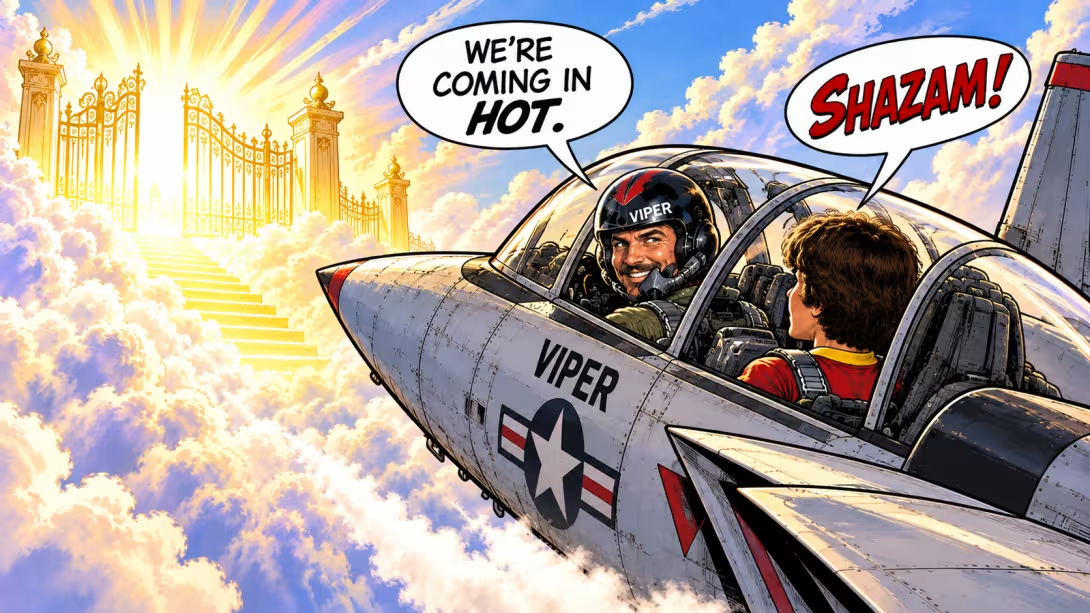
Somewhere above the clouds, a Navy fighter jet banks toward a brilliant city of light. At the controls sits Commander Mike "Viper" Metcalf, looking over his shoulder at the young passenger in the seat behind him.
"We're coming in hot," Viper announces.
And Billy Batson, grinning with the enthusiasm of a boy who knows that the greatest adventure is still ahead, answers with the only word he needs.
"SHAZAM!"
Godspeed, Tom Skerritt and Michael Gray. Thank you for the adventures.