
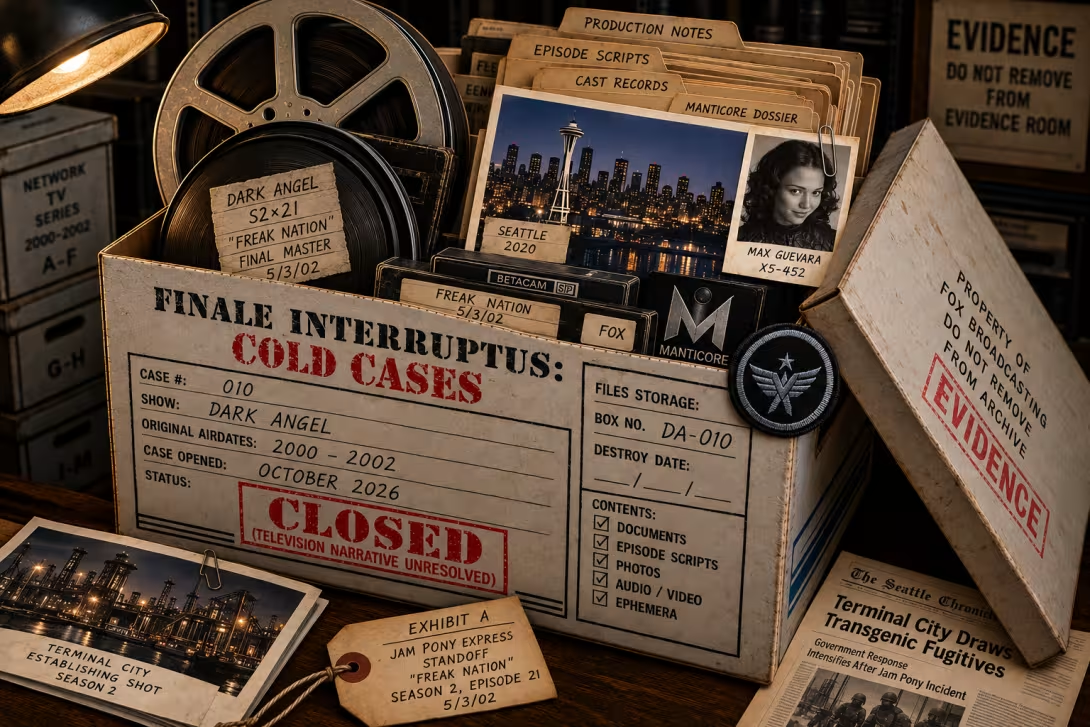
Finale Interruptus: Cold Cases - Case File #010: Dark Angel
Every television series begins with a promise.
Most do.
Some don’t.
Some endings are still missing.
These are their case files.
The Girl Who Escaped Manticore
The future arrived on October 3, 2000, and it wasn't particularly interested in welcoming us. In the world of Dark Angel, the United States had suffered a catastrophic electromagnetic pulse that crippled its infrastructure, devastated its economy, and reduced a former superpower to something considerably less impressive. By 2019, the country was still struggling to recover. Seattle had become a city of checkpoints, black markets, institutional corruption, and citizens who remembered prosperity largely as something their parents used to talk about.
It was an unusually pessimistic vision for a television series arriving at the dawn of a new millennium. While much of popular entertainment was still preoccupied with the possibilities of the digital age, James Cameron was imagining what might happen if the technological civilization everyone had come to depend upon suddenly stopped working. Into that landscape rode Max Guevara, a bicycle messenger with a motorcycle, a criminal sideline, a complicated romantic future, and considerably more genetic engineering than her employers at Jam Pony Express suspected.
Played by Jessica Alba, Max was not simply a young woman with extraordinary abilities. She was government property that had escaped its owners.
Born and raised inside a clandestine military program known as Manticore, Max belonged to a generation of genetically engineered children designed to become superior soldiers. Their DNA had been modified to enhance strength, speed, agility, reflexes, and other physical characteristics. They were trained to obey orders, endure punishment, and regard their extraordinary abilities as instruments of military necessity.
In 2009, Max and eleven other children escaped the facility during a winter night that would define the rest of their lives. They scattered into a world they barely understood, leaving behind the only home they had known and a government apparatus that had no intention of allowing its investments to remain missing.
Ten years later, Max was still running. That was the essential promise of Dark Angel: a young woman searching for the family she had lost while trying to remain invisible to the people who had created her.
The science fiction was elaborate, but the emotional foundation was straightforward. Max wanted to know where she came from, what had happened to the other children, and whether she could build a life that belonged to her rather than to Manticore. The answers would prove more complicated than the questions.
Cameron Comes to Television
Dark Angel carried an unusual pedigree for a network science-fiction series. Its creators were James Cameron and Charles H. Eglee, with Cameron bringing the reputation of a filmmaker whose credits included The Terminator, Aliens, The Abyss, Terminator 2: Judgment Day, and Titanic.
Cameron's name alone ensured that the series would receive attention. This was not an anonymous genre program quietly filling an inconvenient hour of network television. It was a high-profile production from a filmmaker associated with technologically ambitious spectacle, strong female protagonists, and stories in which humanity's inventions frequently developed unfortunate ideas about who should be in charge.
There was, however, a practical challenge. Television was not cinema, and a weekly series could not operate on the production timetable or budget of a Cameron feature film.
The solution was to build a world that could sustain action and science fiction without requiring a theatrical effects sequence every seven minutes. Post-Pulse Seattle supplied that world. The city looked familiar enough to be photographed as an urban environment, while the circumstances of its collapse allowed the writers to introduce a different political and social order.
The setting also gave Dark Angel an identity beyond its genetically enhanced heroine. This was a country in which the government could still exercise enormous power over individuals despite having failed to protect the larger population from economic catastrophe. Wealth remained concentrated among those who had survived the collapse comfortably, while everyone else improvised a living beneath the remnants of the old system.
Max's bicycle-messenger job was therefore more than a convenient excuse to move her around the city. It placed her among people whose daily lives were shaped by the consequences of the Pulse, even as she concealed a personal history that made her uniquely vulnerable to the state's attention. The series was built around two kinds of survival: the ordinary struggle of people living in a broken society, and the extraordinary struggle of someone who had been engineered to serve that society's most secretive institutions. For a while, the distinction worked remarkably well.
The Man Behind the Voice
Max's life became considerably more complicated when she encountered Logan Cale, played by Michael Weatherly. Logan was a wealthy cyberjournalist who operated under the identity Eyes Only, using clandestine broadcasts to expose corruption and challenge powerful interests. Where Max generally preferred to look after herself and the people immediately around her, Logan believed that possessing the means to confront injustice created an obligation to do something about it.
Their relationship began as an uneasy arrangement between two people with different priorities. Logan needed someone capable of carrying out dangerous missions in the physical world, and Max possessed abilities that made most conventional security arrangements little more than temporary inconveniences. Max, meanwhile, needed resources and information that Logan could provide, particularly when it came to locating her fellow Manticore escapees.
Neither expected the arrangement to remain strictly professional. The romantic tension between Max and Logan supplied the series with a human center, but Logan's role was important for another reason. Eyes Only was, in effect, an underground news operation working in a society where official institutions could no longer be trusted to police themselves.
His broadcasts exposed abuses that powerful people preferred to keep hidden. His wealth provided some protection, but the work placed him and his associates in danger. The series repeatedly returned to the question of what an individual owed to strangers when helping them might threaten the life that individual had managed to build.
Max had been trained to carry out missions without questioning their purpose. Logan wanted her to choose missions precisely because their purpose mattered.
The difference helped define her growth throughout the first season. It also established a conflict that would remain central to the series: whether Max could ever stop living as a fugitive long enough to become someone who made her own decisions about the world.
The Family Manticore Made
Although Max was the principal character, the missing children of Manticore supplied the larger mystery. Their escape had scattered them across the country, and Max had spent years trying to locate them. Some had found ways to live ordinary lives. Others remained caught between the conditioning of their childhood and the uncertain freedom they had gained.
The search introduced a recurring tension between the idea of family as something inherited and family as something chosen. The children had been assembled by scientists and military planners, but their shared captivity had created bonds that their creators never intended.
For Max, finding another escapee meant recovering a piece of her own identity. It also meant risking the fragile anonymity that had kept her alive.
Manticore, meanwhile, had not forgotten its missing assets. Colonel Donald Lydecker, portrayed by John Savage, served as the program's relentless representative during the first season. He knew what Max and the others were capable of, understood how they had been trained, and possessed the resources to pursue them through a society already accustomed to surveillance and coercion.
Lydecker was an effective antagonist because his relationship with the escapees was more complicated than simple hatred. He regarded them as products of a program in which he had invested years of his life, and his pursuit carried an unsettling mixture of professional determination, possessiveness, and something resembling paternal concern. From Max's perspective, none of those distinctions made him less dangerous.
The children had escaped a system that claimed ownership of their bodies and futures. Lydecker intended to restore that ownership, regardless of what the escapees wanted.
That conflict gave the first season its momentum. Individual episodes could involve criminal schemes, corrupt officials, or Logan's investigations, but the larger story remained Max's search for her siblings and Manticore's determination to bring them home.
The question was never merely whether Max could defeat the people hunting her. It was whether she could discover enough about her origins to stop being defined by them.
A Hit With an Uncertain Future
Dark Angel premiered on Fox on October 3, 2000, and quickly established itself as one of the network's more prominent new dramas. Jessica Alba's performance was central to its appeal. Max could be sarcastic, selfish, loyal, reckless, and unexpectedly vulnerable, sometimes within the same scene. Her enhanced abilities made her dangerous, but her emotional inexperience and uncertainty about ordinary relationships kept her from becoming an invulnerable action figure.
The supporting cast gave her a world worth inhabiting. At Jam Pony, characters such as Original Cindy, Sketchy, and Normal provided humor and everyday complications that contrasted with the conspiracies surrounding Manticore. Logan's investigations introduced a different set of moral and political concerns, while the search for Max's fellow escapees kept the science-fiction mythology moving.
The series received considerable attention during its first season, and Alba won a Golden Globe nomination for her performance. Fox renewed the program for a second season.
That renewal should have represented a measure of security. The show had a recognizable star, a substantial creative pedigree, an established mythology, and a central character whose search for her lost family offered years of potential stories. But the first season also ended by dramatically changing the conditions under which those stories could be told.
The Manticore program was no longer merely a shadowy institution pursuing its escaped children from a distance. Max's confrontation with its operations had brought her closer to the center of the conspiracy, while the revelations surrounding the other transgenics suggested that her childhood escape was only one part of a much larger story. The writers had begun expanding the world beyond the original group of children, and the consequences of that expansion would become impossible to ignore. When Dark Angel returned for its second season, the series would be operating with a different creative emphasis, a different broadcast night, and an increasingly crowded mythology. Max Guevara had spent the first season trying to find the people who had escaped Manticore with her. Soon, she would discover that the number of people who needed saving was considerably larger than twelve.
A Different Kind of Monster
When Dark Angel returned to Fox on September 28, 2001, Max Guevara was still fighting for her freedom. The television series surrounding her, however, had undergone a transformation of its own.
The first season had been built around a relatively straightforward premise: a genetically engineered young woman living under an assumed identity in a broken America, searching for the children who had escaped a secret military installation with her. There were conspiracies, corrupt officials, and government experiments, but the story remained grounded in Max's immediate circumstances. Her extraordinary abilities were generally concealed beneath an otherwise recognizable human appearance, and the people pursuing her were dangerous precisely because they could move through ordinary society without attracting attention.
The second season expanded that premise considerably. Manticore was no longer simply the institution that had created Max and her fellow escapees. It was revealed as the source of an entire population of genetically engineered beings, some of whom could never hope to pass unnoticed among ordinary humans.
The change was more than cosmetic. It altered the kind of story Dark Angel was telling. A series that had begun with one woman's search for her family was becoming a story about an emerging population of outsiders, their struggle for recognition, and a society increasingly prepared to regard them as monsters. Whether that transformation made Dark Angel more ambitious or less coherent would become one of the defining arguments surrounding its abbreviated run.
The End of Manticore Was Only the Beginning
The first season concluded with Max back inside Manticore, where she discovered that the program was considerably larger and more complicated than she had understood. Her attempts to escape its control had brought her directly into the institution responsible for her creation, and the season ended with the consequences of that confrontation still unfolding. The second-season premiere, “Designate This,” completed the destruction of the facility and sent its surviving inhabitants into the outside world.
For Max, the destruction of Manticore might initially have seemed like a victory. The organization that had pursued her since childhood was no longer operating from the installation that had served as its center of power. The physical institution had been eliminated, and its captives were no longer confined behind its walls. But destroying a prison does not necessarily solve the problems of everyone released from it.
Some of Manticore's creations looked like Max. They possessed enhanced abilities but could move through the world without immediately revealing their origins. Others had been engineered with animal characteristics that were impossible to conceal.
These individuals had spent their lives inside a controlled environment, subjected to experimentation and military discipline. Now they were loose in a society that had no understanding of who they were, why they existed, or what they might be capable of doing.
Max had spent ten years learning how to survive outside Manticore. Many of the newly freed transgenics had never experienced that freedom at all.
The destruction of the facility therefore created a new responsibility for the heroine. Finding the members of her original escape group was no longer enough. She was confronted with an entire community of people who shared her origins but lacked the advantages that had allowed her to build a life beyond the program. The writers had effectively transformed Manticore from a pursuing antagonist into the source of a much larger social crisis. It was an interesting development, but it also changed the dramatic balance of the series.
Enter the Freaks
The most immediately visible change involved the introduction of transgenics whose appearances reflected the animal DNA used in their creation. Among the new characters was Joshua, portrayed by Kevin Durand, a large, gentle, canine-featured transgenic whose appearance made it impossible for him to blend into ordinary society. Joshua became one of the season's most important additions, offering Max a relationship with someone whose circumstances were fundamentally different from her own.
Max could conceal what she was. Joshua could not. His presence gave the series an opportunity to examine prejudice through a character whose physical appearance invited fear before anyone had learned anything about his personality. Joshua was capable of extraordinary violence, but he was also affectionate, loyal, emotionally vulnerable, and frequently bewildered by the world beyond Manticore.
The contrast was deliberate. The people who appeared most human were not necessarily the most humane, while those dismissed as monsters could possess qualities that their persecutors lacked.
Other transgenics introduced variations on the same theme. Some were frightened and desperate. Others had been so thoroughly shaped by Manticore's conditioning that they struggled to imagine a life outside its hierarchy. Still others responded to their newfound freedom with anger, aggression, or a determination to protect themselves by whatever means seemed necessary.
The series was no longer concerned exclusively with the rights of a small group of escaped children. It was asking what happened when an entire class of engineered beings emerged into a society that had neither anticipated nor consented to their existence.
That question had considerable dramatic potential. It also introduced an obstacle the first season had largely avoided: the need to make the audience accept a substantially more fantastic world.
The original Dark Angel had been a science-fiction action drama in which the central conspiracy was generally invisible to ordinary citizens. By its second season, the program increasingly featured creatures whose appearances belonged as comfortably in a monster movie as in a dystopian thriller.
The difference was unmistakable. Viewers who had embraced the first season's blend of cyberpunk intrigue, street-level crime, and government conspiracy were now being asked to follow a broader story involving visibly mutated people, genetic hierarchies, and an increasingly elaborate mythology.
That was not necessarily a creative mistake. Science fiction has a long history of using the monstrous to examine the human condition. But the transition required the audience to adjust its expectations, and Dark Angel was making that demand while undergoing changes elsewhere.
A New Night and a New Direction
The second season also arrived with a significant scheduling disadvantage. Fox moved Dark Angel from Tuesday nights to Fridays, a night that had acquired an unfortunate reputation among genre television viewers. Although a Friday assignment did not automatically doom a series, it could make attracting and retaining a young audience more difficult, particularly for a program that had established itself elsewhere on the schedule.
The move coincided with changes behind the scenes. Charles H. Eglee, who had co-created the series with James Cameron and played a central role in shaping its first season, was succeeded as showrunner by René Echevarria. Eglee remained associated with the production, but the change in day-to-day creative leadership occurred as the program was expanding its mythology and introducing a substantially different supporting cast.
These developments are sometimes presented as a simple explanation for the series' declining fortunes. The first season had worked, the second season changed, and the audience began to disappear.
The actual relationship between those events is harder to establish. A move to Friday nights could affect ratings regardless of creative quality. A change in storytelling direction could alienate some existing viewers while attracting others. The expanded mythology might have been a deliberate attempt to develop the series beyond its original premise rather than evidence that the production had lost confidence in what it was doing. What can be established is that the second season asked more of its audience while offering less scheduling continuity. The result was a program that felt increasingly different from the one Fox had introduced a year earlier.
For viewers invested primarily in Max's search for her fellow escapees, the new emphasis could seem like a diversion. For viewers interested in the ethical implications of genetic engineering, it opened possibilities that the first season had only begun to explore.
Both reactions were understandable. The problem was that Fox needed the audience to remain large enough to justify the program's continued production, regardless of which version of Dark Angel individual viewers preferred.
The Virus Between Them
The transformation was not confined to the larger world of the transgenics. It also affected the relationship that had supplied much of the first season's emotional momentum.
Max and Logan had spent their early adventures negotiating the distance between mutual attraction and the practical complications of their lives. Their romance was built on the difficulty of trusting another person when trust could expose vulnerabilities that enemies might exploit.
In the second season, that difficulty became biological. Max had been infected with a genetically targeted virus designed to kill Logan if the two came into physical contact. The threat turned their relationship into an exercise in enforced separation, making even an ordinary expression of affection potentially fatal.
As a dramatic device, the virus created a clear obstacle. Max and Logan could love each other, work together, and risk their lives for one another, but they could not safely touch. The arrangement also extended a romantic conflict that might otherwise have moved toward resolution.
Television writers have long relied on obstacles to preserve the tension between characters whose relationship forms a major part of a series' appeal. In Dark Angel, however, the obstacle was particularly severe because it emerged from the same genetic conspiracies that governed Max's larger story.
Her creators had not merely shaped her abilities or dictated her childhood. Their experiments now threatened her ability to maintain an intimate relationship of her own choosing. The virus therefore reinforced one of the series' original concerns: Max's body remained a battleground on which other people attempted to exercise control.
Yet the device carried a cost. The first season had allowed Max and Logan to grow closer through their decisions, disagreements, and shared experiences. The second season increasingly defined their relationship through a condition neither could overcome by ordinary means. Their emotional progress was repeatedly interrupted by a problem that required a scientific solution. The audience could reasonably wonder how long the writers intended to maintain that arrangement, and whether its eventual resolution would be worth the delay. The cancellation would ensure that television viewers never received a definitive answer.
A Conspiracy Older Than Manticore
While the destruction of Manticore broadened the series' population of genetically engineered characters, another storyline expanded the conspiracy itself. The second season introduced a secretive breeding cult whose activities suggested that Max's creation was connected to a conflict much older than the military program that had raised her.
The cult's members had pursued selective breeding across generations, cultivating abilities and genetic characteristics through an elaborate hereditary system. Their interest in Max was not incidental. Her genetic makeup represented something unusual, and the mystery surrounding her origins began to extend beyond Manticore's laboratories.
Alec, played by Jensen Ackles, became another major addition to the cast. Like Max, he belonged to Manticore's genetically engineered X5 series, but his personality and experiences differed sharply from hers. His humor, opportunism, and complicated loyalties provided a counterpoint to Max's increasingly burdensome sense of responsibility.
The arrival of Alec also illustrated the difficulty of treating the transgenics as a single unified population. Shared origins did not produce identical values, personalities, or ambitions. Max might regard the destruction of Manticore as liberation, but freedom meant different things to different people who had spent their lives under its control. The breeding-cult storyline complicated matters further by suggesting that the genetic experiments were part of a much larger design.
At first, Max had wanted to know why she had been created. Now the series was beginning to imply that the answer might have consequences for humanity itself. The mythology was expanding at precisely the point when the show's remaining lifespan was becoming uncertain.
The Trouble With Building a Bigger World
There is a recurring problem in serialized television: the more successfully a series expands its fictional world, the more difficult it becomes to conclude that world on short notice. A self-contained adventure can reach a natural stopping point at the end of an episode. A continuing mystery requires answers, and each new revelation creates expectations about what the eventual resolution will explain. By its second season, Dark Angel had accumulated several major obligations to its audience.
Max still needed answers about her origins and the purpose of her unusual genetic makeup. The surviving transgenics needed a future beyond hiding from the authorities. The breeding cult's plans remained only partially understood. The virus separating Max and Logan required resolution, while the larger question of whether genetically engineered people could coexist openly with humanity was becoming increasingly difficult to avoid. These were not minor details that could be tidied away in a closing conversation. They were central components of the story the series had chosen to tell. The more Dark Angel developed those ideas, the less plausible it became that a conventional episode could provide a satisfying conclusion to all of them.
And yet the second season's expansion also offered the writers an opportunity. Rather than continue treating Max as a fugitive who happened to encounter other fugitives, the series could allow her to become something more consequential: a leader whose choices affected an entire community.
The foundations of that transformation were already visible. Max had begun the series running from Manticore. By the end of the second season, she was increasingly running toward the people Manticore had abandoned. The difference would become decisive in the final episode.
The Road to Terminal City
As public awareness of the transgenics increased, the possibility of peaceful coexistence became more remote. Fear spread faster than understanding, and the existence of visibly altered people made it increasingly difficult for the authorities to conceal the consequences of Manticore's experiments. The transgenics were no longer merely escaped military assets. They were becoming a public controversy, and the response to their existence was shaped by suspicion, hostility, and the willingness of powerful institutions to treat them as threats. For Max, this created a moral dilemma that the first season had never required her to confront on such a scale.
She could continue protecting herself, Logan, and the small circle of people closest to her. Or she could accept responsibility for a population whose members might be strangers but whose circumstances reflected her own.
The series had spent two seasons establishing Max's resistance to authority. Now it was preparing to ask whether she could exercise authority without reproducing the abuses she had escaped. That was a considerably more ambitious question than whether she could evade another Manticore retrieval team. It also suggested a direction for the series that would have been difficult to reverse. Once the transgenics became a visible community demanding the right to exist, Dark Angel could no longer return comfortably to its original arrangement of Max hiding her abilities while delivering packages through Seattle.
The world had changed, and Max was changing with it. By the time the series approached its second-season finale, the writers had positioned their heroine at the center of a confrontation that could redefine the relationship between ordinary humanity and the people created in Manticore's laboratories.
The episode would be called “Freak Nation.” It would bring James Cameron back behind the camera, place Max and the transgenics at the center of a public standoff, and end with an image that suggested their struggle was only beginning.
Fox would give the episode its scheduled broadcast. What the network would not give the series was the opportunity to follow through.
The Night Terminal City Raised Its Flag
On May 3, 2002, Fox broadcast an episode of Dark Angel that looked remarkably like the beginning of a new television series. There was an armed confrontation, a desperate rescue, a population of fugitives demanding recognition, and a heroine who had finally stopped running. The final moments offered a powerful image of solidarity among people who had spent their lives being treated as property, weapons, or biological mistakes. For viewers who had followed Max Guevara since the beginning, it represented a transformation that had been building across two seasons. It was also the last time they would see her on television.
The episode was “Freak Nation,” the twenty-first and final installment of Dark Angel’s second season. Directed by series co-creator James Cameron, it was broadcast as an extended season finale, with the expectation that the story might continue if Fox renewed the program. The network would announce the cancellation less than two weeks later.
That timing makes “Freak Nation” particularly interesting as a Cold Case. Unlike finales written after their creators had been informed that a series was ending, this episode was produced while another season remained a possibility. Its final scenes were not designed to dispose of every remaining storyline. They were designed to establish the circumstances under which those stories could continue. What television audiences received was therefore something unusual: a finale that delivered a meaningful conclusion to one phase of the story while opening the door to a much larger conflict. The door never opened.
The Incident at Jam Pony
The crisis that would lead to Terminal City began in a location that had been central to Dark Angel since its premiere: Jam Pony Express. For two seasons, the bicycle-messenger business had served as Max's connection to ordinary life. It provided employment, friendships, and a collection of coworkers whose concerns were generally far removed from genetic engineering and clandestine military programs. Jam Pony was also one of the few places where Max could pretend to be an ordinary young woman. That illusion collapsed when a group of transgenics sought refuge at the business, bringing the attention of the authorities with them.
Among those seeking shelter were a young X6 and a pregnant X5 named Gem. Their arrival turned a tense situation into a crisis that Max could not conceal from her coworkers. The crisis drew Max's coworkers into a conflict they had previously understood only through rumors, government statements, and occasional glimpses of the extraordinary things Max could do.
The people at Jam Pony were suddenly forced to confront the reality that genetically engineered beings were not distant laboratory curiosities or anonymous threats appearing in news reports. They were individuals standing in the same room, frightened of what would happen if they were returned to the institutions that had created them.
The confrontation escalated into a hostage situation as armed authorities surrounded the building. During the crisis, Normal helps Gem deliver her baby, confronting him with the humanity of people he had previously feared.
For Max, the predicament was especially dangerous because it brought together the two lives she had worked so hard to keep separate. The transgenics needed protection, but the people she regarded as friends were now exposed to the consequences of her hidden identity. The situation also made it impossible to preserve the convenient distinction between Max and the other escaped experiments.
She had spent years passing as human while concealing the genetic modifications that made her different. The fugitives at Jam Pony did not all possess that advantage, and protecting them required her to acknowledge a connection she could no longer afford to hide. The question was no longer whether Max could escape the authorities. It was whether she would abandon people who could not escape without her.
The Public Learns What Manticore Created
The confrontation unfolded against a background of increasing public hostility toward the transgenics. Manticore's destruction had released genetically engineered individuals into a society that knew almost nothing about them. Their unusual appearances and abilities made them easy targets for sensationalism, while the secrecy surrounding their creation allowed the authorities to control much of the public narrative. The government had created these beings, concealed their existence, and then treated their freedom as a public-security emergency. That contradiction had been present throughout the second season, but “Freak Nation” brought it into the open.
The standoff at Jam Pony attracted attention that could not be contained within the usual machinery of secret operations. The transgenics were no longer merely fugitives being pursued through back alleys and abandoned buildings. Their existence had become a matter of public concern, and the people attempting to capture them had to contend with the possibility that their actions would be witnessed.
The episode used that visibility to sharpen its central conflict. Max and her allies were not asking for permission to continue serving Manticore. They were demanding the right to exist outside its control. The authorities, meanwhile, approached the situation as though the escapees remained dangerous property that had to be recovered or eliminated. The distinction between public safety and institutional self-protection became increasingly difficult to maintain.
That was consistent with one of the series' oldest themes. Dark Angel had always portrayed a society in which powerful institutions justified extraordinary control over individuals by invoking the need for order. Max's personal history was an extreme example of that principle, but the larger post-Pulse world supplied plenty of less spectacular ones. In “Freak Nation,” the argument finally moved beyond Max's private struggle. An entire population was demanding recognition, and the authorities were responding with force.
The Cost of Standing Together
The episode did not treat the confrontation as a simple contest between heroic fugitives and anonymous soldiers. The transgenics themselves were not uniformly peaceful, disciplined, or united. Some had been conditioned for combat, some had experienced years of captivity, and others had little reason to trust the ordinary humans who regarded them with suspicion. Their anger was understandable, but it also threatened to reinforce the fears that made coexistence so difficult.
Max was therefore required to do more than fight. She had to keep frightened and heavily armed people from making decisions that could turn a desperate situation into a massacre. She also had to convince those around her that the lives of ordinary humans mattered, even when those humans belonged to a society that had repeatedly denied the transgenics the same consideration. The episode's tension came partly from the possibility that neither side could fully control the situation.
The authorities possessed superior numbers and firepower. The transgenics possessed abilities that made them formidable opponents, but those abilities did not guarantee survival against a coordinated military response. And both sides had reasons to believe the other might resort to lethal force.
The danger became personal as the standoff put Gem and her unborn child at risk. Normal’s assistance during the delivery complicated his previously hostile view of the fugitives. For a series that had often relied on Max's ability to defeat opponents through superior speed and strength, the lesson was significant.
She could win individual fights. She could not protect an entire population by fighting every enemy herself. That realization helped push the story toward its final destination.
Terminal City
The fugitives ultimately regrouped in Terminal City, an abandoned section of Seattle contaminated by a toxic spill. Other transgenics had already established a presence there before the finale.
For ordinary humans, the district was dangerous enough to discourage occupation. For many of Manticore's genetically engineered creations, enhanced resistance to environmental threats made it a possible refuge. The location was an effective choice because it embodied the contradiction at the heart of the series.
The transgenics had been engineered to survive conditions that ordinary people could not endure, yet those same abilities made them objects of fear. Their safest refuge was a place the rest of society had rendered uninhabitable.
Terminal City was not a paradise or a permanent solution. It was a collection of abandoned structures inside a poisoned urban landscape, defended by people who understood that leaving its boundaries might mean capture or death. But it was also a place where the transgenics could gather openly. For the first time, Max and the others had something resembling territory of their own.
That development fundamentally altered the premise of Dark Angel. The original series had followed a fugitive who concealed her identity while searching for others like herself. Terminal City created the possibility of an organized community whose members no longer intended to hide. The conflict was no longer simply between Max and the remnants of Manticore. It was between a newly visible population and a society that had not decided whether to recognize its right to exist. A third season could have explored that conflict through questions of leadership, citizenship, military containment, public opinion, and the practical difficulties of sustaining a community under siege. The finale established the conditions for those stories without attempting to tell them.
Max Guevara Stops Running
The final movement of “Freak Nation” is built around a choice. Max has spent most of her life escaping one form of captivity or another. Her earliest memories are of Manticore, her adolescence is defined by flight, and her adult life depends on concealing the truth about herself. Even her relationships are shaped by the danger of being discovered.
By the end of the episode, she has an opportunity to continue that pattern. Max possesses the abilities and experience necessary to disappear again, and she has already demonstrated that she can survive outside the institutions determined to control her.
But disappearing would mean leaving others behind. Instead, Max remains with the transgenics in Terminal City.
The decision completes an important part of her character's development. The girl who escaped Manticore to save herself has become a woman willing to stand beside people who cannot save themselves alone. It is an emotionally satisfying progression, and the episode gives it an appropriately dramatic conclusion.
As the transgenics gather beneath their newly raised flag, the image announces that they are no longer simply scattered fugitives. They have become a community prepared to defend its existence. The flag is particularly important because it changes the language of the conflict.
Manticore had identified its creations through designations, classifications, and genetic specifications. Those labels defined individuals according to their usefulness to the institution that owned them.
A flag represents something different. It is a symbol chosen by a group to express a shared identity. Raising it does not guarantee freedom, but it announces the intention to claim that freedom. For Max, whose identity had been assigned to her before she was old enough to understand what identity meant, the symbolism is difficult to miss.
She is no longer merely X5-452. She is Max Guevara, standing among people who have chosen to belong to one another. Had Dark Angel ended there by design, the image might have provided a defensible conclusion to the series' central emotional journey. The problem is that the story surrounding that image was nowhere near finished.
The Questions Beyond the Barricades
Terminal City provided the transgenics with a temporary sanctuary, but it did not resolve their relationship with the outside world. The authorities remained capable of surrounding the district, restricting movement, and treating its inhabitants as a security threat. Ordinary citizens still had reasons to fear the unfamiliar beings living behind the barricades, and the episode offered no lasting agreement that would protect the transgenics from renewed attempts at capture. Nor had the series resolved the mystery of Max's genetic makeup.
The breeding cult remained an active threat, and its interest in Max suggested that her importance extended beyond the military applications Manticore had pursued. The full purpose of the genetic work surrounding her remained unclear, as did the consequences of the cult's long-term plans.
The virus separating Max and Logan was another unresolved problem. Their relationship had survived extraordinary circumstances, but the biological threat that prevented physical intimacy remained in place. The finale did not provide the scientific breakthrough necessary to remove that obstacle, leaving one of the series' longest-running emotional conflicts suspended. The surviving transgenics also faced questions that were larger than any single character.
Could they establish a functioning society inside Terminal City? How would they obtain food, medicine, and supplies? Who would make decisions on behalf of a population whose members had different abilities, backgrounds, and loyalties? Could they negotiate with the government, or would their continued existence depend on the ability to resist military intervention?
These were not incidental loose ends. They were the natural consequences of the finale's central development.
By establishing Terminal City, the writers had created an entirely new political and social situation. The episode concluded at the moment when that situation became unavoidable. The final image supplied an answer to the question of whether Max would stand with her people. It did not answer what would happen when the rest of the world responded.
A Finale Directed by Its Creator
James Cameron's involvement makes the circumstances of “Freak Nation” especially noteworthy. Although Cameron had co-created Dark Angel and remained associated with its production, the finale marked his first time directing an episode of the series. His participation gave the installment additional significance and ensured that the season ended with a level of creative attention unusual for a routine network drama. It would be tempting to interpret his decision to direct as evidence that he knew the program was approaching cancellation.
The chronology does not support that conclusion. Contemporary reporting indicates that Cameron took over the directing assignment when the originally scheduled director became unavailable. The episode was prepared as a season finale, and Fox's cancellation announcement followed its broadcast. That distinction matters because the final scenes have sometimes been treated as though Cameron deliberately constructed a definitive farewell to the characters. There is no need to impose that interpretation on the evidence.
The episode certainly contains imagery capable of functioning as a conclusion. Max's decision to remain with the transgenics provides an emotional resolution, and the flag-raising sequence gives the audience a memorable final tableau. But a memorable final image is not the same thing as a completed narrative. The episode's larger purpose appears to have been to move Dark Angel into a new phase, one in which Max's personal search for identity would become inseparable from the struggle of an entire community.
That future was still available when “Freak Nation” aired. It would disappear before the month was over.
The Last Image and the Missing Story
There is a reason “Freak Nation” can leave viewers with two apparently contradictory impressions. On one level, the episode works. Max has found a purpose larger than her own survival. The transgenics have emerged from hiding, and the series has brought its heroine to a point where she is prepared to defend the people who share her origins. The emotional trajectory is clear enough that the final image can feel triumphant even without another episode.
On another level, the finale is unmistakably incomplete. The transgenics have not secured their freedom. Their enemies have not abandoned their plans. The mystery surrounding Max's creation remains unresolved, and her relationship with Logan is still constrained by a potentially fatal virus. Most importantly, the series has introduced a new situation whose consequences have barely begun to unfold.
Terminal City is a beginning disguised as an ending. That is what makes Dark Angel different from a series that simply stopped in the middle of an ordinary storyline. Its final episode was designed to provide a dramatic seasonal culmination while positioning the characters for an entirely different kind of conflict. The writers gave the audience a flag, a community, and a heroine who had finally decided where she belonged. What they did not give the audience was the future that decision was supposed to create. For less than two weeks after “Freak Nation” aired, a third season remained a possibility.
Then Fox made its decision. The next phase of our investigation concerns the cancellation itself: what the ratings actually showed, why the network declined to continue the series, and how James Cameron responded when he learned that the story he had helped create would not receive another season.
The Cancellation That Came Too Late
For less than two weeks after its finale, Dark Angel still had a possible future. On May 3, 2002, Fox aired “Freak Nation,” the second-season finale directed by James Cameron. Max Guevara and her fellow transgenics had established a refuge in Terminal City, raised a flag, and prepared to defend their right to exist. The episode had resolved one important stage of Max's personal journey while establishing the foundation for a potentially ambitious third season.
The series had not been renewed, but neither had it been publicly declared dead. The possibility of another season remained, and the finale's unresolved storylines were written with that possibility in mind. In mid-May, as Fox prepared to unveil its 2002–2003 schedule, word emerged that Dark Angel would not return. On May 16, contemporary reports confirmed the cancellation and recorded Cameron’s disappointment, along with his doubts about a concluding television movie. Because the decision came after the finale had aired, the producers had no opportunity to reshape “Freak Nation” into a planned series conclusion. The broadcast therefore became the series’ last installment without being written to resolve its central mysteries. Max and the transgenics were left behind the barricades of Terminal City, awaiting a confrontation that television would never show.
A Successful Beginning, a Difficult Second Year
Dark Angel had not entered television as an obscure experiment whose disappearance surprised no one. The series premiered in October 2000 with the substantial promotional advantage of James Cameron's name and a young lead actress whose performance quickly became one of its principal attractions. Jessica Alba received a Golden Globe nomination, and the program earned enough attention during its first season to justify a renewal. Fox had reason to believe it possessed a viable science-fiction property.
But the ratings picture changed during the second season. According to contemporary Reuters reporting carried by the Houston Chronicle, Dark Angel was averaging approximately six million viewers during its sophomore year and ranked around 125th among prime-time television programs.
Those figures did not mean that nobody was watching. Six million viewers represented a substantial audience, particularly by the standards of later decades. In the network television environment of 2002, however, the number had to be evaluated against production costs, advertising expectations, competing programs, and the audiences Fox believed it could attract with other programming.
A television series does not need to lose every viewer to become commercially vulnerable. It only needs to fall below the level at which its network considers continued investment worthwhile. The problem was especially acute for a program carrying the production demands of Dark Angel.
Although the series made extensive use of recognizable urban environments, its action sequences, specialized sets, creature makeup, and science-fiction effects required resources beyond those of a conventional contemporary drama. The second season's expansion of the transgenic population introduced additional visual and production challenges.
There is no need to invent a precise cancellation threshold to understand the pressure. Fox was evaluating an expensive genre series whose audience had declined, and the network had other programs competing for limited space on its schedule.
That is the documented business context. Whether Fox made the correct decision is a different question.
The Friday-Night Problem
The network's scheduling decisions complicated any simple assessment of the show's performance. During its first season, Dark Angel aired on Tuesdays. For its second season, Fox moved it to Fridays, where it faced the challenge of retaining an established audience on a night with different viewing habits and expectations.
Friday had long been associated with the difficulties of maintaining younger audiences, particularly those likely to spend the evening away from home. That reputation did not mean a Friday series was automatically doomed, but it did make the move a potentially consequential decision.
A program's ratings are not generated in isolation. They reflect the audience's interest in the material, the competition airing opposite it, the network's promotional support, and the practical circumstances under which viewers are expected to watch.
In 2001, viewers did not possess the same array of convenient on-demand options available today. Missing an episode of a heavily serialized drama could make following subsequent installments more difficult, especially when reruns and home-video releases were not immediately available. That mattered for Dark Angel, whose second season was becoming increasingly dependent on continuing storylines.
The expansion of the Manticore mythology, the introduction of the breeding cult, and the virus separating Max and Logan all required viewers to remember information established across multiple episodes. The program was asking its audience to follow a more complicated narrative at the same time that Fox had moved it to a less favorable night.
The relationship between those decisions and the ratings decline cannot be reduced to a single proven cause. The creative changes may have affected audience enthusiasm. The scheduling change may have affected availability. Both may have contributed, along with factors that contemporary ratings reports cannot fully explain. What can be said is that the series faced two significant transitions simultaneously, and its second-season audience was smaller than the network wanted. The eventual cancellation demonstrated which consideration carried the greatest weight.
Cameron Returns to the Director's Chair
One of the more unusual aspects of Dark Angel's final weeks was James Cameron's decision to direct “Freak Nation.” Cameron had co-created the series with Charles H. Eglee, but his primary reputation remained that of a feature-film director. His decision to direct a television episode therefore attracted attention even before it became clear that the installment would be the program's last.
In a March 14, 2002, interview reported by TV Guide, Cameron explained that the opportunity arose when the originally assigned director became unavailable. He stepped in to direct the season finale himself. That account is important because it challenges a tempting retrospective interpretation.
It would be easy to assume that Cameron took the director's chair because he knew the series was ending and wanted to give it a personal farewell. The available contemporary reporting does not establish that. Instead, his involvement appears to have resulted from a production circumstance that gave him an opportunity to direct an episode of the show he had helped create.
The difference changes how “Freak Nation” should be understood. Cameron did not arrive to stage a funeral for Dark Angel. He directed an episode intended to conclude the season while leaving the characters positioned for further adventures.
That makes the final scenes in Terminal City especially poignant in retrospect. The transgenics' flag was raised under the direction of the filmmaker who had helped conceive their world, but the image was not necessarily intended to be his last contribution to their story.
Fox's decision would give it that significance. The cancellation also created an unfortunate mismatch between creative ambition and commercial reality. The episode established a new political and social situation that could have sustained another season, while the network was preparing to eliminate the program from its schedule.
The writers were building outward. The network was closing the door.
Could the Story Have Continued Elsewhere?
Once Fox's decision became public, the obvious question was whether Dark Angel might survive in another form. Television history contains examples of canceled programs being rescued by other networks, revived through special productions, or granted concluding films after their original runs ended. Such outcomes were not impossible in 2002, although they were far less common than the later streaming era would make them appear. For a series associated with James Cameron, a concluding television movie might have seemed particularly attractive.
The unresolved storylines were substantial enough to justify further material, and “Freak Nation” had left Max and her people in circumstances that practically demanded another chapter. A two-hour production could, at least in theory, have resolved the most urgent questions without requiring a complete third season.
Cameron was not optimistic. In a May 16 interview with TV Guide, he discussed the cancellation and expressed skepticism about the likelihood of Fox financing a two-hour movie to finish the story. His response is significant for this investigation because it demonstrates that the possibility of further resolution was being considered immediately after the cancellation, rather than invented years later by disappointed fans. It also suggests that the creative team understood the distinction between a satisfying season finale and a complete series ending. The final episode had supplied an emotional culmination, but there was still unfinished business.
A television movie might have addressed some of it. Fox did not commission one. Nor did another network pick up the series for a third season. The television version of Dark Angel ended with “Freak Nation,” and the story's remaining questions were left to other media and the recollections of people involved in its production.
The Replacement Was Firefly
There is an extraordinary footnote to the cancellation, and it connects Dark Angel to another case already familiar to readers of Finale Interruptus. Fox replaced Dark Angel on Friday nights with Firefly, the new science-fiction series created by Joss Whedon.
The irony is difficult to overlook. One ambitious genre series was removed from the schedule after two seasons, and another ambitious genre series was installed in its place. The replacement would become one of television's most frequently cited examples of premature cancellation.
Firefly premiered on September 20, 2002, and lasted only eleven broadcast episodes before Fox canceled it in December. The network's handling of the series, including its decision not to premiere with the original pilot, became a central part of the program's troubled history.
The comparison is useful, but it requires care. Dark Angel and Firefly were different productions with different budgets, creative structures, and ratings histories. The fact that one replaced the other does not establish that Fox canceled Dark Angel specifically to make room for a series it expected to abandon a few months later. Networks routinely replace programs they consider underperforming with new projects they hope will attract larger or more desirable audiences.
That is the business. What makes the sequence memorable is the outcome. Fox removed a science-fiction series whose mythology had expanded beyond the time available to resolve it, then introduced another science-fiction series whose mythology would suffer the same fate even more quickly. The network's scheduling decisions created two unfinished stories where it had hoped to find one successful replacement. There is also an important distinction in how those stories eventually continued.
Firefly received the feature film Serenity in 2005, giving its characters a theatrical continuation and resolving several major elements of the television narrative. It did not answer every possible question, but it supplied an ending in the same audiovisual medium, with the principal cast returning to their roles.
Dark Angel received no comparable production. Its continuation would take place on the printed page. That difference is central to the eventual disposition of this case.
The Third Season That Survived on Paper
When Fox canceled Dark Angel in May 2002, Max Guevara was left in a peculiar position. She had finally found a place where she belonged, but that place was an abandoned, contaminated section of Seattle surrounded by people who wanted its inhabitants captured or destroyed.
Terminal City had become a sanctuary for the genetically engineered survivors of Manticore. It was also a prison of another kind, its boundaries defined by the hostility of the outside world rather than the walls of the laboratory that had created them.
Max and her fellow transgenics had raised their flag. They had not won their freedom.
The distinction was supposed to provide the foundation for another season of television. Instead, the story would continue in a medium that required no sets, stunt performers, creature makeup, or network approval of an expensive production budget.
The future of Dark Angel would be written in paperback. That responsibility fell to Max Allan Collins, a novelist and comics writer whose career had already demonstrated a particular talent for working with characters created by other people. Collins was the author of the Nathan Heller historical mysteries and the creator of Ms. Tree, and his novel Road to Perdition had become the basis for the 2002 film starring Tom Hanks and Paul Newman. He was also an experienced writer of media tie-in fiction, including novels based on television and film properties.
For a series whose cancellation had left an unusually large collection of unfinished storylines, Collins was a logical choice. He understood the challenge of translating an established fictional world into prose while preserving the personalities and relationships that made audiences care about it. The assignment, however, was more complicated than writing another adventure for Max Guevara.
Collins would eventually publish three Dark Angel novels. Together, they supplied a prehistory for the television series and a continuation of its final episode. They also created something that many canceled television programs never receive: an identifiable ending. Whether that ending should be considered the conclusion of James Cameron's story is another matter.
Before the Dawn: The Story Before the Story
The first novel, Dark Angel: Before the Dawn, appeared in 2002. Rather than attempting to resolve the events of “Freak Nation,” Collins initially turned backward, exploring Max's life during the years between her escape from Manticore and the beginning of the television series. It was a period that the program had established but never fully dramatized.
Viewers knew that Max had escaped Manticore as a child in 2009 and spent the following decade surviving in the post-Pulse United States. They knew that she had developed the skills necessary to conceal her identity, avoid capture, and operate in a society where the ordinary protections of law and government were unreliable. What they had not seen was much of the process by which the frightened child became the guarded, resourceful young woman introduced in the pilot episode.
Before the Dawn gave Collins room to explore that transformation. The choice was significant because it allowed the author to work within the established continuity without immediately confronting the unresolved questions created by the cancellation. A prequel could deepen Max's history while leaving the television series' ending untouched. It also provided readers with a reminder of the story's original appeal. Before the breeding cult, the transgenic population of Terminal City, and the biological mystery surrounding Max's genetic makeup, Dark Angel had been the story of a fugitive trying to construct an identity outside the institution that had created her. That premise remained compelling even after the television series had expanded beyond it. The first novel therefore functioned as an addition to the established story rather than an attempt to finish it. The next two books would have a different responsibility.
Skin Game: The Third Season Begins
Dark Angel: Skin Game, published in 2003, moved the story forward from the events of “Freak Nation.” The transgenics remained in Terminal City, and the uneasy relationship between their community and the outside world continued to define their existence. Max had accepted a position of responsibility, but leadership did not eliminate the practical problems of sustaining a population that much of society regarded as dangerous.
The novel also returned to the question of public fear. As the existence of the transgenics became increasingly difficult to ignore, the distinction between legitimate concerns about public safety and prejudice against genetically engineered people grew more contentious. Collins introduced a murder investigation that threatened to inflame that hostility, placing Max in the position of having to confront both a criminal mystery and the consequences it could have for her community. The premise was consistent with the direction established by the television finale.
Max could no longer treat every problem as an individual mission. Her decisions now affected people who depended on her ability to protect Terminal City and prevent its inhabitants from becoming targets of a wider panic.
That was the most important narrative inheritance from “Freak Nation.” The television series had transformed Max from an isolated fugitive into a reluctant leader. Skin Game explored what that responsibility might look like once the dramatic excitement of raising a flag had passed.
It was not enough to declare independence. The transgenics had to survive the consequences. In that sense, the novel resembles the opening of a third television season more than a conventional sequel written years after a program had ended.
Collins’s published novels take the story beyond “Freak Nation,” but they should not be mistaken for scripts of the unproduced third season. The books establish a licensed literary continuation; they do not independently document Cameron’s intended television plot. That distinction matters because the novels can be faithful to the series while pursuing developments chosen for prose fiction. Their publication confirms that Max’s story continued in an authorized form, not that every plot development had been approved as a future television episode. The distinction matters because a licensed continuation can be faithful to a series without being identical to the future its original creators envisioned. Skin Game demonstrated that the Terminal City premise could sustain additional adventures. It did not establish that those adventures were the ones television audiences would have received.
After the Dark: An Ending at Last
The third novel, Dark Angel: After the Dark, also published in 2003, carried a more definitive responsibility. Where Before the Dawn explored the past and Skin Game continued the present, After the Dark moved toward resolving the central mysteries and relationships that the television series had left unfinished.
The breeding cult, whose plans had increasingly dominated the second season's mythology, remained central to the conflict. Max's unusual genetic makeup and the reasons powerful people were interested in controlling her could no longer remain indefinitely unexplained. The novel also addressed the virus that had prevented Max and Logan from safely touching.
For television viewers, that unresolved condition had become one of the most conspicuous consequences of the cancellation. The second season had made the virus an obstacle to the couple's relationship, then ended without providing the breakthrough necessary to remove it. A continuation that ignored the problem would have left a major part of the series' emotional story suspended.
Collins did not ignore the problem. The novel returns to the barrier between Max and Logan while also bringing the breeding-cult conflict toward a conclusion; the precise mechanics of its resolution should not be confused with an unfilmed television ending.
That combination gave the novel a different function from an ordinary media tie-in adventure. It was not simply another story that happened to feature familiar characters. It was an attempt to provide answers to questions the television series had deliberately left open. For readers who followed the novels, Dark Angel therefore possessed something resembling a complete narrative arc.
Max's origins could be understood in a larger context. The cult's ambitions could be confronted. The relationship with Logan could progress beyond the condition that had kept the characters physically separated. The story did not have to remain frozen at the moment the transgenics raised their flag. But the existence of a published conclusion raises an uncomfortable question for an investigation devoted to unfinished television. If the story received an ending in a novel, is it still missing?
The Problem of the Authorized Ending
There are several different ways to continue a canceled television series, and they do not all carry the same creative authority. A revival featuring the original cast and creative team is generally understood as a direct continuation, even when years have passed between installments. A television movie produced specifically to resolve an unfinished storyline can serve a similar purpose.
Licensed fiction occupies a more complicated position. A novel published with the approval of the rights holder is an authorized addition to the property. Its author may have access to scripts, production materials, and people familiar with the original series. The resulting work can preserve continuity and provide a coherent resolution. But authorization does not automatically establish that every development represents the precise ending the television creators intended.
That is especially important in the case of Dark Angel. James Cameron and Charles H. Eglee created the series. Its television mythology developed through the work of numerous writers and producers, and the second season underwent changes in creative leadership. Collins entered that established world as a novelist responsible for extending it beyond the point where Fox had stopped production. His continuation deserves to be evaluated as a professional work within the licensed Dark Angel universe. It should not automatically be treated as a transcription of Cameron's missing third season.
The available evidence supports the conclusion that Collins wrote a continuation intended to address unresolved storylines. It does not, by itself, establish that the events of Skin Game and After the Dark correspond scene for scene with plans developed for television. The distinction may seem academic to readers who simply wanted to know what happened to Max and Logan.
For a Cold Case investigation, it is essential. Our purpose is not merely to determine whether someone eventually supplied an ending. It is to establish what happened to the story its creators were telling when the television series disappeared. Those are related questions, but they are not identical.
The Third Season Cameron Never Filmed
The second-season finale clearly left room for another season, although the precise contents of any unproduced third-season outline cannot be reconstructed from the broadcast alone. That is hardly surprising. “Freak Nation” had established Terminal City as a new center of operations, while the breeding-cult storyline and Max's unusual genetic characteristics suggested that the larger mythology was moving toward another major revelation. A third season could have explored the transgenics' efforts to establish a functioning community while gradually exposing the purpose behind Max's creation.
Some retrospective accounts describe a possible biological threat involving the breeding cult and Max’s unusual genetics. Without a verifiable production outline or a direct, attributable statement from the creative team, those details should be treated as reported possibilities, not an established third-season plot. That possibility would have provided a striking reversal of the series' central conflict.
For two seasons, Max had been pursued, exploited, and feared because she was genetically different from ordinary humans. If her unusual biology ultimately made her essential to humanity's survival, the people who regarded her as a threat might have discovered that their own future depended upon her. It would have been an appropriate destination for a story that began with a government manufacturing human beings for its own purposes.
The surviving evidence does not justify treating that reported storyline as a completed plan. The documented point is narrower: the finale left Terminal City, the cult, and Max’s genetic significance unresolved, and no third season was produced. What can be said with confidence is that the series had not exhausted its mythology when Fox canceled it. The final episode introduced a new political situation, left the breeding cult active, and preserved the mystery surrounding Max's genetic importance.
The creative team had substantial material available for further development. Collins's novels addressed some of those questions through their own narrative. The television version remained unproduced.
Two Audiences, Two Different Endings
The distinction between the television finale and the novels also created two different experiences of Dark Angel. For viewers who watched the series and never read the books, the story ended in Terminal City.
Max and the transgenics had survived the immediate confrontation, but their future remained uncertain. Logan was still separated from Max by the virus, and the larger conspiracy surrounding her origins had not been resolved.
The final image offered hope without providing closure. For readers who continued into Collins's novels, the story extended beyond that moment. They could follow Max into new conflicts, learn more about the threats facing her, and encounter resolutions to questions that television had abandoned. The novels therefore provided an option that many canceled series never receive. They did not, however, erase the experience of the original audience.
Television is a performance medium. The characters exist through the actors portraying them, the voices audiences recognize, and the visual world established by the production. Jessica Alba's Max Guevara was not simply a collection of character traits that could be transferred without alteration to another format. The same was true of Michael Weatherly's Logan, Kevin Durand's Joshua, and the supporting characters whose performances helped define the series.
A novel can preserve their personalities and continue their adventures, but it asks the audience to participate differently. The reader must supply the voices, expressions, movements, and atmosphere that television previously provided.
For some fans, that is a perfectly acceptable exchange. For others, it is a reminder of what was lost. The story may continue, but the television series does not.
A Rare Opportunity for Closure
There is nevertheless something unusually generous about the existence of the Dark Angel novels. Many television series end with unresolved storylines and leave their audiences with little more than interviews in which creators describe what they might have done. Some receive comic-book continuations, while others survive through fan fiction, retrospective discussions, or occasional revival rumors. Dark Angel received three professionally published novels within a relatively short period after its cancellation.
The first expanded the heroine's history. The second continued the situation established by the finale. The third attempted to resolve major elements of the unfinished narrative. That sequence created a beginning, middle, and ending beyond the boundaries of the television broadcast. It also gave Max Allan Collins an unusual role in the history of the series.
He was not one of the creators who had launched Dark Angel, and he did not possess the authority to reverse Fox's cancellation. But he was able to provide something the network had declined to finance: a continuation that treated the unanswered questions as obligations rather than loose ends to be forgotten. Whether every reader accepted his answers is ultimately a matter of personal judgment.
Their existence is a matter of record. For this investigation, that makes Dark Angel different from cases in which no official continuation was ever attempted.
We can identify where the televised story stopped. We can identify who continued it. We can also identify the limits of what that continuation tells us about the future James Cameron and his collaborators might have produced.
The missing third season remains missing. But Max Guevara's story did not end entirely on May 3, 2002. It simply changed authors, changed formats, and continued beyond the reach of Fox's programming department.
Case Disposition — The Future That Never Arrived
There is something fitting about the way Dark Angel ended. A television series about people fighting to escape an institution that controlled their lives was ultimately brought to a halt by an institution that controlled its future.
The comparison has its limits. Fox was a television network making a commercial programming decision, not a clandestine military laboratory. The network had financed two seasons of an ambitious science-fiction drama, and declining ratings gave its executives legitimate reasons to reconsider that investment. But the result was an irony that would not have been lost on the writers.
Max Guevara spent two seasons struggling to determine her own destiny. Just as she finally stopped running and chose to stand with her people, someone else decided her story was over.
The transgenics raised their flag on May 3, 2002. Less than two weeks later, the network had decided not to return to their story.
They would never leave Terminal City on television. For the purposes of Finale Interruptus, the question is not whether the cancellation was commercially justified. Networks cancel programs for reasons that have little to do with whether their fictional worlds have reached a satisfying conclusion. The question is whether Dark Angel fulfilled the narrative promise it made to its audience. After examining the series, its final episode, the circumstances of its cancellation, and the novels that continued the story, the evidence supports a verdict that requires more than a simple declaration of guilt.
Dark Angel received an ending. It just wasn't the ending of its story.
The Verdict
The evidence supports a clear distinction between the fate of the television series and the fate of its fictional characters. Dark Angel was canceled after two seasons, with its final episode produced as a season finale rather than a planned conclusion. James Cameron directed “Freak Nation,” and the episode brought Max Guevara's personal journey to a meaningful turning point while leaving the series' larger mythology unresolved. Fox's decision prevented the production of a third season that could have explored Terminal City, the breeding cult, and the remaining conflicts surrounding Max and Logan. Max Allan Collins subsequently continued the story in licensed novels, providing readers with developments and resolutions unavailable to the television audience.
Those books constitute a genuine continuation. They do not change the fact that the television series ended before its creators could complete the narrative they had established. The case belongs in the Finale Interruptus archive, with the qualification that viewers who followed the novels received a degree of closure denied to those who watched only the television series.
CASE FILE #010: DARK ANGEL
Status: CLOSED — INVESTIGATION COMPLETE
Finding: PREMATURE CANCELLATION; TELEVISION NARRATIVE UNRESOLVED
Mitigating Evidence: AUTHORIZED LITERARY CONTINUATION
Final Disposition: Dark Angel received a meaningful season finale and a subsequent conclusion in licensed fiction, but no completed television ending. Its intended third-season narrative remains unproduced.
The Last Word
In the end, Dark Angel leaves us with an image that may be more appropriate than any conventional cliffhanger. There is no explosion frozen at the moment before impact, no beloved character suspended between life and death, and no sudden revelation that transforms everything the audience thought it knew.
There is a flag. Beneath it stands a young woman who has spent her entire life being told what she is, what she was created to do, and who has the authority to determine her future.
For the first time, she has chosen the answer herself. Max Guevara is no longer running from Manticore. She is standing with the people who survived it, prepared to confront whatever comes next.
The image is hopeful because it suggests that the story is entering a new chapter. It is frustrating because the chapter never arrives.
Max Allan Collins eventually gave readers a way forward, and his novels deserve their place in the history of the series. But the television audience was left at the barricades, watching a community celebrate a freedom it had not yet secured. For a brief period after the finale, there was still a chance Fox would allow the story to continue. Then the schedule changed, and Terminal City became a place that existed only in reruns, recordings, and the imaginations of those who remembered it.
The flag was still flying when the screen went dark. Twenty-four years later, television has yet to show us what happened when the sun came up.