
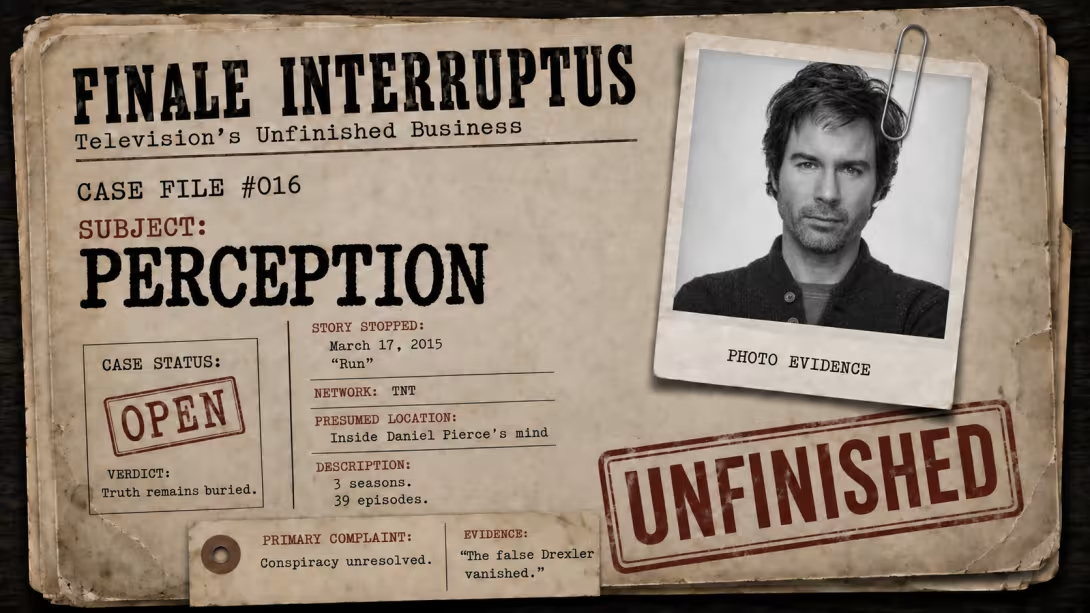
Finale Interruptus: Case File #016 - Perception
A Mind That Could Not Trust Its Own Evidence
Every criminal investigation begins with an assumption: the investigator can trust what he sees. Perception began by removing that assumption. Dr. Daniel Pierce was a brilliant neuropsychiatrist, a gifted professor and an FBI consultant capable of recognizing neurological explanations that conventional investigators overlooked. He could identify the medical condition hiding beneath an apparent confession, expose the damaged memory behind an eyewitness account or recognize when supposedly irrational behavior followed a perfectly logical pattern inside an injured brain.
The difficulty was that Daniel could not always trust his own. Daniel lived with paranoid schizophrenia. He experienced elaborate hallucinations, constructed connections that did not exist and occasionally became convinced that ordinary events concealed coordinated threats against him. The same mind that allowed him to solve cases could also manufacture evidence, witnesses and entire conversations.
That contradiction supplied Perception with more than its weekly mystery device. It created a continuing argument about certainty. Daniel understood better than almost anyone how the brain could distort reality, yet knowledge alone could not protect him when his own perceptions became unreliable. The series, created by Kenneth Biller and Mike Sussman, premiered on TNT on July 9, 2012. Eric McCormack played Daniel without sanding away the character’s fear, arrogance or vulnerability. Daniel could command a lecture hall, dismantle an FBI theory and recognize an obscure neurological syndrome in minutes. He could also become overwhelmed by a ringing telephone, a disrupted routine or the suspicion that someone had entered his home.
His principal connection to the outside world was Max Lewicki, the teaching assistant who managed Daniel’s schedule, monitored his medication and attempted to recognize the warning signs of a deteriorating episode. Lewicki was caretaker, student, colleague and occasionally the only person capable of persuading Daniel that what he saw was not real.
FBI Special Agent Kate Moretti occupied a more complicated position. She had been Daniel’s student and trusted his abilities enough to bring him into federal investigations. She also knew that trusting Daniel did not mean accepting every conclusion he reached. Kate had to distinguish between the insight of an exceptional neuropsychiatrist and the certainty of a man whose illness could make a hallucination feel indistinguishable from evidence.
Daniel’s most persistent hallucination was Natalie Vincent, a confident woman who served as confidante, challenger and interpreter of the messages his subconscious was trying to deliver. Natalie often appeared to know things Daniel had overlooked because she was, in the most literal sense, part of him. Her questions could lead him toward a solution, but her presence also demonstrated how fully his mind could create another person.
The first season eventually revealed that Natalie’s appearance had been drawn from Dr. Caroline Newsome, a real woman Daniel had seen during college. Caroline could enter his life, leave it or disagree with him. Natalie could not. She remained the version Daniel’s mind required, capable of appearing whenever an unresolved fear or suppressed realization needed a face.
That structure allowed Perception to turn exposition into character. Daniel rarely arrived at an answer simply by staring at laboratory results. His subconscious staged arguments, created symbolic encounters and gave unfamiliar faces to ideas he was not yet prepared to recognize as his own. The hallucinations were not supernatural visitors delivering information from outside Daniel’s knowledge. They were his knowledge reorganized into a form he could confront.
The show’s cases repeatedly exploited the distance between observable behavior and its underlying cause. A person who appeared violent might be responding to a neurological condition. A reliable witness might unknowingly possess a fabricated memory. A suspect who sounded delusional might be accurately describing a conspiracy no one else was willing to believe. Daniel therefore lived inside the central question of every episode: when does skepticism become wisdom, and when does it become another way to ignore the truth?
That question became especially dangerous whenever Daniel encountered an actual conspiracy. His diagnosis gave adversaries an obvious weapon. If they could make the evidence disappear, imitate the patterns of his hallucinations and encourage the people around him to doubt what he had experienced, Daniel could expose the truth and still appear to be having a breakdown. The third season carried that possibility to Paris.
Daniel had traveled there after pursuing a relationship with Miranda Stiles, a cellist whose presence offered the possibility of a life beyond his university, his consulting work and the routines that helped keep him stable. Paris removed nearly every familiar support. Lewicki was absent, Kate was an ocean away and Daniel found himself navigating an unfamiliar city while his symptoms intensified. A man approached him claiming to be Special Agent Drexler, the FBI legal attaché at the American embassy. Drexler recruited Daniel to recover information concerning an experimental neurological drug and involved him in what appeared to be an international intelligence operation.
Then the operation vanished. The embassy’s real Drexler was a woman who had never contacted Daniel. Supposed participants disappeared, physical evidence was removed and the people responsible constructed events to make Daniel appear unstable. Daniel’s friends were forced to consider the possibility that Paris had triggered a severe episode and that the federal agent, secret assignment and international conspiracy had never existed.
Daniel ultimately proved that much of the plot was real. Yet the series never showed the man who had impersonated the FBI legate being captured or identified. He watched from a distance as another conspirator was taken into custody, then disappeared from the series as successfully as he had disappeared from Daniel’s evidence. For most television procedurals, that would have been a villain reserved for a later return. For Perception, he became something more dangerous: a real man whom Daniel’s mind could now reproduce.
The Man Who Pretended to Be the FBI
The deception in Paris was designed specifically for Daniel Pierce. A stranger identifying himself as Special Agent Drexler approached Daniel with credentials, a plausible position at the American embassy and a mission tailored to his professional interests. A Chinese neuropharmacologist, Dr. Soong, had supposedly developed an experimental cognitive-enhancement drug. According to Drexler, Soong wanted the research delivered to the United States before the Chinese government could turn it into a military advantage.
Daniel was not merely being asked to serve as a courier. He was being offered access to a neurological breakthrough. The proposition appealed simultaneously to his curiosity, professional ambition and susceptibility to conspiratorial thinking. Daniel understood that someone claiming to represent the FBI could be lying, but he also knew that intelligence operations depended upon secrecy and deniability. Every suspicious element could therefore be interpreted as evidence that the mission was genuine.
That was what made Drexler effective. He did not need Daniel to suspend disbelief. He needed Daniel to apply his intelligence in the wrong direction. The operation soon began collapsing around him. The people Daniel believed were involved could not be verified. Locations changed, evidence disappeared and the man presented as Dr. Soong was killed. Daniel found himself arrested while Miranda’s apartment appeared to have been ransacked, reinforcing his conviction that they had become targets of an international conspiracy.
Then the FBI entered the story—and produced the real Special Agent Drexler. The legitimate Drexler was a woman working from the American embassy. She had never recruited Daniel, authorized an operation involving the experimental drug or sent him to recover anything from a Chinese scientist. The man Daniel had trusted was an impostor using fabricated federal credentials.
To everyone around Daniel, the explanation appeared increasingly obvious. He had suffered a psychotic episode in an unfamiliar city. His mind had transformed anxieties about his work, his illness and his relationship with Miranda into an espionage story in which he occupied the indispensable center. Daniel faced the nightmare built into his diagnosis. He could describe exactly what he had seen, but the absence of supporting evidence made his certainty sound like another symptom. The more forcefully he insisted that the conspiracy was real, the easier it became to interpret his insistence as proof that it was not.
Kate and Donnie arrived in Paris prepared for both possibilities. Daniel might have uncovered a genuine operation, or he might be experiencing a dangerous breakdown. Their investigation eventually established that real people had staged much of what Daniel remembered. The immediate architect was Serge, Miranda’s colleague and traveling companion. Serge wanted Miranda separated from Daniel and willing to continue performing with him. He exploited Daniel’s psychiatric history to manufacture a crisis that would convince Miranda that remaining with Daniel was impossible.
The plan was unusually cruel because it did not simply invent a delusion. It constructed reality to resemble one. People performed assigned roles. Physical evidence was removed. Miranda’s apartment was restored before authorities could verify that it had been disturbed. Daniel’s familiarity with hallucinations was used against him until even he struggled to identify which experiences had originated outside his mind.
Serge was exposed and taken into custody. That resolution allowed Daniel to prove that he had not imagined the entire affair, but it did not account for everyone who had participated. The series never accounted for the false Drexler after Serge was arrested.
As Serge was removed, the man who had impersonated the FBI legate watched from a distance. The episode did not provide his real name, explain how Serge had recruited him or establish whether he was merely a hired performer. It also did not reveal how much of the supposed intelligence operation he had created, what happened to the experimental research or whether his involvement extended beyond Serge’s personal scheme. He simply disappeared.
The omission was notable because impersonating an FBI agent was not incidental to the plot. The false Drexler had recruited Daniel, supplied the operation with federal credibility and directed him toward conduct that resulted in an international arrest. He was one of the most consequential participants in the scheme, yet Serge’s arrest allowed the series to close the immediate case without closing the file on the man who had set it in motion. Daniel returned to Chicago, but Drexler’s face returned with him.
Once Daniel understood that the impostor had been real, his subconscious adopted the man as a new hallucination. Drexler could now appear whenever Daniel confronted a conspiracy, suppressed an uncomfortable conclusion or suspected that a visible explanation concealed another layer. That transformation created an especially treacherous ambiguity. The original Drexler had been a real adversary. Every later appearance could be a hallucination—but Daniel could never dismiss the possibility that the actual man had returned.
The series used that uncertainty in its final episode. When Kate disappeared on her wedding day and Daniel became convinced that several events were connected, Drexler reappeared to question his conclusions and lead him toward information he had not yet consciously assembled. The apparent return did not solve the Paris mystery. It confirmed that Daniel was hallucinating Drexler.
By then, the impostor no longer needed to be present to manipulate him. Daniel’s own mind had preserved the face of the man who proved that reality could be arranged to make the truth look insane. The genuine impostor remained somewhere outside the frame. The false one had moved inside Daniel’s head.
Cancellation Before the Final Lecture
Perception was not cancelled because its third-season finale failed. The finale had not aired yet. TNT announced the cancellation on November 13, 2014, after broadcasting the first ten episodes of the third season. Five completed episodes remained on the shelf, including “Run,” the hour that would eventually become the series finale.
The network did not begin airing those episodes until February 17, 2015. “Run” arrived on March 17, more than four months after the cast, producers and audience already knew that there would be no fourth season. That sequence matters. The episode had been constructed as the conclusion of a season, not the conclusion of the series. Its writers were free to resolve the immediate emergency while preserving consequences, adversaries and relationships for stories they expected to tell later.
The cancellation came after a measurable decline in viewership. Perception had premiered strongly in 2012, attracting more than six million viewers for its first episode and becoming one of cable television’s more successful new dramas. Co-creator Kenneth Biller told National Public Radio during that first season that the series had opened as the third-highest-rated program on cable for its week and had improved in key demographic groups with its second episode.
By the third season, the audience had contracted. The ten episodes broadcast during the summer of 2014 averaged approximately 2.78 million viewers and a 0.6 rating among adults ages 18–49. Those numbers remained respectable for a cable procedural, but they represented a substantial reduction from the program’s first season. The decline alone does not fully explain the timing.
TNT was changing direction. Kevin Reilly, formerly chairman of entertainment at Fox, had recently taken control of TNT and TBS. The network was reassessing an established lineup built heavily around accessible procedurals and character-driven dramas. Perception was caught in a broader clearance. TNT also cancelled the revived Dallas, which had ended its third season on a far more conspicuous cliffhanger, and Franklin & Bash, which had completed four seasons. The network was preparing to pursue programming executives considered younger, darker and more distinctive.
The description was ironic in Perception’s case. The series centered on a neuropsychiatrist with schizophrenia, regularly questioned the reliability of memory and made its protagonist’s mental illness inseparable from both his brilliance and his vulnerability. Its structure may have resembled a familiar investigative procedural, but Daniel Pierce was hardly a conventional television detective. The problem was not necessarily that Perception lacked difficult material. It presented that material inside a dependable weekly framework.
That dependability had once been an advantage. A viewer could enter through the case of the week while gradually learning about Daniel, Kate, Lewicki, Natalie and the tensions surrounding Daniel’s treatment. By 2014, however, the qualities that made Perception accessible also made it representative of the type of programming TNT was beginning to leave behind. When the cancellation became public, Eric McCormack described it as a sad day and thanked the fans and production crew for three seasons. He added a concise judgment: there “shoulda been more.”
There was briefly some speculation that ABC Studios, which produced the series, might seek another outlet. With only 39 episodes, Perception had not accumulated the larger library traditionally associated with an attractive syndication package. A fourth season could have expanded that inventory and given another network or streaming service an established drama with a recognizable cast. No rescue followed.
The remaining five episodes instead became an accidental farewell tour. They continued storylines involving Donnie’s prosecution for murder, Daniel’s feelings for Kate, the approach of Kate and Donnie’s wedding, and the return of Dr. Josiah Rosenthal—a psychiatrist revealed to be a serial killer. Nothing in those episodes behaves as though the series is methodically closing its world. Lewicki does not receive a decisive departure. Daniel does not retire from consulting or reach a stable resolution with his illness. The university, the FBI and the relationships surrounding him remain functional enough to support another season.
Even the wedding, the most obvious element of closure, was not designed to settle everything. Daniel had finally acknowledged his love for Kate, first to himself and eventually to Donnie. Kate nevertheless chose the life she had rebuilt with her former husband. That decision closed one possible romance, but it did not resolve Daniel’s emotional future or end his connection with her. Daniel would remain the FBI consultant working beside the woman he loved and the man she married.
The writers also carried the false Drexler forward by converting him into one of Daniel’s recurring hallucinations. That choice would have allowed the Paris mystery to return whenever the series required it, while also giving Daniel’s subconscious a new and unsettling voice. Most importantly, the final episodes assembled a continuing threat around Rosenthal. The immediate plot could be defeated, but defeating it would require Daniel, Kate and Donnie to commit acts that could not be admitted without destroying their careers and potentially sending them to prison.
That was not a path toward finality. It was the foundation of another season. By the time “Run” aired, viewers knew no consequences would follow. The network had cancelled the investigation before the characters committed the crime.
The Missing Bride
Kate Moretti appeared to abandon her wedding with a handwritten message. “I can’t do this.” The note confirmed Donnie’s worst fear and appeared to settle Daniel’s private conflict. Kate had spent months preparing to remarry her former husband, but she had disappeared before the ceremony and left behind words that could only be read as a rejection.
Daniel knew that interpretation did not fit. He had visited Kate shortly before the wedding began. He intended to confess that he loved her, finally saying aloud what the series had allowed him to avoid for three seasons. Standing in the bridal room, however, Daniel recognized that the confession would not free Kate. It would place his emotional burden upon her at the moment she had chosen another life.
Daniel told her only that seeing her happy made him happy. Nothing in their conversation suggested that Kate intended to run. She appeared nervous, but not unwilling. She did not ask Daniel to stop the wedding, confess doubts about Donnie or indicate that she planned to disappear.
Daniel initially had little more than that impression. His concern could easily be dismissed as wishful thinking from a man who did not want Kate to marry someone else. Donnie was angry, humiliated and prepared to believe that his bride had left him. Kate’s father, Joe, advised everyone to respect her apparent request for space. Then Daniel received a telephone call.
The caller demanded the release of Dr. Josiah Rosenthal, a psychiatrist who had worked with Daniel and presented himself as an ally. Rosenthal had ultimately been exposed as a serial killer whose knowledge of psychology allowed him to manipulate patients, investigators and victims. He had been convicted and was awaiting execution. Kate was the leverage needed to free him.
The demand transformed the supposed runaway bride into a hostage. Daniel and Donnie now understood that the note had been planted, but reporting the call immediately would probably endanger Kate. The people holding her knew enough about the wedding, Rosenthal and the relationships among Daniel, Kate and Donnie to predict how each man would react. Rosenthal denied direct knowledge when Donnie confronted him in prison, but his performance was transparent. He offered information about additional victims in exchange for temporary release, presenting the arrangement as an act of belated cooperation. He knew Donnie could use the promise of undiscovered remains to persuade federal authorities to transport him outside the prison.
Daniel and Donnie constructed a plan that depended upon deceiving the FBI and the United States Marshals. Rosenthal would claim that he had buried victims in a remote area. Once the escort reached the location, he would recover a gun Daniel had planted and use Donnie as a hostage. The weapon would be unloaded, allowing Rosenthal to believe that he had escaped while the marshals remained alive and capable of raising the alarm.
The staged escape was still an escape. Daniel and Donnie were conspiring to release a convicted serial killer, deceive federal officers and obstruct an active investigation. If the plan failed, Kate could die. If it succeeded exactly as designed, both men could still face prison. Donnie added a safeguard without telling Daniel.
He carried a loaded gun. When Rosenthal attempted to assert control, Donnie shot him in the leg and demanded immediate proof that Kate remained alive. The act was reckless, but it forced Rosenthal’s accomplice to place Kate on the telephone. Daniel and Donnie then transported their wounded prisoner to the arranged exchange.
Kate was released. Rosenthal appeared to depart with the masked accomplice. The victory lasted only minutes. The getaway van was driven by an uninvolved cab employee who had been paid to follow instructions without inspecting the cargo area. Rosenthal and his accomplice had escaped through a concealed opening into the sewer system, leaving Daniel, Kate and Donnie with an escaped serial killer and no explanation they could safely give the FBI.
Daniel needed to solve the kidnapping before federal authorities separated and questioned them. Kate remembered very little. She had been attacked in the bridal room, stunned and sedated before she could identify her captor. While imprisoned, she had been blindfolded and moved through an unfamiliar building. The sensory details she retained appeared too incomplete to identify a location.
Daniel’s hallucination of Drexler pushed him toward the clue he had overlooked. Tasha Ogden had appeared at the wedding. She was supposedly one of Rosenthal’s surviving victims and had testified against him during sentencing. Daniel had interpreted her presence as evidence that she still had feelings for Donnie, with whom she had briefly become involved.
Her behavior suggested something else. Tasha had been crying—or, as she insisted, suffering from allergies. Kate remembered her captor sniffing repeatedly. Daniel reconstructed Tasha’s earlier story and concluded that she had never escaped from Rosenthal by accident. She had helped him misdirect the investigation, posed as a victim and used her sentencing testimony to assure him that their plans remained alive.
Rosenthal and Tasha had selected Kate because Donnie would risk his career and freedom to save her. They had studied the wedding, learned its location and used Tasha’s access to remove Kate without attracting attention. Daniel led the others to Tasha’s home.
The house initially appeared empty of useful evidence. Kate then reconstructed the number of steps she had taken while blindfolded and recognized that the visible basement dimensions did not correspond with her memory. A concealed room revealed the location where she had been held—and where other victims had been killed. Rosenthal and Tasha were discovered inside.
The immediate case was over. Kate had been rescued, Rosenthal had been recaptured and his accomplice had been exposed. The people responsible for the kidnapping could no longer threaten the wedding or continue their crimes. Kate’s father then fired two shots.
Joe claimed that Rosenthal and Tasha had attempted to seize his weapon, forcing him to kill them in self-defense. The timing and his subsequent comments made the truth considerably less comfortable. Joe had eliminated two people who could expose everything Daniel and Donnie had done to secure Kate’s release. The villains were dead. The bride was safe. Kate and Donnie could return to the church and complete the ceremony. But the only available happy ending now depended upon everyone telling the same lie.
The Conspiracy the Heroes Created
Kate Moretti wanted the truth before she contacted the FBI. She knew Daniel and Donnie had broken laws to save her. What she did not yet know was how many, which federal officers had been deceived or whether Rosenthal had injured anyone during the manufactured escape. Kate believed that if she understood every step, she might construct an explanation that protected the people responsible for rescuing her.
Rosenthal immediately recognized the problem. Whatever version Kate offered would be tested against his account and Tasha’s. Daniel and Donnie had engineered the release of a condemned prisoner, planted a weapon, disarmed federal officers and transported Rosenthal without authorization. Donnie had also shot him.
The justification was compelling: Kate would probably have been killed if they had refused. The law would not necessarily be as accommodating. Daniel and Donnie had not acted under official authority. They had concealed the kidnappers’ demand, manipulated the government into authorizing Rosenthal’s transport and staged an armed escape. The fact that the planted gun was unloaded reduced the intended danger, but it did not erase the fear experienced by the marshals who believed they were facing a genuine weapon.
Rosenthal had survived every stage and could describe it. That changed when Joe Moretti shot him and Tasha. Joe immediately supplied the official explanation. Both prisoners had moved for his gun, forcing him to fire in self-defense. There were no neutral witnesses inside the concealed room. Rosenthal and Tasha could not contradict him, and the physical location already contained evidence of their crimes.
Kate did not accept the story at face value. She asked her father what he had done, understanding that the shots had arrived at precisely the moment Rosenthal threatened to expose everyone. Joe did not retreat from the implication.
He reminded Kate that Rosenthal and Tasha were killers. Rosenthal had already been sentenced to death, while Tasha had helped abduct Kate and conceal other victims. Allowing them to speak could send Daniel and Donnie to prison for actions taken to save Kate’s life. Joe’s reasoning reduced the problem to a choice between two groups. Rosenthal and Tasha could remain alive long enough to tell the truth, or Kate could protect her father, her husband and Daniel.
She could not do both. The resolution therefore required Kate, an FBI agent, to participate in concealing a potentially unlawful shooting. It also required her to fabricate an explanation for her own disappearance.
Kate told her supervisor that she had experienced cold feet and left the wedding voluntarily. She claimed she had gone to stay with her father, where they later saw news reports about Rosenthal’s escape. Suspecting Tasha because of her earlier behavior, Kate and Joe supposedly followed that suspicion to the house and happened to discover the fugitives. The story removed Daniel and Donnie entirely.
There was no kidnapping, no ransom demand and no unauthorized agreement to release Rosenthal. Daniel had not planted a gun. Donnie had not deceived the marshals or shot an escaped prisoner. Kate had not been drugged, bound and held in a hidden room. Joe had simply accompanied his daughter while she followed a fortunate hunch. The explanation was difficult to believe because it depended upon too many coincidences.
Kate’s supervisor said as much. The entire account “stank,” and he made clear that he did not believe he had been given the real story. He could not immediately prove what had happened, but he promised to find out. That promise was not a closing observation. It was the beginning of the next investigation.
Telephone records could reveal the call Daniel received. Prison surveillance would show Donnie meeting with Rosenthal before the supposed disclosure of additional victims. Federal officers could describe the staged escape and identify Daniel and Donnie as active participants. Ballistics and medical evidence could establish that Donnie had shot Rosenthal before the fatal confrontation at Tasha’s home. The cab driver could explain how he had been recruited, while forensic examination of the van, the concealed room and the surrounding sewer system might contradict portions of Kate’s account. The more carefully the FBI investigated, the more difficult the conspiracy would become to maintain.
The participants also had different levels of knowledge. Daniel and Donnie understood the prison escape but had not anticipated Joe’s shooting. Kate knew she had been abducted but had not witnessed everything done to secure her release. Joe controlled the account of the deaths, while the marshals and agents possessed pieces of the escape that could not simply be removed.
A successful cover-up would require everyone to remember the same invented sequence while investigators approached them from different directions. Daniel understood the irony before the others fully acknowledged it.
He had spent his life fearing hidden agreements, manufactured evidence and institutions determined to conceal the truth. His illness could persuade him that unrelated people were coordinating against him or that harmless events formed part of a larger design. This time, the conspiracy was real.
Daniel was one of the people maintaining it. His hallucinated Drexler appeared to make the point explicit. Daniel had feared conspiracies throughout his life, and now he belonged to one. The hallucination announced that it intended to remain and watch how the situation developed.
That line gave a future season two interconnected stories. The first was external. Kate’s supervisor would investigate the account, placing careers, marriages and freedom at risk. Daniel’s continuing work with the FBI could be terminated, Kate could lose her badge and Donnie could lose his position as an assistant United States attorney. Joe could face scrutiny for the deaths of Rosenthal and Tasha.
The second was internal. Daniel’s guilt had given Drexler a permanent role inside his hallucinations. The false agent represented both the unresolved man from Paris and the real conspiracy Daniel now had to protect. Kate and Donnie returned to the church and completed their wedding. Their friends applauded, the immediate danger had ended and Daniel accepted that Kate had chosen Donnie. The ceremony offered emotional closure. Drexler was sitting among the guests.
The Face Still Sitting in the Church
Daniel Pierce finally told Donnie the truth. He loved Kate. The admission came shortly before Kate and Donnie attempted their wedding again. Daniel did not present his feelings as a reason to stop the ceremony or as evidence that Kate had chosen the wrong man. He had already made the more difficult choice in the bridal room, withholding his confession when it would only have burdened her.
Daniel told Donnie because the two men could not preserve their friendship through another lie. Donnie initially resisted hearing it. Rosenthal had exploited Daniel’s feelings while trying to divide them, and Donnie wanted to dismiss every accusation as manipulation. Daniel acknowledged that Rosenthal had been playing with them, but that did not make everything he said false.
Daniel loved Kate, which was why he was relieved she had found someone capable of making her happy. That confession resolved one of the series’ longest emotional questions. Daniel’s attachment to Kate had moved between professional trust, dependence, jealousy and romantic longing. He could now recognize the feeling without allowing it to become another justification for controlling her life.
Kate and Donnie married. The ceremony supplied the familiar images expected from a television ending. Friends gathered. The couple exchanged vows. Daniel attended, applauded and accepted his place in the life Kate had chosen.
Had Perception ended on that image alone, “Run” could reasonably be treated as a functional conclusion. The weekly cases could continue beyond the screen, but Kate’s relationship had reached a destination and Daniel had demonstrated genuine emotional growth. The episode did not end there.
Daniel delivered another lecture about the brain’s response to crisis. Survival depends upon different neurological systems working together, he explained, much as people must sometimes cooperate to rescue someone from danger. But if those systems fail to coordinate at the decisive moment, fear can produce a breakdown. His words described more than Kate’s rescue.
Daniel, Donnie, Kate and Joe had worked together during a crisis. Their cooperation had saved Kate, but it had also crossed boundaries none of them could safely acknowledge. Their collective response had produced another emergency—one hidden beneath the wedding’s apparent restoration of normal life. As Kate and Donnie celebrated, Daniel saw Drexler seated in the church.
The man was not identified as the genuine impostor from Paris. He was Daniel’s hallucination, the latest face his subconscious had assigned to an idea Daniel was not prepared to confront directly. That distinction resolves the immediate question of whether the false FBI legate physically infiltrated the wedding. It does not resolve what happened to the actual man.
The real impostor had participated in the Paris deception, watched Serge’s arrest and disappeared. The series never supplied his name, motive beyond the immediate assignment or ultimate fate. He could have been a hired performer, an experienced criminal or someone with access to intelligence information sufficient to imitate a federal official convincingly. No later episode found him.
Daniel’s mind nevertheless retained him because Drexler represented a unique wound. He was proof that Daniel’s paranoia could be exploited by constructing a conspiracy around him—and proof that people could dismiss the truth precisely because Daniel was the person reporting it. At the wedding, Drexler embodied Daniel’s new fear.
The danger was no longer that no one would believe a conspiracy Daniel had uncovered. The danger was that investigators would discover a conspiracy Daniel had helped create. Kate’s supervisor had promised to continue examining the story surrounding Rosenthal and Tasha’s deaths. Daniel remained troubled by what they had done. Donnie and Joe had stronger incentives to preserve the official account, while Kate occupied the impossible position of being both an FBI agent and one of the people concealing material evidence.
Those conflicts did not disappear when the vows were completed. A fourth season could have tested how long the group maintained its story and whether the investigation fractured their relationships. Kate might have been forced to choose between her badge and her family. Donnie’s federal career could have placed him under particular scrutiny. Joe’s claim of self-defense could have collapsed under forensic examination, leaving Kate to decide whether protecting her father justified continuing the deception.
Daniel’s role would have been equally unstable. His testimony could expose everyone, but his psychiatric history might make investigators question him. Telling the truth could be interpreted as another delusion, while maintaining the lie could deepen the guilt already shaping his hallucinations. Drexler provided a face for that pressure.
He could taunt Daniel, challenge inconsistencies and force him to consider whether protecting Kate was worth becoming part of the machinery he feared. At the same time, the unresolved real impostor remained available to re-enter the story and turn Daniel’s hallucination into an actual warning. None of that happened.
Perception ended after 39 episodes. No fourth season, television film, licensed continuation or revival returned to test the cover story. Kate’s supervisor never completed his inquiry, and the genuine false Drexler was never located. The cancellation therefore left the series in an unusual position. Its final criminal case was solved. Kate survived, Rosenthal and Tasha were stopped, Daniel acknowledged his feelings and the wedding took place.
The interruption lies in what the solution cost. The heroes escaped immediate danger by creating a false account that the FBI had already begun to question. Daniel’s last lecture described a mind failing under pressure, while his final hallucination waited inside an apparently happy ending.
The series did not finish with Daniel unable to distinguish reality from delusion. It finished with Daniel knowing exactly what was real—and realizing that the truth had become the one thing none of them could afford to perceive.