
Songwriters Win Worldwide Copyright Battle After Supreme Court Lacks a Quorum
A rock-and-roll song written in 1962 has produced a copyright decision with implications reaching far beyond the recording studio. On Monday, the U.S. Supreme Court left intact a ruling allowing songwriter Cyril Vetter to reclaim worldwide rights in “Double Shot (Of My Baby’s Love),” the composition he wrote with Donald Smith. Yet the justices did not settle the legal dispute. They could not assemble enough participating members to hear it.
Four justices took no part in the case, leaving the Court without its legally required quorum. A rarely used federal statute dictated the result: the lower court’s judgment was affirmed with the effect of an affirmance by an equally divided Supreme Court. Vetter won, but the nation’s highest court issued no controlling explanation of whether American copyright termination law can reclaim foreign rights.
A Hit Song and a Contract From Another Era
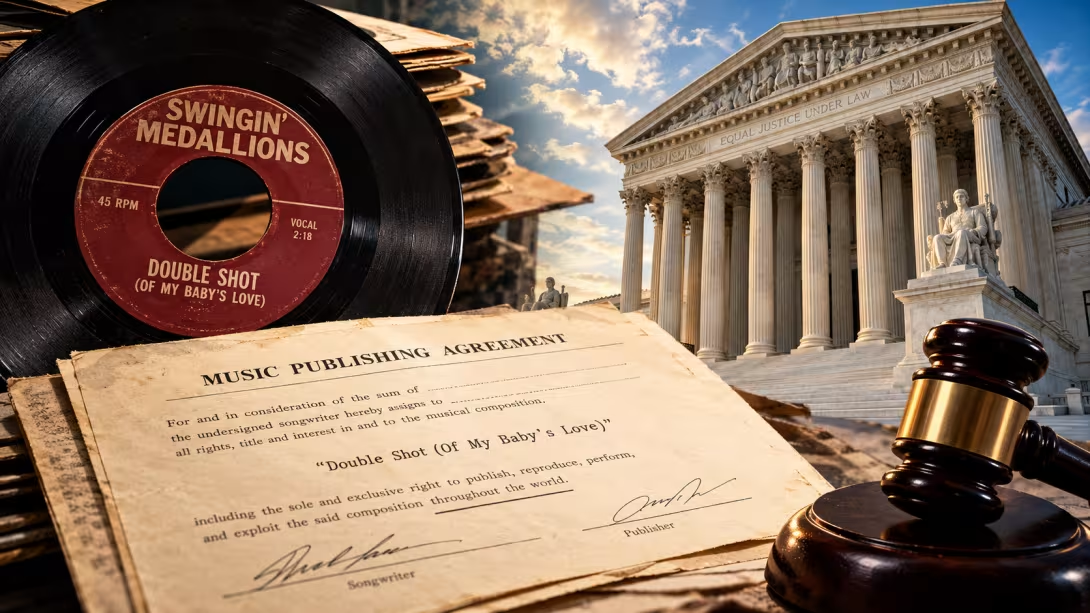
Vetter and Smith wrote “Double Shot (Of My Baby’s Love)” in 1962. Vetter assigned his copyright interests to Windsong Music Publishers in 1963, under an agreement encompassing worldwide exploitation. The Swingin’ Medallions made the song famous with their 1966 recording, turning what might have seemed a routine publishing agreement into an asset with a long commercial life.
The original deal mattered because copyright law gives certain creators a second chance to recover rights granted earlier in their careers. Section 304(c) of the Copyright Act allows qualifying authors or their statutory successors to terminate some pre-1978 grants after specified periods, subject to exacting notice and timing requirements. It is not a universal escape clause for an unfavorable contract, and it does not cover every work or ownership arrangement.
Vetter served a termination notice in 2019, effective in 2022. Smith had died years earlier, and Vetter Communications Corporation separately acquired the renewal interests held by Smith’s heirs. Together, Vetter and his company sought a declaration that their ownership interests extended worldwide. The opposing interests were held by Robert Resnik and Resnik Music Group, successors in the chain of publishing rights.
Does a Reclaimed Copyright Stop at the Border?
That question went to the heart of the case. Copyright is generally territorial: countries establish and enforce rights under their own laws. Music publishers therefore argued that an American statutory termination could recover American rights without undoing foreign rights conveyed in the original agreement. Their position reflected a longstanding industry understanding of international licensing.
The Fifth Circuit Court of Appeals took a different view in January 2026. Examining the statutory language and the rights originally granted, the court held that the recaptured interest was not confined to U.S. exploitation. It affirmed the district court’s declaration recognizing the Vetter plaintiffs’ ownership of their respective interests throughout the world. The court also addressed the separate renewal rights purchased from Smith’s heirs.
That does not mean an American court can casually rewrite every foreign copyright agreement. The dispute concerned a particular grant, a qualifying termination, and the Fifth Circuit’s interpretation of rights arising under the U.S. Copyright Act. Whether courts elsewhere will follow that reasoning remains an open and consequential question.
Why the Major Publishers Objected
BMG, Sony, Universal, and Warner-associated publishing interests asked the Supreme Court to review the appellate ruling. They warned that a worldwide interpretation could unsettle longstanding licenses and ownership assumptions, especially where foreign contracts had been negotiated on the expectation that American termination rights were limited to American copyright interests.
The practical stakes are easy to understand. A publisher may have licensed a composition abroad believing it still controlled the relevant rights. If a U.S. termination is later interpreted to have reclaimed those rights worldwide, the publisher, its licensees, and the songwriter may disagree about who can authorize future uses. That uncertainty is real, even if the broadest predictions of disruption remain arguments made by the publishers rather than proven consequences.
Vetter’s position rests on a competing principle: when the law permits an author to recover a grant of rights, the recovery should not necessarily be reduced to a domestic fragment of what was originally conveyed. The disagreement is not merely technical. It concerns how much economic benefit creators can regain from work that may continue earning money long after its original sale.
Five Justices Cannot Make Six
The Supreme Court’s October 19 order named four justices who did not participate: Sonia Sotomayor, Neil Gorsuch, Amy Coney Barrett, and Ketanji Brown Jackson. The order did not state why. With only five justices participating, the Court lacked the quorum required by 28 U.S.C. § 1.
Under 28 U.S.C. § 2109, when a quorum is unavailable and the qualified justices conclude that the case cannot be heard and decided during the next term, the Court must affirm the judgment below with the same effect as an affirmance by an equally divided Court. This was not an ordinary denial of review and not a Supreme Court endorsement of the Fifth Circuit’s reasoning. It was a statutory resolution of a procedural impasse.
The result is nonetheless decisive for the parties: the judgment in Vetter’s favor stands. The Fifth Circuit opinion also remains important precedent within its jurisdiction. But the Supreme Court has not created a nationwide rule resolving the geographic reach of copyright termination. Another case, arising elsewhere, could bring the dispute back into focus.
Beyond the Recording Studio
The controversy is about a song, but the broader mechanism is not limited to music. Qualifying grants involving books, illustrations, and comic-book properties may also implicate copyright termination law. Creators and heirs have fought high-profile battles over rights to valuable characters and stories, sometimes decades after the first contracts were signed.
There are critical limitations. Work-made-for-hire status, the date and terms of the agreement, the identity of the statutory claimant, and notice deadlines can change the outcome entirely. Nothing in Monday’s order automatically restores a novelist’s foreign editions or a comic-book artist’s international rights. What the case does provide is a significant appellate interpretation that other creators and rights holders will study closely.
A Victory With an Unfinished Legal Argument
For Vetter, the result preserves a hard-won declaration of worldwide ownership in a song whose commercial life outlasted the assumptions behind its original publishing contract. For the publishing industry, it preserves uncertainty about how U.S. termination law interacts with international rights transactions. Both consequences follow from a Supreme Court proceeding that ended without the justices deciding the central legal question.
The irony is difficult to miss: a song called “Double Shot” has given its author another opportunity to benefit from the rights he transferred more than sixty years ago. Whether that opportunity becomes a model for other creators, or remains a contested reading of the law, will depend on litigation still to come.
Sources and further reading
U.S. Supreme Court docket and October 19 order
Fifth Circuit opinion in Vetter v. Resnik (January 12, 2026)
Reuters report on the Supreme Court disposition