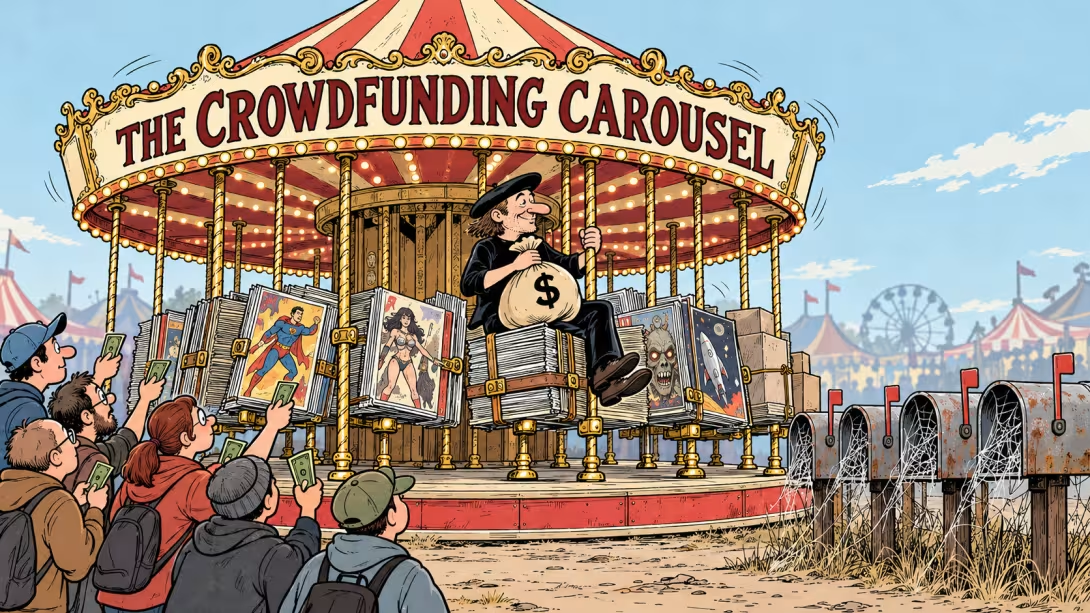
The Crowdfunding Carousel: When Yesterday's Comics Depend on Tomorrow's Backers
THE PROMISE AND THE PAYMENT
There was a time when getting a comic book published required convincing somebody else that it deserved to exist. A writer needed a publisher. An artist needed an assignment. A publisher needed a distributor willing to carry the finished product, and that distributor needed retailers willing to put it on their shelves. Somewhere along that chain, somebody with a calculator decided whether the proposed comic book was worth the financial risk.
Crowdfunding changed that equation. It removed many of the traditional gatekeepers and put the decision directly into the hands of readers. A creator no longer needed to convince an editor that a comic would sell. The creator needed only to convince enough prospective customers that it was worth buying before it existed.
The arrangement was simple enough. Show the audience what you intend to make, establish how much money you need to make it, and offer rewards in exchange for financial support. If enough people contribute, the project moves forward. The creator receives the money, produces the promised work, and delivers it to the people who made its existence possible. Everybody wins. At least, that's how the system is supposed to work.
Nearly two decades after crowdfunding began reshaping independent publishing, the comic book industry has developed an increasingly complicated relationship with the business model that helped democratize it. Crowdfunding has made possible books that traditional publishers might never have considered. It has provided opportunities for independent artists, established professionals seeking creative freedom, and entrepreneurs who wanted to build publishing businesses without depending on conventional distribution.
It has also created a peculiar financial relationship between creators and their audiences. The people purchasing a product are often the same people financing its manufacture. They pay months, sometimes years, before receiving anything tangible. In exchange, they accept a degree of uncertainty that would be unusual in an ordinary retail transaction. That uncertainty is not necessarily a defect in crowdfunding. It is part of the arrangement. But uncertainty is not the same thing as an unlimited obligation to wait. And when a creator continues accepting money for new projects while older projects remain unfinished, the arrangement deserves closer examination.
THE DIFFERENCE BETWEEN FUNDING AND FULFILLMENT
A simplified production path; actual arrangements differ by platform and project.
Funding is a financial milestone. Fulfillment is a delivery milestone. They are not interchangeable.
A successful crowdfunding campaign is not necessarily a successful publishing project.
Consider the distinction between two events that crowdfunding platforms frequently present as milestones. The first occurs when a campaign reaches its funding goal. The second occurs when the creator delivers the promised rewards.
The first is comparatively easy to measure. A campaign either raises its stated goal or it does not, subject to the particular platform's funding rules. The amount raised, number of contributors, and campaign deadline are generally recorded publicly. The second is more complicated.
A comic book may be written but not illustrated. It may be illustrated but not lettered. It may be completed digitally but not printed. Printed books may be sitting in a warehouse awaiting fulfillment, or some backers may have received their copies while others continue waiting.
Each of those circumstances represents a different stage of production or delivery. None necessarily means the creator has abandoned the project, and none establishes that every obligation to every backer has been satisfied.
This distinction matters because crowdfunding platforms do not necessarily provide a comprehensive public accounting of completed fulfillment. A campaign can stop accepting contributions without all its rewards having been delivered. Conversely, a campaign may remain open for additional orders after some or even most of its original backers have received their merchandise. A campaign's public fundraising status therefore cannot be treated as a reliable substitute for its fulfillment status.
For this investigation, we will distinguish between projects that are still accepting money, projects whose production remains incomplete, projects whose fulfillment remains incomplete, and projects whose final delivery status cannot be independently established.
Those distinctions are essential. A creator who has shipped 95 percent of a campaign's rewards is in a substantially different position from one who has not begun manufacturing the product. Both may technically have outstanding obligations, but reporting them as equivalent would misrepresent the available evidence. The same principle applies to delays.
A comic book that ships three months late because a printer encounters mechanical problems is not automatically evidence of a failing business. Neither is a book that takes longer than anticipated because an artist becomes ill, a shipping carrier loses a shipment, or production costs unexpectedly increase. Crowdfunding involves risks, and not every risk can be eliminated through responsible planning.
Nevertheless, a missed delivery date remains a missed delivery date. The explanation may be reasonable, the circumstances may be beyond the creator's control, and the eventual product may be worth the wait. None of those possibilities changes the original promise or eliminates the need to account for its status. The longer the delay continues, the more important that accounting becomes.
THE MONEY IS REAL, EVEN WHEN THE COMIC ISN'T FINISHED
Illustrative accounting only—not actual records of any creator in this article.
Crowdfunding is no longer a novelty operating at the margins of the comic book industry.
According to Publishers Weekly’s June 2026 reporting, approximately 3,414 comics projects launched on Kickstarter during 2024, collectively raising roughly $46.5 million. More than two-thirds reportedly reached their funding goals.
Those figures demonstrate the scale of the market. Independent creators are not merely collecting pocket change from sympathetic readers. Comics crowdfunding represents a substantial commercial activity involving significant sums of money and thousands of individual purchasing decisions. The financial appeal is understandable.
Under conventional publishing arrangements, the publisher typically assumes substantial upfront expenses. Writers, artists, editors, printers, distributors, and retailers all participate in a process that requires investment before the finished book generates revenue. Crowdfunding can reverse much of that sequence.
Instead of financing production and recovering the investment through subsequent sales, the creator can collect customer payments before production is complete. Those payments may then be used to finance the work itself.
This can be a legitimate and effective publishing model. It can reduce the financial barriers to entry, provide a clearer estimate of demand, and allow creators to produce projects that would otherwise be commercially impractical. But it also introduces a responsibility that should not disappear when the fundraising period ends. The money collected represents more than a successful marketing campaign. It is connected to specific expectations about what will be produced and delivered.
A campaign raising $100,000 has not necessarily earned $100,000 in profit. The proceeds may need to cover creative labor, printing, packaging, shipping, platform fees, taxes, and numerous other expenses. Depending on the campaign's structure, the creator may have relatively little money remaining after fulfilling those commitments. Indeed, a campaign can raise far more than its original goal and still encounter financial difficulty if its costs were underestimated. This is one reason we must resist the temptation to treat a crowdfunding total as evidence of available cash. A campaign that raised $500,000 does not necessarily have $500,000 sitting in a bank account. Nor does an unfinished $500,000 campaign establish that $500,000 has disappeared. What it establishes is that the campaign collected a substantial amount of money in connection with promises that must be evaluated against the creator's subsequent performance.
The appropriate questions are not simply how much was raised, but what was promised, what has been delivered, what remains outstanding, and what evidence exists concerning the project's progress.
WHEN ONE CAMPAIGN BECOMES TWO
A successful crowdfunding project can create an audience for another. A creator who delivers an excellent comic book may reasonably expect readers to support the next installment. In fact, recurring campaigns can form the foundation of a sustainable independent publishing business. There is nothing inherently improper about launching a second campaign before every administrative detail of the first has been completed.
Publishers routinely maintain multiple projects at different stages of development. A comic book company may have one title being written, another being illustrated, a third at the printer, and a fourth already shipping to customers. Managing overlapping production schedules is a normal part of publishing. The financial question becomes more complicated when the earlier project is not merely in progress but significantly overdue.
Suppose a creator raises $100,000 to produce a graphic novel. After paying legitimate expenses, the creator discovers that the remaining funds are insufficient to print and ship the promised books. The creator now has an outstanding obligation and a funding shortfall.
There are several possible ways to address that problem. The creator might contribute personal funds, secure outside financing, renegotiate production arrangements, reduce expenses where the campaign terms permit, or use profits from other business activities to complete the work. A creator might also launch another crowdfunding campaign.
That second campaign could be entirely legitimate. If it generates enough revenue to cover its own production and fulfillment costs while producing additional profit, that profit could help finance the earlier project. But consider a different possibility. What happens if the creator needs money earmarked for the second campaign's production to finish the first campaign? The original shortfall may be reduced, but the newer campaign could now face a shortfall of its own.
If a third campaign becomes necessary to finance the second, and a fourth becomes necessary to finance the third, the business may develop a dependency on a continuing supply of new customer payments. This hypothetical arrangement is the central financial question behind our investigation. We will refer to it as potential cross-campaign financing dependency.
The term describes a possible condition in which a creator or publishing business relies on proceeds from newer crowdfunding campaigns to meet outstanding obligations associated with earlier campaigns, particularly where doing so may leave insufficient resources to fulfill the newer projects independently. It is a descriptive investigative term, not a recognized legal classification or an allegation that any particular creator has committed wrongdoing. Nor is every instance of cross-campaign financing evidence of financial distress.
Established businesses frequently use revenue generated by current operations to satisfy earlier obligations. Money is not necessarily reserved in separate accounts for every product sold, and ordinary business accounting does not automatically prohibit using general operating revenue to pay existing expenses. The question is whether the business can meet its commitments without continually creating additional obligations that it lacks the resources to satisfy. That distinction separates a sustainable publishing operation from a potentially unsustainable cycle of advance payments and delayed delivery. And determining which situation exists requires evidence.
THE PONZI QUESTION
Whenever money from newer customers is discussed as a possible source of funding for obligations to earlier customers, comparisons to a Ponzi scheme are almost inevitable. The comparison requires considerable care.
A conventional Ponzi scheme is a form of investment fraud in which money from newer investors is used to pay purported returns to earlier investors, creating the appearance of a profitable investment operation. Comic book crowdfunding generally operates differently.
Backers ordinarily contribute money in exchange for promised products or rewards. They are not purchasing an investment that promises interest, dividends, or other financial returns. A reader pledging $50 for a hardcover graphic novel expects a book, not a financial distribution funded by subsequent investors. That distinction is substantial.
A publisher using current revenue to meet earlier production expenses is not automatically operating a Ponzi scheme. Even a business that repeatedly underestimates costs and falls behind on fulfillment is not necessarily engaged in fraud.
Financial mismanagement, poor forecasting, production difficulties, and intentional deception are different things. They may produce similar frustrations for customers, but they cannot responsibly be treated as interchangeable.
For that reason, this investigation will not label a creator's business a Ponzi scheme merely because the creator has launched multiple campaigns or accumulated a backlog of unfinished projects. Instead, we will examine what the available evidence actually establishes. If a creator acknowledges using proceeds from a newer campaign to finance an older one, that statement can be reported and examined in context. If a creator acknowledges outstanding fulfillment obligations while continuing to raise money for additional projects, both facts can be documented.
But neither circumstance, standing alone, establishes that newer backers have been deceived, that campaign funds have been improperly diverted, or that the creator intended to avoid fulfilling any promise. Those conclusions would require additional evidence. The distinction may make for a less sensational headline, but it makes for a more credible investigation.
WHAT THE PLATFORMS PROMISE
Crowdfunding platforms occupy an unusual position in this relationship.
They provide the infrastructure through which creators solicit support, collect payments, communicate with backers, and sometimes manage subsequent orders. They also establish rules governing creator conduct. But the platform's involvement does not necessarily mean it guarantees the creator's performance.
Kickstarter's published rules place responsibility for completing projects and communicating with backers on the creators who launch them. Indiegogo likewise distinguishes the platform's role in facilitating crowdfunding from the creator's responsibility for delivering promised rewards. Those arrangements help explain why a campaign can successfully collect money without providing backers the same assurances they might expect from an ordinary retail purchase. The platform facilitates the transaction. The creator assumes the project obligations. The backer accepts the risks disclosed through the crowdfunding arrangement. But that division of responsibility raises further questions when projects remain unfinished for extended periods.
What happens when a creator launches another campaign while earlier rewards remain outstanding? What standards do platforms apply when deciding whether additional fundraising should be permitted? What remedies are available to backers when communication stops or promised delivery dates pass repeatedly? And how consistently are those standards enforced? These are questions about platform policies and documented practices, not assumptions about the motives of particular platform operators. The answers may vary between Kickstarter, Indiegogo, FundMyComic, BackMeBro, and other services. They may also change as platforms revise their rules. We will examine those differences later in this investigation, relying on published policies and documented enforcement actions rather than speculation.
FOLLOWING THE PROMISES
The purpose of The Crowdfunding Carousel is not to identify every comic book that has ever shipped late.
Such a list would be enormous, constantly changing, and of limited value. Delays happen throughout publishing, including among companies with substantial resources and established distribution networks. Our concern is with prolonged, unresolved obligations and the financial questions that arise when additional fundraising continues alongside them.
We will examine campaigns with substantial delays, creators managing multiple outstanding projects, and documented instances in which money from newer projects has been discussed as a means of completing older commitments. Where possible, we will compare original delivery estimates with subsequent creator statements, production updates, and evidence of shipment.
We will distinguish between a campaign that has begun fulfillment and one that has completed it. We will also distinguish between individual backers reporting missing rewards and evidence that an entire campaign remains unfinished. Most importantly, we will not presume that every creator whose campaign appears in this investigation has engaged in the same conduct.
A decade-long production delay, an acknowledged financing shortfall, and a company operating several overlapping crowdfunding campaigns may present different circumstances requiring different explanations. The common thread is the obligation created when a creator accepts money in exchange for a promise.
Crowdfunding has given comic book creators an extraordinary opportunity to reach readers directly, retain creative independence, and finance projects outside traditional publishing structures. Those advantages are worth preserving.
But the model depends on something more fundamental than technology, payment processing, or marketing. It depends on the willingness of readers to believe that a creator's promise will eventually become a finished product. When that confidence begins to erode, the consequences extend beyond any single campaign. They affect every creator who must persuade an audience to pay today for a comic book that will not exist until tomorrow. And they raise a question that deserves an answer before the next campaign begins: How many unfinished promises can a crowdfunding business carry before tomorrow's backers become responsible for yesterday's books?
THE MILLION-DOLLAR BACKLOG
Editorial classifications; not official labels used by every platform.
| Status | Meaning |
|---|---|
| Funded | Funding threshold met, subject to platform rules. |
| In production | Work reported underway; delivery not thereby established. |
| Partially fulfilled | Some rewards delivered; others may remain outstanding. |
| Delayed | A stated delivery estimate has passed. |
| Fulfilled | Promised rewards delivered, subject to documented exceptions. |
| Status unverified | Evidence does not establish the current fulfillment position. |
Ethan Van Sciver is not an obscure independent creator trying to finance his first comic book. He is a veteran professional artist whose credits include work for DC Comics on titles such as Green Lantern, The Flash, and Sinestro Corps War. His move into independently crowdfunded comics brought an established audience to a publishing model that promised greater creative independence and a direct relationship between creator and customer.
His flagship property, CyberFrog, became the foundation of a growing catalog of crowdfunded comics, merchandise, collectibles, and related projects. Operating through business names associated with Van Sciver Studios and All Caps Comics, he launched campaigns that collectively attracted millions of dollars in contributions. The scale of that fundraising makes his subsequent acknowledgment of unfinished projects particularly significant.
In a statement reproduced by a third-party archive discussing his company's production schedule, Van Sciver acknowledged that his publishing operation was behind schedule and identified several projects with anticipated completion dates extending into 2028. The original post and its full context have not been independently authenticated.
That statement provides something investigators of unfinished crowdfunding projects do not always possess: an acknowledgment from the creator himself that substantial work remained outstanding. It also allows us to distinguish between campaigns whose status is disputed by individual backers and projects the creator has publicly identified as unfinished.
The distinction matters because an unfulfilled promise is not necessarily evidence of misconduct. But it is a measurable obligation, and the creator's own description of that obligation is a legitimate starting point for examining the business responsible for delivering it.
THE CAMPAIGNS BEHIND THE NUMBERS
Figures displayed on Indiegogo’s creator index at the October 30, 2026 review. Gross receipts, not outstanding liabilities.
Indiegogo’s public creator index displays eight campaigns corresponding to the projects identified in the publicly reproduced backlog statement. Their displayed gross funding totals add to $2,526,982 as reviewed October 30, 2026. The figure is not an estimate of the amount still owed to backers, nor does it establish the number of unfulfilled rewards.
| Campaign | Reported funding | Creator's stated completion target |
|---|---|---|
| CyberFrog 3: Red Extermination | $856,087 | December 2027 |
| Reignbow the Brute | $540,833 | December 2026 |
| CyberFrog: Warts and All | $439,141 | Summer 2027 |
| Reignbow action figures | $235,398 | Sometime in 2028 |
| CyberFrog Universe Prequels | $174,964 | April 2027 |
| Fearsome | $131,034 | April 2027 |
| Wrath of H3LL3PHANT | $104,247 | Artwork reported complete; printing anticipated |
| Rekt Planet line-art variants | $44,278 | October 2026 |
| Combined reported funding | $2,526,982 |
Reported campaign receipts, not outstanding liabilities. Figures transcribed from the rough draft and subject to campaign-page verification. The amounts are publicly displayed campaign funding totals. They are not estimates of outstanding debt, unspent money, or the cost of completing the projects. Nor does inclusion in this table mean that no backer has received anything.
A campaign can be partially fulfilled while substantial work remains outstanding. Individual rewards may have shipped, digital products may have been delivered, and certain editions may be complete even when others remain unfinished. The table therefore establishes the scale of crowdfunding activity associated with the projects Van Sciver discussed, not the value of undelivered merchandise.
There is also a separate Ultra CyberFrog: Warts and All Oversized Hardcover campaign reporting $149,517 in funding. Because Van Sciver's reference to Warts and All does not clearly establish whether his revised schedule encompasses that particular edition, we have excluded it from the combined total. That distinction is important. Separate crowdfunding campaigns should not be silently merged merely because they involve related intellectual property.
Similarly, these eight campaigns do not represent the entirety of Van Sciver's crowdfunding history. His Indiegogo creator profile contains additional projects, including campaigns that may have completed fulfillment or require separate examination. Our concern here is with the projects identified in his public acknowledgment, not an assumption that everything he has ever crowdfunded remains unfinished.
A CALENDAR THAT KEEPS MOVING
The most revealing feature of Van Sciver's statement may not be the number of campaigns involved, but the projected completion dates.
According to the schedule he provided, Reignbow the Brute was expected to reach completion in December 2026. Fearsome and CyberFrog Universe Prequels were projected for April 2027, followed by Warts and All during the summer and CyberFrog 3: Red Extermination in December. The Reignbow action figures were assigned an even later target: sometime in 2028. These dates establish that Van Sciver anticipated a production and fulfillment backlog extending well beyond the time of his statement. They do not, by themselves, establish precisely how late every project is. To determine that, the original estimated delivery dates must be compared with the revised targets. One campaign provides a particularly clear example. The Indiegogo campaign for Fearsome lists October 2024 as an estimated delivery month for its rewards. Van Sciver's subsequent schedule places completion in April 2027. That is a difference of approximately 30 months between the original estimate and the revised completion target.
As of October 30, 2026, approximately 24 months had elapsed since the original estimated delivery month. The remaining six months represented additional time under the creator's announced schedule.
It would be inaccurate to say the project was already 30 months late in October 2026. It would also be inaccurate to overlook the fact that the creator's own revised target anticipated a delay of that length. The difference illustrates why original estimates and subsequent projections must be reported separately. A revised delivery date does not erase the original estimate. But a projected future completion date is not evidence that the creator will necessarily miss that newer target. It is a statement of intention, and its eventual accuracy remains to be determined. For the other campaigns, the original delivery estimates require further verification before equivalent calculations can be published.
WHAT DOES “UNFULFILLED” MEAN?
The word unfulfilled can describe several materially different circumstances.
A project may remain unfinished because the artwork has not been completed. It may be finished creatively but awaiting printing. It may have been printed but not packaged. Or fulfillment may have begun without reaching every backer. Van Sciver's own statement illustrates these distinctions.
He described Wrath of H3LL3PHANT as complete and moving toward printing. That is a different production status from a project assigned a completion target more than a year in the future. Similarly, the Rekt Planet line-art variants were associated with an October 2026 target, making their status particularly important to verify as that month concluded. Neither statement establishes that all promised rewards were delivered. But neither should be represented as evidence that no work had been completed. For this investigation, we classify the campaigns according to what the available evidence supports. Projects with future completion targets are creator-acknowledged unfinished as of the statement's date. Projects described as complete but awaiting printing are production-complete according to the creator, with fulfillment unverified. Projects whose announced completion dates have arrived require fresh evidence before their current status can be characterized.
This approach may seem unnecessarily cautious to readers who have been waiting years for a promised book. But it protects an important distinction between documenting an outstanding obligation and assuming the absence of all progress. A creator's statement can establish that work remains unfinished. It cannot necessarily tell us how many individual rewards remain outstanding. That would require additional records.
THE OPEN PLEDGE MANAGERS
Illustrative ratio: reported gross receipts divided by reported backers. Figures for Gemshock and Pitt are not independently authenticated and are omitted from the publication version.
Van Sciver's Indiegogo profile also identifies several campaigns whose pledge managers remain open. A pledge manager allows backers to manage orders and, depending on the campaign's configuration, may permit additional purchases after the original crowdfunding period ends. Seven campaigns on the creator's profile were listed in an open pledge-management status during our review.
Those projects included CyberFrog 3, Reignbow the Brute, the Reignbow action figures, CyberFrog Universe Prequels, Fearsome, the oversized Warts and All hardcover, and an All Caps merchandise campaign. Their displayed funding totals collectively exceeded $2.1 million. This is noteworthy because it demonstrates that additional ordering opportunities can remain available while projects are still working toward fulfillment. But an open pledge manager is not evidence that every associated order remains undelivered. It is a platform classification describing the availability of order-management functions. Likewise, a closed pledge manager does not establish that a project has been fulfilled. The distinction is particularly important when examining older campaigns whose fundraising activity has ended but whose production or delivery obligations may continue. For readers attempting to evaluate a creator's record, a campaign's public status can therefore provide an incomplete picture. The relevant question is not merely whether the creator is still accepting orders.
It is whether the creator has delivered the products associated with the orders already accepted.
NEW PROJECTS, OLD OBLIGATIONS
While discussing his backlog, Van Sciver also described plans to supplement his company's budget through additional projects involving other creators. That statement deserves attention because it establishes that new publishing activity was part of his announced plan while previously funded projects remained unfinished. The arrangement is not inherently unusual.
Publishers commonly develop new books while earlier titles remain in production. Revenue from completed projects may support the broader business, including expenses associated with older titles. The financial significance depends on whether the newer projects can meet their own obligations and whether the company has sufficient resources to complete the outstanding work. Public crowdfunding totals do not answer those questions. Nevertheless, the continuation of fundraising is independently observable. On BackMeBro, the All Caps Comics creator profile identified an active campaign titled CyberFrog #1: Nothin' Weird plus Last Chance for Wrath of H3LL3PHANT!. At the time of our review, the campaign displayed approximately $62,804 in funding from 716 backers. The campaign also offered products associated with earlier projects, including Wrath of H3LL3PHANT. This establishes that Van Sciver's publishing business continued soliciting contributions and orders while he acknowledged unfinished commitments elsewhere in its catalog. It does not establish that the money collected through BackMeBro was being used to pay expenses associated with the older campaigns.
Nor does the existence of the BackMeBro campaign establish anything about the reasons that platform was created. Those questions are separate from the publicly observable campaign activity, and we will not substitute speculation for evidence.
WHAT THE NUMBERS CANNOT TELL US
The $2.5 million figure is substantial, but it must be understood correctly. It represents the combined reported crowdfunding receipts of eight campaigns associated with Van Sciver's acknowledged production backlog. It does not represent $2.5 million in undelivered products. It does not establish that $2.5 million remains available. It does not establish that any portion of the money has been misappropriated. And it does not tell us how much additional funding would be required to finish the outstanding work. Answering those questions would require information that is not generally available through public campaign listings.
A meaningful financial accounting would need to identify the cost of producing each project, the expenses already paid, the rewards already delivered, and the remaining cost of completing fulfillment. It would also need to distinguish between funds collected for specific campaigns and the company's broader operating revenue. Without that information, attempts to calculate a precise fulfillment deficit would be speculative.
The publicly available evidence supports a narrower but still significant finding: a creator who has raised millions of dollars through crowdfunding has acknowledged that multiple associated projects remain unfinished, with projected completion dates extending years beyond the present. That is a matter of public record worth examining.
THE QUESTION OF ACCOUNTABILITY
There is a temptation, when examining a large backlog, to assume that the financial explanation must be as dramatic as the numbers. Sometimes it may be. Other times, delays arise from poor scheduling, underestimated costs, production difficulties, or the challenges of managing multiple projects simultaneously. The available evidence does not permit us to determine which explanation accounts for Van Sciver's backlog. What it does establish is that the creator has publicly recognized the problem and announced a schedule intended to address it. That acknowledgment should be reported accurately. So should the continued fundraising activity. Neither fact requires an accusation of dishonesty, and neither should be omitted merely because it might prove uncomfortable for the creator or his supporters. Backers who contributed to these campaigns have a legitimate interest in knowing what has been completed, what remains outstanding, and when they can reasonably expect delivery. Prospective backers considering newer projects have an equally legitimate interest in understanding the creator's existing commitments.
The purpose of examining this record is not to declare Van Sciver guilty of wrongdoing. It is to establish what his crowdfunding history and public statements actually show.
The campaign figures assembled for this investigation suggest a substantial backlog associated with more than $2.5 million in reported crowdfunding receipts, based on publicly displayed campaign totals, while current reward-by-reward fulfillment statuses remain unverified, accompanied by a schedule extending into 2028 and continuing activity on newer campaigns. Whether the underlying business is financially capable of meeting all those commitments cannot be determined from the public fundraising totals alone. That uncertainty brings us to the broader question at the center of The Crowdfunding Carousel. What happens when the money collected for one promised project is no longer sufficient to bring that project to completion? In at least one other long-running comics crowdfunding campaign, a creator has addressed that question in unusually explicit terms. And his answer leads directly to the financial relationship between yesterday's promises and tomorrow's backers.
WHEN ONE CAMPAIGN PAYS FOR ANOTHER
The financial relationship between successive crowdfunding campaigns is difficult to examine from the outside. Public campaign pages disclose how much money was raised, how many people contributed, and what those contributors were promised. They generally do not provide a detailed accounting of what happened to the money after the campaign concluded.
A creator might use the proceeds to pay artists, purchase printing services, manufacture merchandise, or cover shipping expenses. Some of those expenditures may occur immediately. Others may not become necessary until months or even years later. The amounts remaining after those expenses are paid are rarely disclosed publicly. Consequently, when a campaign remains unfinished, outsiders may be able to establish what is owed without knowing precisely why the obligation remains outstanding. But occasionally, a creator offers an unusually direct explanation of how an older project might finally reach completion. In the case of comic book artist Richard Pace, that explanation involved money from a different crowdfunding campaign.
The statement provides a useful opportunity to examine the financial question at the center of The Crowdfunding Carousel: what happens when the proceeds of one project become a source of financing for another?
A HARVEST THAT NEVER SEEMED TO END
On November 15, 2013, Richard Pace launched a Kickstarter campaign titled Midnight Harvest: Thirty-One Drawings by Richard Pace.
The project proposed collecting a series of illustrations into a published volume. The campaign initially sought CA$4,500 and concluded on December 13, 2013, having raised CA$7,295 from 100 backers. By crowdfunding standards, it was a modest undertaking.
The amount raised was sufficient to exceed the original goal, and the campaign's success led to expanded production ambitions. A stretch goal introduced a hardcover edition, while another added a short horror comic to the planned collection.
Those additions are relevant because they changed the specifications of the product the creator intended to deliver. They may also have affected its eventual production costs, although the public record does not establish how much additional expense they created. What is clear is that the campaign received its funding in December 2013. More than a decade later, backers were still asking about fulfillment.
The project's Kickstarter record lists an update dated August 22, 2025. Subsequent public comments include questions about whether the promised work had been completed and whether the creator would provide another substantive update.
One backer, Paul Thomas Smith, wrote in 2026 that a previous update had apparently not produced the anticipated result. He asked Pace to break what he characterized as a recurring pattern of silence, updates, and promises that were not followed through. That comment is evidence of the backer's frustration and his account of the project's status. It is not, by itself, proof that every backer remained without a reward. Nevertheless, the persistence of those questions is significant. A campaign funded in 2013 was still the subject of fulfillment inquiries in 2026, and the creator's own earlier remarks help explain why those inquiries continued.
ENTER COVEN
Approximately a decade after Midnight Harvest was funded, Pace introduced another illustrated project through Zoop, a crowdfunding platform specializing in comics and related creative work. The newer project was titled Coven: A Book of 100 Witches. Its premise was straightforward: a collection of 100 witch illustrations by Pace, presented in book form.
According to the campaign materials, the artwork was already complete when the project was offered. That meant the campaign was primarily concerned with bringing existing creative work into a finished physical publication rather than financing the creation of all the artwork from scratch. Coven sought $5,000 and ultimately reported $25,151 in contributions from 307 supporters. That was substantially more than the project's stated funding goal.
As with any crowdfunding total, however, the amount raised should not be confused with the creator's earnings. Platform expenses, production costs, fulfillment services, and other obligations can reduce the money ultimately available to the creator.
RELATED READING | The Perpetual Raise: Crowdfunding Operators & Investors — Amazon affiliate advertisement.
As an Amazon Associate, Critical Blast may earn from qualifying purchases. This advertisement is not evidence supporting the investigation.
The distinction becomes particularly important in this case because of something Pace subsequently said about the relationship between Coven and Midnight Harvest.
THE CREATOR'S OWN WORDS
A screenshot supplied to Critical Blast depicts a Kickstarter creator-designated reply attributed to Richard Pace concerning the older Midnight Harvest campaign and the newer Coven project. The original dated comment and surrounding thread have not been independently retrieved, so this is evidence of an attributed statement, not a separately authenticated public record.
The supplied image displays the reply as a creator comment. Its precise date and complete thread context remain unconfirmed. The statement, if authentic, expresses an intention to use newer campaign revenue to help print and deliver the older project; it does not establish that funds were actually transferred or that Coven backers were disadvantaged.
The screenshot suggests a stated financing plan, but the evidence does not establish whether it was implemented, whether it was disclosed elsewhere, or whether it affected fulfillment of either campaign.
The statement is also unusually important because it identifies both sides of the proposed financial relationship. There is a newer campaign generating revenue and an older campaign whose promised product still requires printing and delivery. Pace described the former as a source of money for completing the latter. But the statement does not provide an accounting.
It does not disclose how much of the Coven proceeds Pace expected to use, whether those proceeds represented gross campaign receipts or money remaining after Coven expenses, or whether the proposed financing was ultimately carried out. Nor does it establish that the arrangement violated the terms of either campaign. The comment is evidence of the creator's stated financing approach, not independent proof of a completed transfer of funds. That distinction is essential to understanding what this case does—and does not—demonstrate.
DID COVEN DELIVER?
One possible concern with financing an older campaign through a newer one is that the newer project's own obligations might be compromised.
If money needed to print and ship a new book is instead spent completing an older project, the newer campaign could encounter the same shortfall that prevented the earlier one from being fulfilled. That possibility is central to the concept of potential cross-campaign financing dependency. But it is not something we can simply presume happened to Coven. The available evidence points to genuine fulfillment activity.
The Coven campaign originally anticipated fulfillment in February or March 2024. On July 1, 2024, Zoop announced that orders would reopen briefly before fulfillment was expected to begin in mid-July. That announcement establishes a revised shipping plan, although an anticipated fulfillment date is not proof that every order was delivered. More significantly, a backer named Allan Grohe subsequently commented on the Midnight Harvest Kickstarter page that he had received his Coven shipment from Zoop. His statement provides direct testimony from a recipient that at least one Coven order reached its destination. It does not establish that every Coven supporter received everything promised, but it prevents us from characterizing the newer project as universally unfulfilled. Indeed, the contrast between the two campaigns is one of the most interesting features of the record. The newer project reached a documented shipping stage, while questions about the much older project continued. That raises an obvious question: if Coven generated the money Pace intended to use to complete Midnight Harvest, what happened next?
The publicly available evidence does not yet provide a complete answer.
THE OLDER PROMISE REMAINS IN QUESTION
Following the reported delivery of Coven, Allan Grohe returned to the Midnight Harvest comments to ask about the older project's status. He specifically referenced the completion of Coven and requested an update on Midnight Harvest fulfillment. Other backers continued raising similar questions. In a comment posted during 2026, Paul Thomas Smith referred to a 2025 update and questioned whether the anticipated progress had actually occurred. These comments establish that some backers remained dissatisfied with the information and progress available to them. They do not establish how many rewards remained outstanding, whether any copies of Midnight Harvest had been printed, or whether individual backers received partial fulfillment. Nor have we independently verified the contents of Pace's August 22, 2025 update. Without that information, it would be premature to state that Pace failed to carry out a particular promise made in the update.
What we can say is narrower but still consequential: years after Coven entered fulfillment, public questions about Midnight Harvest continued, and we have not independently established that the older campaign's obligations were completed. The chronology matters.
A project funded in December 2013 remained the subject of backer inquiries more than twelve years later. During that period, its creator publicly identified money from a newer campaign as a means of finally printing and delivering the older work. Those facts are sufficient to justify further examination without asserting that the financing plan failed or that the creator misused campaign funds.
THE DIFFERENCE BETWEEN REVENUE AND DEPENDENCY
It would be a mistake to assume that using revenue from one project to pay expenses associated with another is inherently improper. Businesses do this routinely.
A publisher may use profits from a successful book to finance the next one. Revenue from current sales may cover operating expenses incurred months earlier. A company may allocate available funds among projects according to production schedules and financial priorities. The money generated by one product does not necessarily have to remain isolated from every other business activity. Crowdfunding complicates the arrangement because customers frequently pay before the promised product exists.
Those advance payments are associated with obligations that remain outstanding until the creator delivers the promised rewards or otherwise resolves the commitments under the applicable terms.
If a creator uses genuine profits from a newer campaign to complete an older one, the arrangement may simply represent a business using available earnings to satisfy existing obligations. But if money required to fulfill the newer campaign is used to cover the older campaign's costs, the business may have created another shortfall. The distinction depends on information that public crowdfunding pages rarely disclose. How much did the newer project cost to produce? How much was reserved for fulfillment? What amount, if any, remained available after those obligations were accounted for? And did the creator have sufficient resources to deliver both projects without requiring another round of advance payments? These questions determine whether cross-campaign financing is a sustainable use of business revenue or evidence of a potentially unstable financial arrangement. Pace's statement raises those questions because it directly connects two campaigns. It does not answer them.
A HYPOTHETICAL EXAMPLE
Consider a publisher who raises $30,000 to produce a new illustrated book. Suppose the publisher expects to spend $20,000 on printing, packaging, shipping, and other legitimate expenses, leaving $10,000 available after fulfilling the campaign. If the publisher uses that remaining $10,000 to complete an older project, the newer campaign can still be financially self-sufficient. The older obligation is reduced without necessarily jeopardizing the newer one. Now consider a different arrangement. Suppose the publisher uses $20,000 of the new campaign's proceeds to finish the older project, leaving only $10,000 to cover $20,000 in anticipated expenses for the new book. The publisher now faces a $10,000 shortfall on the newer campaign. Unless that shortfall can be covered through other resources, the business may need additional financing to complete the newer project. If that financing comes from another crowdfunding campaign whose own obligations remain to be fulfilled, the shortfall can effectively move from one project to the next. This is the financial condition we have described as potential cross-campaign financing dependency.
The example is hypothetical. It is not an accounting of Pace's campaigns or an allegation about how he spent their proceeds. Its purpose is to demonstrate why the distinction between campaign revenue and available profit matters. The same public statement—using money from one project to complete another—could describe either a sustainable financial decision or an arrangement that creates further obligations. Without accounting records, the two cannot responsibly be treated as equivalent.
A PATTERN CANNOT BE BUILT FROM ONE STATEMENT
Pace subsequently offered another art-book project through Zoop, titled Idle Hands: The Art of Richard Pace. The campaign described artwork that had already been completed and anticipated fulfillment during February or March 2026. Its existence establishes that Pace continued using crowdfunding to publish additional work. It does not establish that money from Idle Hands was intended to finance Midnight Harvest, Coven, or any other earlier project. We have identified no comparable statement connecting those campaigns. That distinction matters because the existence of multiple crowdfunding projects does not, by itself, demonstrate that their finances are interdependent.
A creator may have one seriously delayed project while successfully completing several others. The completed projects may generate profits, losses, or simply enough revenue to cover their own expenses. Without evidence, there is no basis for assigning those proceeds to particular obligations. The Pace case therefore presents one documented statement concerning cross-campaign financing, not proof of a recurring financing system. Treating it as anything more would require additional records.
WHAT THE BACKERS ARE ENTITLED TO ASK
For a backer who contributed to Midnight Harvest in 2013, the accounting questions may seem secondary to a more immediate concern. Where is the book?
That question remains legitimate regardless of the creator's intentions, production difficulties, or other business activities. A backer does not need to establish financial misconduct to ask for an accurate account of an outstanding reward. Nor does a creator's successful delivery of a newer project automatically resolve obligations associated with an older one. The two campaigns represent separate sets of promises, even if the creator's business finances connect them. Backers can reasonably ask what remains to be completed, whether printing has occurred, how many rewards remain outstanding, and what timetable the creator can substantiate. Those questions do not presume wrongdoing. They ask for information about the performance of commitments made in exchange for money.
In Pace's case, the most useful clarification would be straightforward: Was money from Coven actually used to print or deliver Midnight Harvest, as he publicly stated? If so, what progress resulted, and what obligations remain? The answers could substantially change our understanding of the case. They could demonstrate that the newer project generated sufficient earnings to help resolve an older commitment. They could reveal that the proposed financing was never implemented. Or they could identify further production or financial obstacles that are not apparent from the public campaign records. Until those answers are available, the responsible conclusion is limited to what the documentation establishes.
THE QUESTION THAT FOLLOWS THE MONEY
Richard Pace's Midnight Harvest is not among the largest comic book crowdfunding campaigns. Its CA$7,295 in reported contributions represents a relatively modest amount compared with projects that have raised hundreds of thousands of dollars. But the case is significant for a different reason. It provides a rare, direct statement from a creator describing money from a newer crowdfunding project as a means of completing an older one. That statement makes the financial relationship visible, even though the underlying accounting remains unknown. The subsequent record shows that Coven reached a documented fulfillment stage, while questions concerning Midnight Harvest continued.
What it does not show is whether the proposed transfer of funds occurred, whether either campaign experienced a resulting shortfall, or whether Pace's broader publishing activity depended on repeatedly financing older obligations through newer contributions. Those questions remain unanswered.
The lesson is not that cross-campaign financing is necessarily improper. It is that the practice can have very different consequences depending on whether the newer project generates genuine surplus revenue or requires the same money to meet its own commitments. That distinction becomes increasingly important as the number of outstanding campaigns grows.
One unfinished project may represent a production problem. Several unfinished projects may represent a scheduling or management problem. A business that requires successive rounds of advance payments to complete earlier promises may face a more fundamental financial challenge. Determining which explanation applies requires more than counting campaigns or adding up their fundraising totals. It requires examining the promises, the progress, and the money available to meet the obligations. And it requires recognizing that Richard Pace and Ethan Van Sciver are not the only comic book creators whose crowdfunding histories raise questions about prolonged delays. The problem extends beyond any single creator, publisher, or community.
THE PROBLEM IS BIGGER THAN ANY ONE CREATOR
It would be convenient to dismiss the problems of comic book crowdfunding as the peculiar difficulties of a handful of personalities. Identify the creators with the loudest critics, examine their unfinished campaigns, and conclude that the problem belongs to them alone. Readers who dislike those creators would feel vindicated, their supporters would reject the criticism, and the underlying business model would escape meaningful examination. That would also be a disservice to the people who have paid for books they are still waiting to receive.
Crowdfunding delays are not confined to a particular corner of the comic book industry. They affect established professionals and independent publishers, creators with large audiences and those whose projects attract only a few hundred supporters. They occur on different platforms, involve different kinds of books, and sometimes continue long after the original fundraising campaigns have faded from public attention.
The circumstances are not necessarily identical. One project may be stalled by production difficulties, another may have delivered most of its rewards while leaving a small number unresolved, and a third may have failed to produce its principal promised publication. Treating all three as equivalent would be inaccurate. But examining them together reveals something important about the responsibilities created when a publisher asks readers to finance a product in advance. Those responsibilities do not disappear when the campaign closes, when the creator launches something new, or when the calendar advances into another year.
FRAZER BROWN: FOUR HUNDRED CREATORS, ONE MISSING ANTHOLOGY
In the early months of the COVID-19 pandemic, the comic book industry found itself confronting the same uncertainty affecting nearly every other creative business. Conventions disappeared, retailers struggled, and artists who depended on personal appearances or freelance assignments faced an increasingly unpredictable marketplace. Against that backdrop, British publisher Frazer Brown of Red Cabin Comics proposed an ambitious anthology.
Tales from the Quarantine would bring together approximately 400 writers and artists from 60 countries, documenting their experiences of the pandemic through comics. The contributor list included established industry professionals alongside independent creators, making the proposed collection both a publishing project and a record of an extraordinary moment in recent history. The campaign launched on Kickstarter on August 26, 2020, seeking £13,000. When fundraising concluded on October 9, it had collected £37,185 from 814 backers, nearly three times its original goal.
The numbers suggested considerable enthusiasm for the project. Its premise had attracted a broad creative community, and supporters had provided substantially more money than the campaign initially requested. Yet the printed anthology did not arrive as expected.
Over the following years, contributors and backers raised increasingly serious questions about the book's production and delivery. Some described announcements suggesting that copies had already shipped, followed by the continued absence of the promised books.
In February 2024, comics publication Broken Frontier published an investigation examining the experiences of people involved with the anthology. Its reporting included accounts from contributors who had supplied work, backers who had paid for copies, and members of the comics community who had attempted to obtain answers. The publication documented reported shipping announcements in December 2022 and July 2023 that had not resulted in the expected delivery of the printed anthology.
A digital version had been distributed, although contributors criticized aspects of its presentation and accuracy. Reporting also established that a smaller printed comic containing some contributed material had circulated. Those details matter because they prevent an inaccurate characterization of the project as having produced absolutely nothing. Nevertheless, the principal printed anthology remained the central unresolved obligation. The problem extended beyond disappointed customers.
For contributors, the project represented creative work they had supplied with the expectation that it would appear in a published collection. Some subsequently questioned their ability to use that work elsewhere, particularly when they believed the original project had effectively stalled.
One contributor, Adam Bagley, described pursuing legal action to withdraw his work and recover money he had paid for copies. According to his account, he ultimately received a refund before filing proceedings. The anthology had created obligations not only to the people who funded it, but also to the creative professionals whose contributions formed the basis of the promised publication. And those obligations became increasingly difficult to separate.
WHEN KICKSTARTER INTERVENED
By February 2025, the situation had reached the point of direct platform intervention.
Tales from the Quarantine Kickstarter pageThe official Tales from the Quarantine Kickstarter page displays a notice from Kickstarter's Trust and Safety team stating that it investigated reports concerning the project and determined that Brown had failed to comply with the platform's community rules and responsibilities to keep backers informed. Kickstarter restricted his account from launching additional projects.
That is a significant distinction from the other cases examined in this investigation. The restriction is not an allegation made by a dissatisfied customer or an inference drawn from the campaign's age. It is an enforcement action documented by the crowdfunding platform itself. Kickstarter also explained that it could not directly issue refunds for the project, leaving backers to pursue the creator or other available remedies.
The restriction addressed Brown's ability to launch future Kickstarter projects. It did not, by itself, manufacture the missing books, resolve outstanding rewards, or determine what had happened to the campaign proceeds.
In January 2026, the comics news site downthetubes published a statement reiterating that, to its knowledge, the anthology still had not appeared in print. The publication acknowledged that digital copies had been distributed and that some supporters had received refunds.
That reporting provides a relatively recent account of the project's continuing difficulties, although it does not establish the precise number of outstanding backers as of October 2026.
There is another unresolved issue surrounding the anthology's charitable component. The project was promoted in connection with charitable fundraising, and subsequent reporting raised questions about the disposition of money intended for charitable purposes. The public records reviewed for this investigation do not establish how much was ultimately paid to charity or whether any particular expenditure was improper. Those questions warrant an accounting, not speculation.
The documented outcome is already substantial: a campaign involving hundreds of creators and more than £37,000 in contributions became the subject of prolonged fulfillment complaints, extensive independent reporting, and a formal Kickstarter restriction.
WHEN THE WORK CANNOT SIMPLY MOVE ON
The consequences of Tales from the Quarantine continued beyond the original campaign.
In November 2025, The Beat reported that four stories intended for another anthology, A1 Deadline Special, were being replaced following objections from Brown concerning material originally created for Tales from the Quarantine. The creators involved maintained that they retained rights to their contributions. Brown disputed their position. Rather than resolve that disagreement through the new publication, its organizers arranged for replacement material. The episode demonstrates how an unfinished publishing project can produce consequences extending beyond its original financial obligations.
When a creator contributes artwork or a story to an anthology that does not reach publication, questions can arise about whether the work remains committed to that project, whether the creator can republish it, and what agreements govern those rights. Those questions depend on the actual contractual arrangements. We are not in a position to determine who was legally correct in the A1 Deadline dispute. But the dispute itself is documented. For the contributors involved, the consequences of the unfinished anthology did not necessarily end when they stopped expecting their copies to arrive.
ROB LIEFELD: WHEN A CAMPAIGN LASTS LONGER THAN A DECADE
Frazer Brown was an independent publisher attempting an unusually large anthology. Rob Liefeld approached crowdfunding from a very different position.
Liefeld was already one of the most recognizable artists in American comics, associated with the creation of Deadpool and the early success of Image Comics, when he launched a Kickstarter campaign for the return of Brigade in May 2013. The project promised a revival of the superhero property, accompanied by various rewards and editions for supporters. original Brigade Returns! KickstarterThe original Brigade Returns! Kickstarter sought $17,500 and concluded on June 15, 2013, with $35,343 pledged by 562 backers. The campaign had doubled its original fundraising goal. What followed was a production and fulfillment history that extended across more than a decade.
Unlike Tales from the Quarantine, however, the Brigade record includes evidence of physical production and distribution. Various editions were discussed or made available over the intervening years, and Liefeld subsequently offered related material through Indiegogo. In July 2024, the Kickstarter carried an update titled The Hard Covers have arrived!. That announcement is evidence of reported production progress. It is not proof that every hardcover reward reached its intended recipient. The distinction became important as subsequent reporting continued to describe unresolved obligations.
A 2025 Popverse report discussed hardcover rewards that reportedly remained outstanding for a group of original backers. Reporting in 2026 continued to reference complaints concerning books or refunds associated with Liefeld's crowdfunding history. Those accounts establish continuing concerns, but they do not provide a complete fulfillment ledger.
We cannot determine from the public record how many of the original 562 Kickstarter backers have received every promised reward, how many received partial fulfillment, or how many remain outstanding. Nor would it be accurate to describe Brigade Returns! as a campaign in which nothing was ever produced.
The more precise finding is that the project experienced extraordinary delays, documented production occurred, and reports of unresolved rewards persisted long after the original campaign ended.
THE DIFFERENCE BETWEEN PRINTING AND DELIVERING
The Brigade example exposes a recurring weakness in public crowdfunding records. Creators often announce milestones that sound like the conclusion of a project but represent only one stage in a longer process. Artwork is completed. Files are sent to the printer. Proofs are approved. Books arrive at a warehouse. Packages are assembled. Shipping labels are purchased. Fulfillment begins. Every one of those developments can represent genuine progress. None necessarily establishes that the final backer has received the promised reward.
For a publisher, the arrival of printed books may feel like the successful conclusion of years of work. For a customer who has paid for a book and is still waiting for delivery, it is merely another step toward completion. The difference is not semantic.
A campaign may have fulfilled 95 percent of its orders and still owe rewards to the remaining 5 percent. Depending on the campaign's size, that remainder could represent dozens or hundreds of customers. The unresolved portion should not erase the work already completed. But the completed portion should not erase the unresolved obligation. A credible examination of crowdfunding performance must account for both. That is why the existence of a printed Brigade hardcover is relevant evidence, but not a substitute for proof of completed fulfillment.
B. CLAY MOORE: ANOTHER DECADE-LONG QUESTION
A third example comes from writer B. Clay Moore, whose comics work includes Hawaiian Dick, a detective series combining crime fiction with the atmosphere of mid-century Hawaii. In November 2015, Moore launched a Kickstarter for Great Big Hawaiian Dick, a 100-page hardcover collection of material associated with the property. The campaign sought $10,000. When fundraising ended on December 19, 2015, it had collected $20,794 from 648 backers. The original estimated delivery date was April 2016. The official Kickstarter record lists a creator update dated June 17, 2026, more than ten years after the original delivery estimate. That date establishes that the campaign continued to receive creator updates long after its planned fulfillment period. It does not establish the contents of the June 2026 update, nor does it prove that the project remained unfulfilled on that date. Historical reporting documents prolonged delays associated with the campaign, but its present fulfillment status requires further verification. That limitation prevents us from placing Moore's campaign in precisely the same category as Brown's.
Brown's case includes a formal platform restriction and recent reporting that the promised printed anthology remained unpublished. Moore's case includes a documented 2016 delivery estimate, a long history of delays, and a 2026 creator update whose contents we have not yet independently established. The difference is important. A creator might publish a long-delayed book after years of difficulty. If that occurred, the eventual fulfillment would be part of the story and should be reported.
Until we establish what Moore's latest update says and whether rewards were delivered, the appropriate conclusion is that Great Big Hawaiian Dick represents a historically documented, severely delayed campaign whose current status remains unresolved in our research. It belongs in the investigation, but not as an example of proven current nonfulfillment.
THREE CAMPAIGNS, THREE DIFFERENT RECORDS
The financial scale of these campaigns is considerably smaller than the combined crowdfunding receipts associated with Ethan Van Sciver's acknowledged backlog. That does not make their histories irrelevant. Each campaign illustrates a different problem that can emerge when fulfillment extends far beyond the original schedule.
| Campaign | Funding raised | Backers | Funding concluded | Documented status |
|---|---|---|---|---|
| Tales from the Quarantine | £37,185 | 814 | October 2020 | Printed anthology reported undelivered in January 2026; Kickstarter restriction confirmed |
| Brigade Returns! | $35,343 | 562 | June 2013 | Physical production documented; outstanding rewards reported in 2026 |
| Great Big Hawaiian Dick | $20,794 | 648 | December 2015 | Severe historical delays; current fulfillment not independently established |
Source: Original Kickstarter campaign records and cited follow-up reporting. Funding totals are gross reported contributions, not outstanding liabilities. British pounds and U.S. dollars are deliberately kept separate. These campaigns cannot responsibly be combined into a single dollar total without accounting for currency differences. More importantly, the amounts raised cannot be treated as money that remains unaccounted for.
The table documents crowdfunding receipts and subsequent fulfillment concerns. It does not establish how much money was spent, what production costs were incurred, or what financial resources remain available. The distinction is the same one applied to Van Sciver and Pace.
We can measure the amount collected. We can document original delivery expectations and subsequent public statements. We can report evidence of production, shipping, and unresolved rewards. We cannot manufacture an accounting from information the campaigns have not disclosed.
THE PROJECTS THAT DO MAKE PROGRESS
Not every campaign that experiences a substantial delay belongs in the same category. Consider Gemshock #1, a crowdfunded comic associated with creator Mandy Summers.
The project experienced a lengthy production period, but Summers publicly reported in May 2025 that the book was going to print. In July 2025, she announced that printed copies had arrived and fulfillment was beginning. Those statements establish reported production progress. They do not establish that every backer ultimately received a package, but they are materially different from a campaign for which no comparable progress can be documented.
Similarly, a creator reporting that fulfillment is 40 percent or 90 percent complete provides information that allows backers to evaluate progress more meaningfully than a general assurance that shipping will begin soon. Such figures should still be treated as creator-reported unless independently verified. The purpose of examining these examples is not to award credit merely for issuing updates. It is to distinguish evidence of measurable progress from the absence of reliable information. A creator may be substantially late while making demonstrable efforts to finish a project. Another may have completed the physical product but still be working through shipping obligations. A third may be unable to provide a reliable timetable at all. Those situations should not be described as though they represent the same outcome. And the presence of a delay, even a serious one, does not establish that the creator has engaged in improper financing.
THE UNIDENTIFIED BACKLOG
The problem of overlapping crowdfunding commitments has also attracted attention from within the independent comics community itself.
In February 2026, comics creator Kevin LaPorte published an investigation through The Comic$ Crowd examining an unnamed Kickstarter creator who, according to LaPorte's analysis, had accumulated 17 outstanding campaigns. He reported that those campaigns represented more than $238,000 in contributions from nearly 5,000 backers, with the oldest outstanding project dating to October 2024. LaPorte also described continued fundraising and reported that Kickstarter had not found a policy violation when the situation was brought to its attention. Those findings have not been independently reproduced for this investigation. We have not established the creator's identity, confirmed the complete campaign inventory, or determined whether the reported obligations remain outstanding today. For those reasons, the figures should be understood as LaPorte's reported findings rather than independently verified conclusions. (LaPorte’s published analysis).
Nevertheless, his investigation illustrates a broader concern within the crowdfunding community: whether platforms should permit creators to accumulate large numbers of simultaneous commitments without requiring more detailed public accounting of fulfillment progress. The number of campaigns alone cannot answer that question. A publisher might successfully manage 17 overlapping projects with adequate staffing, financing, and production capacity. Another might struggle to fulfill three. What matters is whether the creator can meet the obligations already accepted while continuing to solicit additional support.
THE COST OF AN UNFINISHED PROMISE
The financial consequences of an overdue campaign are not limited to the amount a backer originally contributed.
For some supporters, the loss may be relatively modest. A $25 or $50 pledge can nevertheless represent a meaningful purchase, particularly when the customer has waited years for delivery. For creators contributing to anthologies, the consequences may involve unpublished work, disputed rights, or missed opportunities to place their material elsewhere. For other independent publishers, the damage can be less direct but equally consequential. Every widely publicized crowdfunding failure can make the next prospective backer more reluctant to support a new project. That reluctance does not necessarily distinguish between creators with reliable fulfillment histories and those whose previous campaigns remain unresolved. A reader who has lost confidence in the process may simply stop participating. This creates an unfortunate imbalance.
The creators who maintain realistic budgets, communicate consistently, and fulfill their promises may find themselves working harder to earn trust because of failures elsewhere in the marketplace. The problem therefore extends beyond the immediate relationship between one creator and one group of backers. It affects the credibility of the entire financing model. That is why examining these cases should not be confused with attacking crowdfunding itself.
The ability of independent creators to finance work directly through their audiences remains valuable. It has enabled projects that might never have existed under traditional publishing arrangements. But that opportunity depends on the continued willingness of readers to advance money in exchange for future performance. Trust is not an incidental feature of the system. It is one of its essential resources.
WHAT THESE CASES DO NOT PROVE
The examples examined here establish that substantial crowdfunding delays have occurred across different segments of the comics industry. They do not establish a common cause. There is no evidence presented in this section demonstrating that Frazer Brown, Rob Liefeld, and B. Clay Moore used the same financing methods. Nor do their campaign histories establish that proceeds from newer projects were used to complete older ones. The existence of overlapping campaigns is not proof of cross-campaign financing dependency.
Even a decade-long delay, standing alone, cannot tell us whether a project was affected by insufficient funding, production problems, business decisions, personal circumstances, or some combination of factors. Those explanations require evidence specific to each campaign. The available records support different conclusions in different cases. Brown's campaign resulted in documented platform enforcement and continuing reports that its principal printed anthology had not been delivered. Liefeld's campaign produced physical merchandise but remained associated with reports of outstanding rewards years later. Moore's campaign experienced substantial historical delays, although its current status remains to be established. Other creators have reported significant fulfillment progress, making it inappropriate to categorize their campaigns as wholly undelivered without additional evidence. These differences do not weaken the investigation. They are what make it credible.
THE PLATFORM BETWEEN THE PROMISE AND THE PAYMENT
The recurring question is not simply why individual creators fall behind. It is what happens after they do.
Crowdfunding platforms facilitate the collection of money, establish rules for creators, and provide mechanisms for communicating with backers. Some also offer pledge management, payment processing, and fulfillment-related services. But their responsibilities and enforcement powers vary.
The Tales from the Quarantine case demonstrates that a platform can restrict a creator's future fundraising while remaining unable to directly resolve the existing project's obligations. Other campaigns demonstrate that fundraising may end years before the final fulfillment questions are settled. And a creator's ability to offer new projects does not necessarily establish that earlier campaigns have been completed. These circumstances raise questions that cannot be answered merely by examining individual publishing failures.
What standards do platforms apply when creators have outstanding obligations? How do they distinguish normal production overlap from an accumulation of unresolved commitments? What information should prospective backers receive before contributing to another campaign? And when a creator repeatedly misses delivery estimates, what responsibility does the platform have to ensure that the public can accurately evaluate that record? Those questions bring us to the next stage of the investigation.
Because if crowdfunding is built upon the promise that creators will eventually deliver what backers have financed, the platforms facilitating those promises occupy a position that deserves examination of its own. The next question is not whether platforms can guarantee that every comic book will be delivered on time. It is what happens when the platform itself decides that enough promises have gone unfulfilled.
WHEN THE PLATFORM SAYS NO
Every crowdfunding campaign involves at least three parties: the creator who promises to deliver something, the backer who provides the money, and the platform that facilitates the transaction.
The responsibilities of the first two parties seem straightforward. The creator asks for financial support in exchange for a promised reward, while the backer contributes money with the expectation that the creator will make a good-faith effort to fulfill that promise. The platform's role is more complicated.
Crowdfunding companies provide the infrastructure through which creators present their projects, collect contributions, communicate with supporters, and sometimes manage orders long after the original campaign has ended. They establish rules governing creator conduct and may intervene when those rules are violated. They also collect fees.
Yet the contractual arrangements governing most crowdfunding transactions place primary responsibility for delivering rewards on the creators themselves. The platform facilitates the relationship without necessarily guaranteeing the outcome. That division of responsibility becomes particularly important when a campaign encounters serious difficulties.
If a creator fails to deliver a promised comic book, the backer may have a claim against the creator. But what responsibility does the platform have when that creator continues collecting money for additional projects? And what happens when the platform finally decides that enough is enough?
KICKSTARTER: THE PLATFORM THAT MADE CROWDFUNDING FAMILIAR
For many comic book readers, Kickstarter is practically synonymous with crowdfunding.
Its all-or-nothing funding model helped establish the familiar arrangement in which a creator sets a financial goal and a deadline, and supporters pledge money toward bringing the project into existence. If the campaign reaches its goal, the pledges are collected. If it fails, backers generally are not charged. That structure provides some protection against projects that cannot attract sufficient initial support. It does not guarantee that a successfully funded project will ultimately be completed.
Kickstarter's published rules make clear that creators are responsible for fulfilling the rewards they offer. The platform does not operate as a traditional retailer guaranteeing the delivery of merchandise purchased from its inventory. Instead, backers support a proposed creative project whose eventual success may involve uncertainty. That distinction is reasonable in principle.
A comic book that has not yet been drawn, printed, or distributed necessarily involves production risks. Unexpected difficulties can arise, and a creator may discover that a project costs more or takes longer than originally anticipated. But the distinction between supporting a creative project and purchasing an existing product becomes less satisfying when the project remains unfinished for years. At some point, the question is no longer whether crowdfunding involves risk. It is whether the creator has fulfilled the responsibilities accepted when the money was collected. Kickstarter's rules recognize those responsibilities, including the obligation to communicate with backers and address situations in which rewards cannot be delivered as promised. The platform also reserves the right to take action against creators who violate its rules. In at least one of the cases examined in this investigation, it did exactly that.
THE FRAZER BROWN RESTRICTION
In Part Four, we examined Frazer Brown's Tales from the Quarantine, an anthology that raised £37,185 from 814 Kickstarter backers in 2020. The project attracted contributions from hundreds of comics creators and promised a substantial printed collection documenting experiences of the COVID-19 pandemic. Years later, the printed anthology remained the subject of serious fulfillment complaints. Backers and contributors described missing books, inadequate communication, and uncertainty surrounding the project's future. Eventually, Kickstarter intervened.
The official Tales from the Quarantine campaign page displays a notice explaining that Kickstarter's Trust and Safety team investigated reports concerning the project and determined that Brown had not complied with the platform's community rules and responsibilities to keep backers informed. Kickstarter restricted his ability to launch additional projects. This is not an allegation that Brown was banned because critics disliked him. It is a documented enforcement action by the platform that hosted the campaign. The distinction matters because crowdfunding controversies often produce claims about creators being banned, suspended, or removed from particular services. Sometimes those claims are supported by official records. Sometimes they are not. In Brown's case, the restriction is documented. But the action also demonstrates the limitations of platform enforcement. Kickstarter explained that it could not directly issue refunds to the campaign's backers.
Restricting Brown's ability to launch another Kickstarter project did not automatically deliver the outstanding anthology, reimburse its supporters, or resolve the questions surrounding its production. It addressed the creator's future use of the platform. The original obligations remained a separate problem.
PREVENTION IS NOT RESTITUTION
This distinction is fundamental to understanding the crowdfunding business model. A platform can suspend a creator's account, remove a campaign, restrict future fundraising, or impose additional requirements. Those actions may protect prospective backers from assuming new risks associated with the creator. They do not necessarily provide restitution to people who have already contributed. Consider a campaign that raises $50,000 and subsequently encounters serious fulfillment problems. If the platform restricts the creator from launching additional projects, it may prevent another $50,000 campaign from being offered through that service. But the restriction does not establish what happened to the original money. It does not determine how much was spent on legitimate production expenses, whether finished inventory exists, or what resources remain available to complete the project. Nor does it automatically create a fund from which refunds can be issued. The platform's enforcement power and the backer's ability to recover money are separate matters.
Kickstarter's action against Brown demonstrates that distinction particularly clearly. The platform imposed a consequence for the creator's conduct, but the consequence did not itself satisfy the creator's obligations. For backers, that can be a frustrating result. A platform may acknowledge that something has gone seriously wrong while simultaneously explaining that it cannot provide the remedy those backers most want.
WHEN THE CREATOR CANNOT FINISH
Kickstarter has also published guidance addressing situations in which creators encounter serious difficulties completing their projects. In May 2024, the company released an explanation of what creators should do when they cannot fulfill their commitments.
The guidance emphasizes communication, transparency about how project funds were used, and efforts to provide appropriate resolutions, which may include refunds or alternative compensation. That advice recognizes an important principle. A creator who cannot complete a project still has responsibilities to the people who funded it.
Failure to deliver does not necessarily establish fraud. A legitimate business can experience financial difficulties, production failures, or circumstances that make a promised product impossible to complete. But those difficulties do not eliminate the need for an accounting.
If a project raised $40,000 and ultimately cannot be delivered, backers have a legitimate interest in understanding how the money was spent and what efforts were made to complete the promised work. An explanation of expenses may not recover their contributions. It may nevertheless establish whether the creator made reasonable efforts, encountered unexpected costs, or failed to maintain adequate financial controls. That information is particularly important when the same creator continues offering additional projects.
Without it, prospective backers may have no reliable way to distinguish between an isolated production failure and a business that has accumulated more obligations than it can reasonably fulfill.
INDIEGOGO: FINANCIAL RISK IS PART OF THE RULES
Indiegogo occupies a significant position in the history of independent comics crowdfunding.
Its funding arrangements and campaign-management services have attracted creators seeking alternatives to Kickstarter, including publishers offering comics, collected editions, merchandise, and other products. Like Kickstarter, Indiegogo places substantial fulfillment responsibilities on campaign creators.
Its published creator terms also address a problem particularly relevant to this investigation: the possibility that a creator's financial condition may threaten the delivery of promised rewards.
Indiegogo reserves the right to withhold, delay, or conditionally release campaign funds when it reasonably suspects that a creator may be unable to fulfill commitments, including circumstances involving material deterioration in the creator's financial condition.
The platform's published options include requesting production documentation, imposing escrow arrangements, releasing money against milestones, requiring additional assurances, and restricting account functions. These provisions are significant because they recognize that crowdfunding risk is not limited to whether a project attracts sufficient initial funding. A campaign can reach its goal and still face financial difficulties that jeopardize completion. A creator might underestimate printing expenses, encounter unexpectedly high shipping costs, or discover that available funds are insufficient to satisfy outstanding obligations. Indiegogo's terms contemplate circumstances in which the platform may respond to those risks. That does not establish how frequently it exercises those powers. Nor does the existence of those provisions prove that Indiegogo has imposed financial safeguards against any particular creator discussed in this investigation. A platform's authority to intervene and evidence that it actually intervened are two different things.
WHAT WE KNOW ABOUT ALL CAPS COMICS
Ethan Van Sciver's crowdfunding history includes multiple Indiegogo campaigns associated with CyberFrog, Reignbow, and related properties. As examined in Part Two, Van Sciver publicly acknowledged a substantial production backlog and announced projected completion dates extending into 2028. His publishing activity has also appeared on other crowdfunding services, including FundMyComic and BackMeBro. Those facts are independently relevant. They establish that the creator has conducted crowdfunding activity across multiple platforms while acknowledging outstanding commitments associated with earlier projects. They do not establish that Indiegogo prohibited him from launching additional campaigns. Nor have we independently verified a formal FundMyComic restriction preventing Van Sciver or All Caps Comics from offering new projects. Claims concerning such restrictions require primary evidence. An official platform notice, attributable statement from the platform, or documented acknowledgment from the affected creator could establish that a restriction occurred.
The mere fact that a creator subsequently launches campaigns elsewhere cannot. Creators may use different platforms for numerous legitimate business reasons, including different fee structures, audiences, payment arrangements, or campaign-management features. Without evidence of an enforcement decision, there is no basis for assigning one. Consequently, this investigation does not characterize Van Sciver as having been banned from Indiegogo or FundMyComic. His documented backlog remains a legitimate subject of scrutiny. Unverified platform restrictions do not become facts merely because they would make the narrative more dramatic.
FUND MY COMIC: A DIFFERENT SET OF RULES
FundMyComic provides another crowdfunding venue serving comics creators and their audiences. Its published refund policy distinguishes between campaigns operating under different funding arrangements. For qualifying all-or-nothing campaigns, the platform describes circumstances in which refunds may be available before funds are disbursed or the campaign concludes. For continuous fundraising arrangements, its policy provides a limited period during which supporters may request refunds through the platform. After the relevant windows close or funds have been disbursed, refund responsibilities generally fall to the campaign creator. FundMyComic also reserves the right to terminate accounts or remove campaigns in response to certain policy violations. These provisions demonstrate that the platform has rules governing financial transactions and creator conduct. They do not establish that the platform independently guarantees every promised reward. Nor do they establish that any particular creator has been restricted. For purposes of this investigation, the distinction between a platform-managed refund window and a creator's continuing fulfillment obligation is especially important.
A backer may lose access to a convenient platform refund mechanism long before the creator's promised delivery date arrives. If the project subsequently becomes severely overdue, the supporter may have to seek a remedy directly from the creator. The platform's published refund policy therefore helps determine the practical options available to backers. It does not necessarily determine whether the creator has satisfied the underlying obligation.
BACKMEBRO: THE CONTRACTUAL RELATIONSHIP
BackMeBro represents another variation on the crowdfunding arrangement. According to its published terms of service, the platform is operated by 9 Lives Comics, Inc., a North Carolina corporation. The terms place responsibility for accurate project descriptions, fulfillment, communication about delays, and appropriate resolutions on campaign creators. They also reserve the platform's right to suspend accounts, remove projects, and refuse service. BackMeBro describes a payment arrangement using Stripe Connect, through which contributions are processed for creators' connected accounts. Its published terms state that BackMeBro does not directly hold backer funds. The platform identifies a 5 percent fee, separate from payment-processing charges. These details matter because they clarify the financial and contractual structure the platform says it uses.
A service that facilitates payment processing without retaining campaign proceeds until fulfillment is complete may have different practical options for issuing refunds than a service that continues holding undistributed funds. The exact legal responsibilities of any platform depend on its agreements, applicable laws, and the circumstances of the transaction. A contractual disclaimer does not necessarily resolve every question of legal liability. But the published terms provide a starting point for understanding how the platform describes its role. BackMeBro also hosts crowdfunding activity associated with All Caps Comics. That establishes the existence of the relationship. It does not establish why the platform was created, why any particular creator chose to use it, or whether its creation was connected to enforcement decisions by another service. Those matters are outside the verified record examined here.
FOUR PLATFORMS, FOUR SETS OF TERMS
The platforms examined in this investigation share an important characteristic. Each provides a means for creators to obtain financial support from people who expect future delivery of promised products. Each also establishes rules governing creator behavior and reserves some authority to respond to violations. But their published terms differ in significant ways.
| Platform | Fulfillment responsibility | Published enforcement powers | Refund considerations |
|---|---|---|---|
| Kickstarter | Creator responsible for promised rewards | May restrict creators and future projects | Platform does not generally guarantee refunds |
| Indiegogo | Creator responsible for fulfillment | May restrict accounts and impose financial safeguards | Depends on campaign terms, payment status, and applicable policies |
| FundMyComic | Campaign creator responsible for rewards | May remove campaigns or terminate accounts | Limited platform refund windows; later requests generally directed to creators |
| BackMeBro | Creator responsible for fulfillment and appropriate resolutions | May suspend accounts or remove projects | Creator bears primary responsibility under published project terms |
This table summarizes the platforms' published policies. It does not establish that each platform enforces its rules with equal frequency or effectiveness. There is no reliable basis in the records reviewed to calculate an enforcement rate for any of these services.
We do not know how many creators have been investigated, how many restrictions have been imposed, or how frequently platforms have intervened before a campaign reached a serious fulfillment crisis. A single confirmed restriction cannot establish that one platform is consistently more aggressive than another. Similarly, the absence of a publicly identified restriction does not prove that a platform never intervenes. Those questions would require additional information from the platforms themselves.
THE PLEDGE MANAGER IS NOT A DELIVERY RECEIPT
Another complication arises from the way crowdfunding campaigns continue operating after their original fundraising periods conclude. A pledge manager may allow supporters to select rewards, provide shipping information, purchase additional products, or pay outstanding shipping charges. Some creators continue accepting new orders through these systems long after the initial campaign closes. That creates a potential source of confusion when evaluating fulfillment records. An open pledge manager does not establish that a campaign remains entirely undelivered. A closed pledge manager does not establish that every backer has received the promised products. The pledge manager describes an administrative and ordering process, not necessarily the completion of physical delivery. This distinction matters when reviewing creators with multiple overlapping campaigns. A creator may have several campaigns with open pledge managers while actively shipping rewards from some of them. Another creator may have closed all ordering systems while substantial fulfillment obligations remain outstanding.
Neither condition provides a reliable measure of delivery without additional information. For backers attempting to evaluate a creator's history, the more useful information would be the number of rewards promised, the number delivered, and the number still outstanding. Those figures are not always publicly available.
SHOULD PLATFORMS COUNT OUTSTANDING OBLIGATIONS?
The most consequential question raised by these policies concerns what platforms should consider before permitting additional fundraising. Suppose a creator has three successfully funded projects awaiting fulfillment. The first is six months overdue, the second is approaching its estimated delivery date, and the third is still in early production. Should the creator be permitted to launch a fourth? There is no universally applicable answer.
Some publishers operate multiple projects simultaneously as a normal part of their business. A creator with adequate financing, staff, and production capacity may be able to manage several campaigns without difficulty. A creator who has consistently fulfilled previous commitments may present a different risk profile from one whose projects remain years overdue with little documented progress. Simply counting open campaigns would not capture those differences. A more meaningful evaluation would consider the status of existing obligations.
How many rewards remain outstanding? How long have they been overdue? Has the creator provided substantive updates? Is there documented production progress? Have previous campaigns been completed? Those questions are relevant to the ability of prospective backers to make informed decisions. They are also relevant to the platforms that decide whether to facilitate additional fundraising. But such evaluations require reliable information.
If platforms do not collect or disclose meaningful fulfillment data, backers may be left to reconstruct a creator's history through campaign pages, comment sections, archived updates, and scattered public statements. That is precisely the difficulty encountered throughout this investigation.
TRANSPARENCY BEFORE RESTRICTION
A platform does not necessarily need to prohibit a creator from launching another campaign in order to provide useful protection to prospective backers. It could require additional disclosure. For example, a creator with substantially overdue projects might be required to identify those campaigns prominently when launching a new one. The disclosure could include original estimated delivery dates, current production status, and the number or proportion of rewards still awaiting fulfillment. Such a system would not automatically establish wrongdoing. Nor would it necessarily prevent creators with legitimate production delays from continuing to work. It would give prospective supporters information relevant to their decision to contribute. The idea is not entirely foreign to crowdfunding. Platforms already collect extensive information about campaigns, funding goals, reward tiers, and creator histories. The question is whether fulfillment performance should receive comparable attention. A project that raises $100,000 is generally easy to identify as a fundraising success.
A project that delivers only part of its promised rewards may be considerably harder to evaluate from its public-facing campaign information. That imbalance favors the visibility of money collected over the visibility of obligations satisfied. And it becomes particularly important when creators return to the same audience for additional funding.
WHAT HAPPENS WHEN THE PLATFORM FINALLY ACTS?
Kickstarter's restriction of Frazer Brown demonstrates that crowdfunding platforms can impose consequences when they determine that creators have violated their responsibilities. Indiegogo's published rules demonstrate that a platform may reserve powers to respond to financial risks threatening fulfillment. FundMyComic and BackMeBro likewise describe circumstances under which accounts or campaigns may be restricted. These are meaningful powers.
But their existence does not guarantee that every overdue project will receive intervention, that every affected backer will recover money, or that a creator restricted by one service will be unable to conduct business elsewhere. The crowdfunding marketplace contains multiple platforms with different policies and contractual arrangements. A creator's obligations to backers do not necessarily end when access to one of those platforms is restricted. Neither does the restriction automatically resolve the financial condition of the underlying publishing business. A company that lacks sufficient resources to complete its existing projects does not acquire those resources merely because a platform refuses to host another campaign. And a backer who has waited years for a promised book does not receive that book simply because the platform has imposed an account restriction. Enforcement can address future conduct. Restitution concerns obligations already incurred. The two may be related, but they are not interchangeable.
THE LIMITS OF THE MIDDLEMAN
Crowdfunding platforms occupy an unusual position in the transaction between creators and supporters.
They provide the infrastructure that makes the fundraising possible. They collect fees associated with successful transactions. They establish rules governing participation and retain the authority to restrict users who violate those rules. Yet their published agreements generally place responsibility for delivering the promised products on the creators. That arrangement can function effectively when projects proceed as expected. It becomes more complicated when substantial delays accumulate.
Backers may believe that a recognizable platform provides a degree of assurance about the creators operating through it. The platform may regard its role as facilitating transactions rather than guaranteeing performance. The difference between those expectations becomes apparent when something goes wrong. The evidence examined here does not establish that crowdfunding platforms are universally indifferent to fulfillment problems. Kickstarter's action against Brown demonstrates otherwise. Nor does it establish that every platform should be financially responsible whenever a creator fails to deliver. Those are separate legal and policy questions. What the evidence does establish is that platform enforcement and backer remedies are not the same thing. A creator can be restricted from future fundraising while existing supporters remain without the promised products or refunds. A platform can reserve extensive powers to intervene without publicly disclosing how frequently those powers are used. And a campaign can continue accepting orders through post-campaign systems without providing a clear public accounting of how many earlier obligations have been satisfied.
Those conditions leave an important question unanswered. When the platform has collected its fees, the creator has received the proceeds, and the promised product remains undelivered, what can the backer actually do? The answer depends on the platform, the creator, the transaction, the applicable law, and how much time has passed. It is also where the consequences of the crowdfunding business model become most personal. Because behind every campaign total is a collection of individual contributions, each made by someone who expected the creator to honor a promise.
And when that promise remains unfulfilled, those contributors are left to determine whether they have purchased a product, supported an unsuccessful creative endeavor, or acquired a legal claim worth pursuing.
WHO PAYS FOR YESTERDAY'S PROMISES?
Somewhere, there is a comic book reader who contributed fifty dollars to a crowdfunding campaign several years ago. The project sounded interesting, the artwork looked promising, and the creator seemed enthusiastic about bringing the book into existence. The reader understood that the comic had not yet been printed and that delivery would take time.
The campaign succeeded. The creator received the money. Updates followed, initially describing progress and eventually explaining delays. The anticipated delivery date passed, followed by another and perhaps another. Meanwhile, the creator announced a new project.
The reader might have supported that one, too, believing that the earlier delay was temporary. Perhaps the creator offered an attractive new book, a continuation of the original story, or an opportunity to purchase something unavailable through traditional retailers. But eventually, the reader stopped contributing. The original book still had not arrived. What happens next?
For a campaign that collected hundreds of thousands of dollars, the question may sound like the beginning of a substantial financial dispute. For the individual backer who contributed fifty dollars, however, the practical options may be surprisingly limited.
The crowdfunding platform may explain that the creator is responsible for fulfillment. The creator may promise another update or announce another revised delivery date. The payment provider may explain that the transaction occurred too long ago to qualify for its ordinary dispute procedures. And a lawsuit over fifty dollars may cost considerably more than fifty dollars. The backer may have a legitimate grievance, but obtaining a remedy can be another matter entirely. That gap between an obligation and the practical means of enforcing it is where the crowdfunding carousel finally comes to rest.
THE CONTRACT BEHIND THE CONTRIBUTION
Crowdfunding is often described as an alternative to traditional retail purchasing. Rather than buying an existing product, supporters contribute money toward making a proposed product possible. That distinction is real, but it does not mean the transaction occurs outside the law.
When creators offer rewards in exchange for contributions, they make representations about what supporters can expect to receive. The applicable platform terms, campaign descriptions, reward specifications, and other communications may establish obligations between the creator and the backer. Those obligations are not necessarily identical to the obligations created by purchasing a finished comic book from a retailer.
A retailer generally offers merchandise that already exists or can be supplied through established distribution channels. A crowdfunding creator may be asking customers to finance artwork, printing, or manufacturing that has not yet occurred. That introduces genuine uncertainty.
A printer may fail. A manufacturer may close. Shipping costs may rise unexpectedly. An artist may become unavailable, or a project may prove more complicated than its creator anticipated. None of those possibilities is inherently evidence of misconduct. But neither does the existence of production risk eliminate the creator's responsibilities.
Kickstarter's published rules place responsibility for fulfilling rewards on project creators. Its guidance also addresses what creators should do when they encounter difficulties completing their commitments, including communicating with backers, explaining the use of project funds, and pursuing appropriate resolutions. Indiegogo likewise establishes obligations for creators under its published terms, including responsibility for delivering promised rewards.
The precise rights of an individual backer depend on the applicable agreement and law. For older campaigns, the relevant terms may be those in effect when the contribution was made, rather than the platform's current policies. Still, the underlying principle is straightforward. A creator cannot simply assume that collecting money through crowdfunding eliminates the responsibilities associated with the promises used to obtain it. The fact that a product did not exist when the money was collected does not mean the creator has no obligations if the product never arrives.
WHEN THE REFUND WINDOW CLOSES
For many consumers, the first response to an undelivered purchase is to contact the payment provider.
Credit-card disputes and chargebacks can provide useful protection when merchandise is not delivered as agreed. But those procedures are governed by deadlines, and crowdfunding presents an unusual problem. The contribution may be collected long before the promised delivery date. Consider a hypothetical campaign funded in January 2024, with rewards estimated for delivery in December 2024. The creator receives the contribution at the beginning of the year. The backer reasonably waits for the announced production schedule to run its course. December arrives, and the creator announces a delay until June 2025. The backer waits again. By December 2025, the project is still unfinished. At that point, nearly two years have passed since the original transaction, even though the backer has spent much of that time following the creator's announced schedule.
Under the federal Fair Credit Billing Act framework, consumers generally must provide written notice of a qualifying billing error within sixty days after the first statement containing the disputed charge is sent.
Other protections may apply through card-network rules, payment-provider procedures, or the circumstances of a delayed-delivery transaction. The sixty-day federal notice period should not be mistaken for a universal deadline governing every possible chargeback. Nevertheless, the timing problem is obvious. Crowdfunding encourages backers to exercise patience while projects are developed. Payment-dispute procedures may require them to act much sooner. A supporter who accepts repeated revised delivery estimates may eventually discover that an ordinary dispute option is no longer available. The result can be particularly frustrating when a creator continues offering new products while the older transaction remains unresolved.
Backers should therefore examine their payment-provider rights promptly when a project becomes seriously overdue, rather than assuming that every additional production update preserves those rights indefinitely.
THE COST OF GOING TO COURT
When platform refunds and payment disputes are unavailable, a backer may consider legal action. A claim involving an undelivered crowdfunding reward may potentially arise under contract law or applicable consumer-protection statutes, depending on the circumstances. But having a possible claim is not the same as having a practical means of recovery. Suppose a backer contributed seventy-five dollars to a campaign.
The creator lives in another state. The campaign was operated through a limited liability company. The applicable platform terms contain provisions concerning disputes, and the creator has continued promising eventual delivery.
Before filing a lawsuit, the backer may need to determine which person or business entity is legally responsible, where the claim can properly be brought, what agreement governs the transaction, and whether the applicable filing deadline has passed. Those questions can be complicated even when the amount at issue is small.
Small claims court may provide a relatively accessible option in some jurisdictions, but the process is not necessarily convenient when the parties live hundreds or thousands of miles apart. There may be filing fees, service requirements, travel expenses, or other costs. And winning a judgment does not guarantee payment. If the defendant lacks sufficient collectible assets, obtaining a judgment may be considerably easier than collecting the money owed. For a seventy-five-dollar contribution, the economics of individual litigation can become irrational long before the underlying claim is resolved. That creates a practical enforcement problem.
A creator might owe relatively small amounts to hundreds of people. Each backer may have a legitimate reason to seek recovery, but the cost of pursuing an individual claim may exceed the contribution itself. The aggregate amount can be substantial even when individual recovery is impractical.
THE MATHEMATICS OF SMALL LOSSES
Consider a hypothetical crowdfunding campaign involving 1,000 backers, each contributing an average of $75. The campaign collects $75,000. If none of the promised rewards is delivered and no refunds are issued, the backers collectively face $75,000 in unresolved contributions. Yet each individual supporter is attempting to recover only $75. The difference between the aggregate amount and the individual claim matters.
A person might reasonably spend several hundred dollars pursuing a dispute involving several thousand dollars. The same expenditure makes much less sense when the claim is worth less than the filing fee and associated expenses. This does not establish that the creator has committed fraud. It establishes that the economic incentives surrounding enforcement can be badly mismatched. A large number of small unresolved obligations may remain practically difficult to pursue, even when their combined value is significant. That difficulty is not unique to crowdfunding. Consumer-protection law has long confronted situations in which individual losses are too small to justify separate litigation. But crowdfunding can amplify the problem because a single campaign may involve hundreds or thousands of contributors scattered across different jurisdictions. The creator's relationship with each backer may be relatively small. The creator's total outstanding obligations may be anything but.
CAN BACKERS ACT TOGETHER?
One possible response is collective legal action. Backers with similar claims might coordinate their efforts, retain counsel jointly, or explore whether their circumstances support a class action. Such approaches can sometimes make litigation more economical by distributing costs among people with related grievances. But collective action is not automatic. Backers may have purchased different rewards, received different portions of their orders, or contributed under different contractual terms. Some may have received refunds. Others may have accepted substitutions. Still others may have agreed to revised arrangements with the creator. Those differences can complicate efforts to establish that the claims should be handled together. A class action must satisfy specific legal requirements, and the availability of that procedure depends on the applicable jurisdiction and circumstances. There is also the question of recovery. A lawsuit involving hundreds of backers may produce a substantial judgment, but that judgment has limited practical value if the defendant cannot satisfy it.
Consequently, collective litigation may be worth investigating in some cases without necessarily providing a practical solution for every failed campaign. For the specific projects examined in this investigation, we have not established the existence of a qualifying class action that resolves the outstanding fulfillment concerns. It would be inappropriate to suggest otherwise.
WHEN A DELAY BECOMES SOMETHING MORE
The legal distinction between an unsuccessful crowdfunding campaign and a deceptive one is particularly important. A creator may fail to deliver a project despite making genuine efforts to complete it. That failure can create contractual issues without necessarily constituting fraud. Deliberate deception involves additional elements, such as materially misleading representations or dishonest conduct established under applicable law. The Federal Trade Commission has pursued crowdfunding cases involving allegations that creators misrepresented how contributions would be used. One of the earliest examples involved a Kickstarter campaign for the board game The Doom That Came to Atlantic City. The campaign raised more than $122,000 from 1,246 backers.
In June 2015, the FTC announced a settlement with campaign creator Erik Chevalier after alleging that he failed to deliver promised rewards and used substantial campaign funds for purposes unrelated to producing the game. The agency alleged that Chevalier had represented the contributions as financing the promised project while spending money on unrelated personal expenses. The settlement imposed restrictions on deceptive representations and addressed refund-related obligations. It was a civil enforcement matter resolved through settlement, not a criminal conviction establishing guilt beyond a reasonable doubt. The case nevertheless demonstrated that crowdfunding representations can fall within federal consumer-protection law. Creators cannot assume that the crowdfunding label places their conduct beyond regulatory scrutiny.
THE IBACKPACK CASE
A second FTC matter involved the operator of the iBackPack crowdfunding campaigns. In 2019, the agency announced allegations against Douglas Monahan and iBackPack of Texas concerning technology products offered through multiple crowdfunding campaigns. According to the FTC, the campaigns raised more than $800,000 from contributors.
The agency alleged that the operator made deceptive representations about the development of the promised products and used substantial portions of the money for unrelated personal expenses. The allegations involved multiple campaigns rather than a single unfinished project. That makes the case particularly relevant to the financial questions examined throughout this investigation. It demonstrates that regulators have considered circumstances in which a business collects contributions for several projects while allegedly failing to use those funds as represented. But the case does not establish that operating multiple unfinished crowdfunding campaigns is itself fraudulent. Nor does it establish that the creators examined in the earlier sections of this article engaged in comparable conduct. Those conclusions would require evidence specific to the creators and campaigns involved. The distinction between a documented regulatory allegation and an unsupported accusation is not a technicality. It is the foundation of responsible reporting. (the FTC’s 2019 complaint announcement).
The case did not end with the 2019 complaint. In May 2020, the FTC announced a settlement permanently barring Monahan from future crowdfunding activities. The settlement should not be described as a criminal conviction. See the FTC’s settlement announcement.
THE DIFFERENCE BETWEEN FINANCING AND DECEPTION
In Part Three, we examined Richard Pace's public statement that he was using money from Coven to print and deliver the older Midnight Harvest project. That statement established a direct connection between the creator's stated plans for two crowdfunding campaigns. It did not establish that money was improperly diverted. The distinction becomes especially important when considering the FTC's enforcement history. A publishing business may use legitimate profits from one project to finance another. Such arrangements are common in ordinary business operations.
The legal and financial questions change if a creator makes materially misleading representations about how contributions will be used or knowingly creates obligations that cannot be satisfied. But those circumstances cannot be inferred merely from the existence of overlapping projects. We do not have Pace's internal accounting records.
We do not know whether the money he described represented proceeds available after satisfying Coven obligations, whether the proposed financing occurred, or whether the arrangement caused any shortfall. Similarly, Ethan Van Sciver's acknowledgment of multiple unfinished campaigns does not establish that their proceeds were misappropriated. The public record supports scrutiny of outstanding obligations and continuing fundraising activity. It does not support declaring the creators guilty of fraud. A long delay is evidence of a missed schedule. An unresolved reward may support a claim that an obligation remains unsatisfied. A finding of deception requires additional evidence. Conflating those categories would weaken the investigation and unfairly prejudge the people involved.
THE MISSING ACCOUNTING
Illustrative project: $100,000 raised − $8,000 in fees − $32,000 in creative and production costs − $35,000 already spent on printing and fulfillment = $25,000 cash remaining. If outstanding work will cost $40,000, the projected shortfall is $15,000, not $100,000.
Throughout The Crowdfunding Carousel, we have examined campaign totals ranging from several thousand dollars to hundreds of thousands. In Part Two, eight campaigns associated with Van Sciver's publicly acknowledged production backlog represented approximately $2.5 million in reported crowdfunding receipts. That figure is substantial. It is also easily misunderstood. The money raised by a campaign is not necessarily the money available to complete it. Platform fees, payment-processing expenses, artwork, printing, manufacturing, packaging, shipping, and other legitimate costs may consume significant portions of the contributions. Some rewards may already have been delivered. Some contributors may have received refunds. Other rewards may require additional expenditures before they can be completed. Without a reliable accounting, the gross fundraising total cannot be converted into an outstanding debt figure. Consider a hypothetical project that raises $100,000. The publisher spends $8,000 on platform and payment-processing costs, $32,000 on artwork and production expenses, and $35,000 on printing and fulfillment already completed.
That leaves $25,000 in available funds. Suppose the publisher estimates that completing the remaining rewards will cost another $40,000. The project would face an estimated funding shortfall of $15,000. That is a serious problem. But it is not a $100,000 shortfall. The difference matters because a public campaign total does not reveal how much of the promised work has been completed or how much additional money is required. Nor does the hypothetical accounting establish that the creator has satisfied the applicable legal obligations. Explaining where the money went may clarify why a project cannot be completed. It does not necessarily excuse the failure to deliver.
A meaningful financial review would need to establish the amount actually collected, the documented expenditures, the rewards already delivered, the refunds issued, and the remaining cost of resolving outstanding commitments. That information is rarely available through the public-facing campaign pages alone. And without it, backers may be left trying to evaluate a creator's financial condition from fundraising totals, production updates, and scattered public comments.
WHAT A REAL ACCOUNTING WOULD LOOK LIKE
A useful crowdfunding accounting should distinguish between money collected and obligations remaining. It should also provide enough information for backers to understand whether a project is progressing toward completion.
The relevant figures would include gross contributions, platform and processing fees, documented production expenses, outstanding vendor obligations, completed rewards, issued refunds, and the estimated cost of finishing what remains. For a campaign that has already entered fulfillment, the creator should be able to identify how many orders have shipped and how many remain outstanding. For a project still in production, the creator should be able to describe what work remains and what resources are required to complete it. Such disclosures need not expose every proprietary detail of a publishing business. But they would provide substantially more information than a repeated assurance that the books are almost ready. They would also make it easier to distinguish a project suffering a temporary production setback from one whose financial condition threatens its ability to deliver. That distinction would benefit both backers and responsible creators. A publisher with a legitimate explanation for delays could demonstrate measurable progress.
A creator whose project has become impossible to complete could provide a clearer account of the circumstances. And prospective supporters could make better-informed decisions before contributing to another campaign.
SHOULD PLATFORMS REQUIRE MORE?
The crowdfunding model depends on a balance between creative freedom and financial accountability. If platforms required every creator to guarantee successful completion before accepting contributions, many worthwhile projects might never be funded. Independent creators frequently turn to crowdfunding precisely because they lack the resources to finance production in advance. The ability to ask an audience to support work that does not yet exist is the model's defining advantage. But the absence of guaranteed success does not require the absence of meaningful disclosure. Platforms could improve transparency without eliminating the flexibility that makes crowdfunding useful. One approach would be to require public fulfillment reporting for campaigns that extend significantly beyond their estimated delivery dates. A creator might report that 70 percent of reward orders have been delivered, 20 percent are awaiting printing, and 10 percent require additional production work. Those figures would need to be identified as creator-reported unless independently verified.
Even so, they would provide a clearer picture than simply describing the campaign as active, completed, or in fulfillment. Another approach would require creators launching new projects to disclose substantially overdue campaigns associated with the same business. That would not automatically prohibit additional fundraising. It would allow prospective backers to evaluate the creator's existing obligations. A third possibility would involve financial explanations when creators conclude that fulfillment has become impossible. Kickstarter already recommends transparency about the use of funds in such circumstances. Making that expectation more systematic could help backers understand whether money was spent on legitimate project expenses and what options remain available. Platforms could also provide clearer information about payment-dispute deadlines, refund procedures, and the legal identity of the business responsible for delivering rewards. These proposals would not eliminate failed projects. They would make the consequences of failure more visible.
THE POSSIBILITY OF MILESTONE FUNDING
Another potential reform concerns the timing of payments to creators. Traditional crowdfunding arrangements often provide substantial portions of campaign proceeds before production is complete. That is necessary because creators may need money to pay artists, printers, manufacturers, and shipping providers. But it also means that a campaign can collect its full funding amount long before the promised rewards are delivered. Some platforms reserve the right to impose financial safeguards, including milestone-based disbursements, when circumstances warrant. Indiegogo's published terms contemplate such arrangements in certain situations involving fulfillment risk. A broader system of optional milestone funding might allow creators to receive portions of campaign proceeds as documented production stages are completed. Such a system would need to be designed carefully.
A printer may require payment before manufacturing begins. An artist may need an advance before completing work. Shipping expenses may become due before the final packages can be dispatched. Withholding too much money could make fulfillment harder rather than easier. Nevertheless, milestone funding deserves consideration as one possible means of protecting project resources. It would not be appropriate for every campaign. But it could provide an additional option for creators and platforms seeking to demonstrate financial accountability.
THE CREATOR WHO DOES EVERYTHING RIGHT
There is another group affected by prolonged crowdfunding failures that rarely receives much attention. They are the creators who fulfill their promises. An independent publisher who accurately estimates production expenses, communicates with backers, and delivers rewards may never become the subject of a public controversy. Successful fulfillment is supposed to be ordinary. Yet every widely publicized failure can make it harder for that publisher to persuade readers to support the next project. A backer who has waited years for one comic may be reluctant to contribute to another campaign, even when the second creator has an excellent delivery record. The resulting skepticism does not necessarily distinguish between responsible and irresponsible publishers. It attaches itself to the crowdfunding model as a whole. That is one reason the industry has an interest in improving accountability. The consequences of unfinished campaigns extend beyond the creators who launched them and the customers who supported them. They can undermine confidence in the financing method that other independent creators depend upon.
The people who successfully fulfill their campaigns therefore have a legitimate interest in standards that help prospective supporters distinguish between reliable performance and unresolved obligations. Transparency is not necessarily an obstacle to crowdfunding. It may be one of the conditions required for its continued success.
THE CAROUSEL COMES FULL CIRCLE
| Publicly observable | Not established by that figure alone |
|---|---|
| Gross funding | Current cash or missing funds |
| Number of backers | Number awaiting rewards |
| Original delivery estimate | Present production cost |
| Creator's revised schedule | Probability of meeting it |
| Printing update | Delivery to every backer |
At the beginning of this investigation, we considered a financial question. What happens when the money available to complete yesterday's promises must come from tomorrow's customers? The evidence examined across these six parts does not establish that every creator with overdue campaigns operates under such an arrangement. Nor does it establish that any particular creator examined here has engaged in fraud. What it does establish is that crowdfunding can produce substantial obligations that remain unresolved long after the original contributions have been collected.
A publicly reproduced statement attributed to Ethan Van Sciver acknowledges a production backlog and provides proposed completion dates through 2028. The original social-media permalink was not independently authenticated, while the corresponding campaign fundraising figures are displayed on Indiegogo’s creator index. The total represents gross funding, not the value of undelivered rewards.
A creator-designated comment shown in a screenshot supplied to Critical Blast appears to describe using proceeds from Coven toward printing and delivering Midnight Harvest. The original dated post has not been independently retrieved; no public accounting reviewed establishes that the proposed transfer took place or caused a shortfall.
These findings describe a system in which money can be collected quickly, production can take years, and the final resolution of outstanding promises may remain difficult to establish. They do not require an accusation of criminal conduct to be consequential.
THE PROMISE THAT MAKES CROWDFUNDING POSSIBLE
Crowdfunding has helped independent creators publish books that traditional publishers might never have considered. It has allowed artists to reach audiences directly, experiment with unconventional ideas, and retain greater control over their work. Those opportunities are worth preserving. But crowdfunding does not function on enthusiasm alone. It depends on trust.
Backers must believe that creators are making genuine efforts to deliver the products they promise. Creators must understand that accepting contributions creates responsibilities that extend beyond the successful conclusion of a fundraising campaign. And platforms must recognize that the credibility of their services depends, at least in part, on whether supporters can distinguish between fulfilled commitments and unresolved ones. No system can guarantee that every creative project will succeed. A book may encounter unexpected difficulties. A creator may miscalculate costs. A production schedule may collapse despite reasonable efforts. Those possibilities are part of the risk inherent in financing work that has not yet been completed. But the existence of risk does not eliminate the need for accountability.
A creator who cannot deliver should communicate honestly about the problem, explain what happened to the resources entrusted to the project, and make reasonable efforts to resolve outstanding commitments. A creator who continues fundraising should provide prospective supporters with accurate information about previous obligations.
And a platform that profits from facilitating crowdfunding transactions should consider whether its users have enough information to evaluate the risks associated with those transactions. The purpose of accountability is not to punish creative ambition. It is to preserve the confidence that allows creative ambition to find financial support. The backer who contributed fifty dollars several years ago may never receive the promised comic book. The money may be gone. The creator may lack the resources to finish the project. The cost of pursuing legal remedies may exceed the amount contributed. Those are real possibilities. But the failure of a project should not require the disappearance of the promise. At a minimum, the backer deserves an accurate explanation of what happened and what, if anything, can still be done. Crowdfunding asks readers to finance tomorrow's books. It should not require them to remain indefinitely responsible for yesterday's promises.
About the reporting
Campaign totals reflect publicly displayed funding figures, not outstanding liabilities. Delivery statuses are described only to the extent supported by dated creator updates, backer reports, or independent documentation. Source access and figures reviewed October 30, 2026.
Reporting cutoff: October 30, 2026. Campaign totals are gross platform-displayed receipts, not confirmed losses or amounts owed. Current fulfillment percentages are not asserted without independent shipment records.