
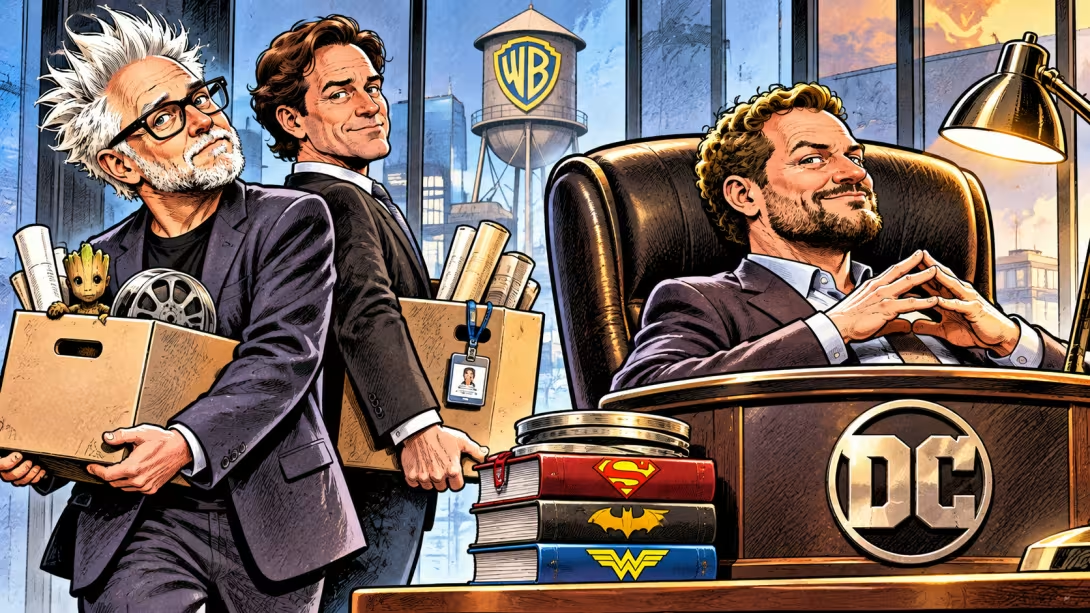
OUT-GUNNED: James Gunn Loses Control of DC Studios as Skydance Changes Course
On October 28, Critical Blast published Under the Gunn: James Gunn's DC Universe Has a Plan. So Why Does He Keep Having to Explain It?, examining the increasingly complicated task of keeping DC's cinematic universe coherent while its chief architect continued explaining which characters, productions, and storylines belonged to his grand design.
Twelve days later, James Gunn has a considerably larger problem.
He is about to lose the authority to decide what that grand design will become.
On November 9, 2026, Skydance announced that Gunn and his DC Studios co-chief Peter Safran would relinquish their executive positions effective December 1. Former Marvel Studios executive Jeremy Latcham will replace them as president and chief creative officer, assuming responsibility for the cinematic universe Gunn and Safran spent four years attempting to build.
Gunn has been out-Gunned.
The irony is difficult to miss. Our previous examination questioned why a supposedly unified DC Universe still required so much explanation from the man running it. Now the company has introduced an entirely new uncertainty: whether that universe can remain unified when the person responsible for its creative direction no longer possesses the authority to enforce it.
And perhaps most remarkably, the company making this change had publicly committed to keeping Gunn and Safran in charge barely five weeks earlier.
A Promise With a Short Shelf Life
On October 5, Skydance issued a formal announcement identifying the executive leadership team expected to guide the company following its acquisition of Warner Bros. Discovery. Among those named were James Gunn and Peter Safran, listed as co-chairmen of DC Studios and members of the company's CEO Business Leadership Team.
This was not an entertainment-industry rumor or an anonymous insider's prediction. It was an official corporate announcement, presenting the executives who would report directly to the company's top leadership.
Gunn and Safran were part of that structure. Dana Goldberg and Josh Greenstein, the co-chairs of Skydance Motion Picture Group, were also included.
Thirty-five days later, Gunn and Safran are preparing to leave their leadership positions, and Latcham will take over DC Studios while reporting to Goldberg and Greenstein.
That is more than a change of personnel. It is a change in where DC Studios sits within the corporate hierarchy.
Under the previously announced arrangement, Gunn and Safran had direct access to the company's highest executives. Under the new structure, DC's president will answer to the executives overseeing the larger motion-picture operation. Whether this translates into greater interference in individual productions remains to be seen, but the organizational independence once associated with Gunn's position is clearly being reconsidered.
There is no confirmed explanation for why Skydance changed course so quickly. Corporate mergers routinely produce organizational adjustments, and the company may have concluded that its new structure would be more efficient. But the timing invites an obvious question: if Gunn and Safran were essential to the future of DC Studios in October, what changed by November?
The Numbers Behind the Cape
When Gunn and Safran took control of DC Studios in 2022, they inherited a superhero franchise whose greatest consistency had become its inconsistency.
The earlier DC Extended Universe had produced substantial successes, including Wonder Woman and Aquaman, but it had also endured critical disappointments, commercial failures, abandoned projects, changing leadership, and conflicting creative directions. The release of The Flash in 2023 was supposed to help reset the cinematic landscape, but its disappointing box-office performance only reinforced the impression of a franchise struggling to find its footing.
Gunn's proposed solution was a coordinated universe spanning theatrical films, television, and animation. The plan promised continuity without requiring every project to look or feel identical. His 2025 Superman would provide the theatrical foundation, introducing David Corenswet as the Man of Steel while establishing the tone of the new DCU.
The film earned approximately $618 million worldwide, a respectable result for a character whose previous cinematic incarnation had become inseparable from years of studio controversy. It demonstrated that audiences were willing to embrace another Superman, although it did not approach the billion-dollar grosses that have historically defined Hollywood's largest superhero successes.
The subsequent releases complicated the financial picture.
Supergirl, released in 2026, reportedly earned approximately $126 million worldwide against a production budget of roughly $170 million. That is a troubling result before marketing and distribution expenses enter the calculation. Clayface, meanwhile, generated approximately $109 million worldwide against a much smaller reported production budget of $44 million, suggesting that more modestly budgeted DC productions might offer a different route to profitability.
Those figures, reported in contemporary coverage of the leadership change, do not establish that box-office performance caused Gunn and Safran's departure. Skydance has not identified ticket sales as the reason for its decision, and theatrical grosses alone do not provide a complete accounting of a film's profitability.
Nevertheless, the results illustrate the business challenge confronting DC Studios. One successful Superman film did not automatically translate into dependable audience demand for every character in the wider universe.
Gunn's creative strategy required time to establish relationships among characters, build audience familiarity, and demonstrate that the interconnected universe was worth following. The studio's ownership, meanwhile, had to evaluate individual films against budgets, revenue expectations, and the financial demands of a newly combined entertainment company.
Those objectives are not necessarily incompatible. But they do not always operate on the same timetable.
The Man Replacing Gunn Comes From Marvel
Jeremy Latcham is hardly an outsider to the superhero business. His career at Marvel Studios began in 2004, placing him inside the company during the formative years of what became the Marvel Cinematic Universe.
His credits include Iron Man, Iron Man 2, The Avengers, Avengers: Age of Ultron, Spider-Man: Homecoming, and Gunn's own Guardians of the Galaxy. He worked within the production system that helped Kevin Feige transform a collection of individual superhero properties into an interconnected cinematic franchise.
After leaving Marvel in 2017, Latcham established his own production company and worked on projects including Bad Times at the El Royale and Dungeons & Dragons: Honor Among Thieves.
His appointment therefore presents an interesting contradiction.
DC Studios is replacing a filmmaker who helped give Marvel's Guardians of the Galaxy its distinctive personality with an executive who helped build the production machinery behind Marvel's larger cinematic operation.
Gunn was an unusual choice to run a major studio division. His reputation rested primarily on his work as a writer and director, and his appointment represented a considerable investment in an individual filmmaker's creative judgment. Safran supplied the producing and business experience that complemented Gunn's artistic responsibilities.
Latcham's background is more closely associated with franchise management, production development, and coordinating projects within an established cinematic universe.
That does not mean he lacks creative instincts, nor does it establish that Skydance intends to impose a Marvel-style formula on DC. It does suggest that the company has selected someone whose experience aligns with a more conventional studio-management structure.
There is also an important personal connection. Gunn and Latcham previously worked together at Marvel, and Gunn and Safran have publicly welcomed their successor. This is not a case of an unfamiliar executive arriving to dismantle a predecessor's work without understanding its origins.
Whether that familiarity will translate into continuity for DC's future productions is another matter.
Gunn Isn't Leaving Superman Behind
The announcement does not mean Gunn has been expelled from DC or that his cinematic universe has been canceled.
According to Entertainment Weekly's reporting, Gunn and Safran will continue their involvement in creative projects, including Man of Tomorrow, the Superman sequel Gunn has written and is directing for release in July 2027.
Gunn has also indicated that he and Safran have begun developing another DC project that he is writing.
In his public reaction to the announcement, Gunn reflected on the extraordinary opportunity of running the studio, describing his lifelong affection for DC characters and the childhood dream that the position represented. He also acknowledged the less glamorous reality of the job: corporate responsibilities, relentless demands on his time, and the difficulty of maintaining a personal life while overseeing an enormous entertainment franchise.
He credited Safran with shouldering much of that administrative burden.
That perspective deserves consideration. Gunn may genuinely prefer returning to filmmaking rather than spending his days managing budgets, supervising productions, and navigating the politics of a multinational corporation.
The joint statement from Gunn and Safran emphasized their pride in the unified creative direction they established and their enthusiasm for returning to storytelling. Skydance leadership likewise praised their contributions and expressed confidence in the transition.
None of this proves that the departure was entirely voluntary. Nor does it prove that the executives were forced out. The public statements establish an amicable presentation of the change, but they do not reveal every conversation that preceded it.
What is certain is that Gunn's responsibilities are changing. He can continue making films within the universe he helped establish, but he will no longer be the executive responsible for approving the universe's broader direction.
That distinction could become increasingly important.
The DCU Survives. But Whose DCU Will It Be?
The immediate production slate does not appear to have been discarded.
Man of Tomorrow remains scheduled for 2027. Matt Reeves' The Batman: Part II, which exists outside the primary DCU continuity, remains planned for 2028. DC television projects and other productions remain part of the company's developing entertainment portfolio.
But announced projects are only one measure of a cinematic universe's stability. The more revealing decisions often concern productions that have not yet reached the cameras.
Which characters receive priority? Which scripts advance? How much money will the studio invest in lesser-known properties? Will interconnected storytelling remain a central objective, or will individual films be expected to succeed without depending on a larger narrative?
Those questions will now fall to Latcham and the executives above him.
This is where the transition becomes particularly significant for DC fans. Gunn's original proposal was not simply a collection of superhero movies. It was a coordinated creative framework, with different projects contributing to a larger fictional world while retaining their own identities.
That framework depended on someone possessing the authority to maintain it.
Gunn's frequent public explanations of continuity, casting, and project status were sometimes exhausting, as we observed in Under the Gunn. But they also reflected the fact that he was personally accountable for the architecture of the new DC Universe.
When fans wanted to know whether a television series belonged to the main continuity or whether a particular character would appear in a future film, Gunn was the person expected to provide an answer.
Soon, that responsibility will belong to someone else.
Latcham could preserve the existing plan almost entirely, allowing Gunn's established productions to proceed while improving coordination and financial oversight. He could also gradually redirect development priorities, reshaping the DCU without announcing another formal reboot.
Either approach is possible. Neither has yet been established as the company's intention.
For audiences who have already endured multiple versions of Batman, Superman, and the Justice League, however, the distinction may offer little immediate reassurance. DC has repeatedly promised stability, only to change direction before its previous plans could fully mature.
The challenge for Skydance is not merely to appoint a capable executive. It is to convince audiences, filmmakers, and creative partners that the company will allow its chosen direction to develop long enough to be judged on its merits.
The Problem Was Never Just Gunn
It would be easy to interpret the leadership change as a verdict on James Gunn's stewardship of DC Studios. His approach has attracted enthusiastic supporters and equally determined critics, and his willingness to engage directly with fans has made him an unusually visible target for every controversy surrounding the franchise.
But reducing the story to Gunn's personal success or failure overlooks the larger institutional problem.
DC's cinematic ambitions have been repeatedly reshaped by executive decisions, corporate restructuring, and changing commercial expectations. Filmmakers have been hired to establish long-term visions, only to see those visions revised or abandoned as leadership changed.
Gunn and Safran were supposed to provide an answer to that instability.
For four years, they attempted to build a unified creative operation around an identifiable plan. Their tenure produced a successful Superman relaunch, expanded television offerings, commercially uneven theatrical results, and a developing slate whose ultimate prospects remain uncertain.
Now, before that slate has fully unfolded, the people who established it are relinquishing control.
Perhaps Latcham will prove to be precisely the executive DC Studios needs. His Marvel experience gives him a substantial understanding of franchise construction, and his previous collaboration with Gunn may help preserve continuity during the transition.
But the appointment also introduces a familiar uncertainty into a franchise that has spent years promising audiences it had finally found a stable direction.
Twelve days ago, Critical Blast asked why James Gunn kept having to explain his DC Universe when he supposedly had a plan.
Today, the question has changed.
Gunn may finally be free to stop explaining the plan.
Someone else is now going to decide whether to follow it.