
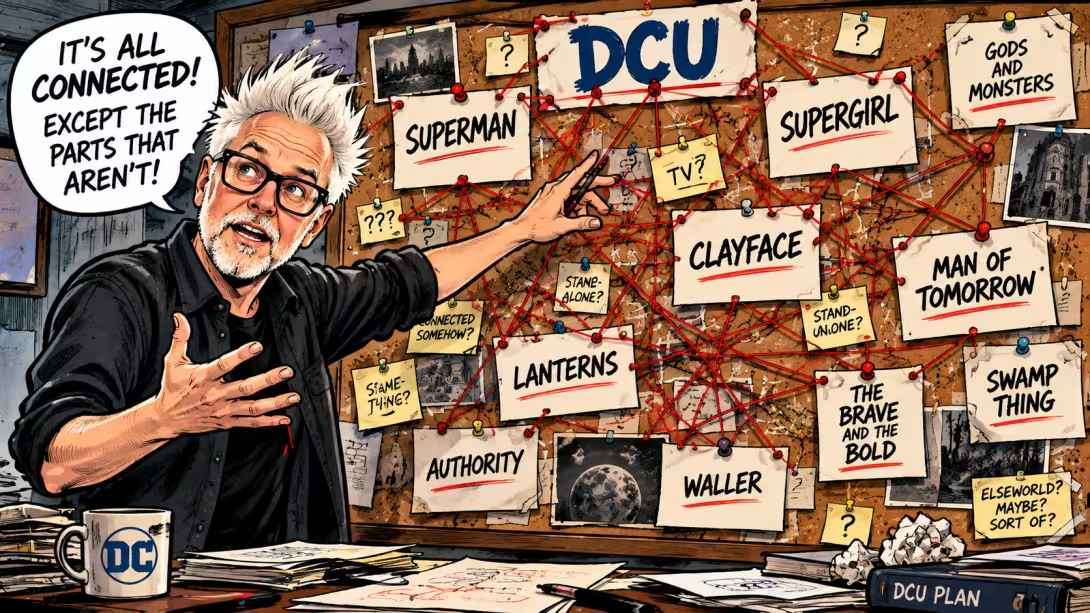
Under the Gunn: James Gunn's DC Universe Has a Plan. So Why Does He Keep Having to Explain It?
When James Gunn and Peter Safran took control of DC Studios in 2022, they inherited something resembling the aftermath of a particularly expensive superhero battle. Characters had been introduced, abandoned, reinvented, and occasionally portrayed by different actors before their previous incarnations had even left the building. Movies contradicted other movies, television series occupied their own corners of the multiverse, and Superman's future seemed perpetually subject to whatever corporate reorganization had occurred that afternoon.
Gunn's solution was supposed to be a plan: a coherent DC Universe capable of accommodating Superman, Batman, Wonder Woman, and an assortment of lesser-known characters under a unified creative vision. That sounded sensible for a company whose greatest challenge had often been explaining which version of its own characters audiences were supposed to be watching. Nearly four years after the announcement, however, Gunn is still explaining how the plan works, and the arrival of Clayface has given that conversation fresh urgency.
The disagreement is less about whether individual films should stand on their own than about what audiences were encouraged to expect from a connected universe. Gunn's creative argument makes sense, but his public explanations reveal a gap between a studio's development strategy and the story audiences thought they were being promised.
The Universe That Was Supposed to Connect Everything
In January 2023, Gunn and Safran unveiled the first chapter of their DC Universe, Gods and Monsters, with projects involving Superman, Batman, Supergirl, Swamp Thing, Green Lantern, and less familiar characters. The ambition extended across theatrical films, television, and animation, with characters occupying a shared fictional world. After years of fragmented DC continuity, that sounded like a promise of coherence as well as a promise of good stories.
Marvel Studios had already taught audiences to expect interconnected storytelling, with films serving as both independent adventures and pieces of a larger narrative. Gunn has recently pushed back against the notion that every DC project must advance an eventual crossover. In reporting on his October comments, TheWrap describes Gunn's comparison to Star Wars: a setting large enough for stories in different places and times, without every installment functioning as a stepping stone to the same destination.
The approach is defensible, but the distinction between a shared setting and a single overarching plot deserves clearer communication. Once a studio emphasizes that its properties are connected, viewers will naturally look for the connections. That isn't a failure of imagination on the audience's part; it's a predictable response to the way cinematic universes have been marketed for more than a decade.
Clayface and the Case for Leaving Well Enough Alone
Clayface is a useful demonstration of what Gunn means. Directed by James Watkins, the film follows Matt Hagen, played by Tom Rhys Harries, whose disfigurement and experimental treatment transform a promising career into a nightmare of identity and revenge. The official DC production information credits Mike Flanagan and Hossein Amini with the screenplay and identifies Matt Reeves among its producers. Reeves's involvement should not be confused with directing the film or placing it in his separate Batman continuity.
As Critical Blast examined in Clayface: DC's $40 Million Gamble on a Monster, Not a Superhero, the film's appeal lies partly in treating a Batman villain as the subject of a horror story rather than as a supporting attraction in someone else's superhero adventure. Gotham can be a shared setting without requiring its most famous resident to appear whenever a monster emerges from the shadows.
The film opened atop the North American box office with approximately $24 million, according to Variety's October 26 coverage. That is a meaningful opening for an unusual DC property, though the theatrical gross is not the same as studio revenue or profit. More importantly for Gunn's argument, the film's identity as a horror thriller is legible without an audience having to study a continuity chart.
The Guardians Defense
Gunn has compared the arrangement to his Guardians of the Galaxy films, describing some DC stories as standalone and others as participants in a larger narrative structure. GamesRadar's October 28 account places Clayface in the first category and the continuing Superman storyline in the second. He also maintains that each installment of a larger story ought to work for someone who hasn't watched everything else.
The comparison is useful, if imperfect. The Guardians films were enjoyable adventures on their own, but they also contained characters and objects that mattered to Marvel's broader Infinity Saga. Their independence was never the same as isolation. A standalone story can occupy shared continuity without devoting its running time to explaining where it fits, and that is a distinction Gunn's DCU would benefit from demonstrating rather than repeatedly debating online.
This is also where the expectations of long-time comic-book readers differ from those of occasional moviegoers. Readers have spent decades following Batman and Superman through separate monthly adventures while accepting that the characters occasionally cross paths. A cinematic universe doesn't need to make every project a chapter of the same novel; it does need to be clear about whether those chapters share a world.
Superman as the Center of Gravity
Gunn's comments suggest that Superman supplies the central narrative thread. David Corenswet's 2025 film leads into Man of Tomorrow, scheduled for July 9, 2027, while characters introduced elsewhere in the DCU may participate in that ongoing story. TheWrap's reporting describes this as connectivity without an obligation for every other production to exist merely as setup.
That is a familiar model in comics publishing. Superman can face a threat in Metropolis while a horror story unfolds in Gotham, and the two can coexist without interrupting one another. The creative advantage is obvious: different filmmakers can explore different tones, ratings, and genres while the studio maintains an intelligible setting. The risk is that the phrase interconnected universe continues to suggest a single destination to audiences who have spent years being trained to expect one.
When a Shared Universe Becomes Homework
Marvel's extraordinary commercial success turned continuity into a kind of currency. Post-credit scenes became promises, cameos inspired theories, and seemingly minor details could be treated as clues to productions still years away. For a while, that arrangement rewarded devoted viewers, but the expectation that everything should connect could also make the franchise feel like an assignment rather than entertainment.
Gunn is right to resist a model in which the primary function of a movie is advertising another movie. Yet the trouble with that model wasn't simply that stories connected; it was that connections sometimes threatened to become more important than the stories. A good shared universe can offer the pleasures of continuity without demanding that every viewer keep an annotated spreadsheet of appearances and Easter eggs.
That balance is especially important when a studio deliberately ranges beyond conventional superhero action. A body-horror film about Clayface, a cosmic adventure with Supergirl, and a more traditional Superman story ought to be allowed different dramatic priorities. Their shared branding should create opportunities, not erase the reasons each project exists.
A Roadmap Is Not a Screenplay
Gunn has also argued that the much-discussed eight-to-ten-year roadmap was never simply a sequence of plot beats. It included plans to strengthen DC's flagship characters, elevate lesser-known properties, support filmmaker freedom, and accommodate varied tones and ratings. Murphy's Multiverse summarizes those remarks, which describe a studio-wide strategy rather than a detailed promise that every release would lead directly to a crossover.
The distinction is significant because a roadmap can mean different things to executives and audiences. Studio leadership may hear a slate of production goals, while fans hear a map of narrative destinations. Both interpretations can coexist until a film arrives that refuses to behave like a waypoint, at which point the debate begins again. Gunn would be better served by showing how the approach works than by treating the confusion itself as unreasonable.
The Movies Will Have the Last Word
The strongest defense of Gunn's DC Universe won't be another social media exchange. It will be a run of films that succeed on their own terms while making their shared world feel coherent when connections do occur. If Clayface works as horror, Man of Tomorrow advances Superman's story, and other productions maintain distinctive creative identities, audiences will eventually understand the structure through experience.
DC doesn't need to become Marvel, and its filmmakers shouldn't be required to turn every release into a trailer for the next one. But a studio that sells a coherent universe should not be surprised when viewers ask how the pieces fit. Gunn may have had a consistent philosophy since 2023; communicating it convincingly is a different task from having it in the first place.
For a company built around Superman, Batman, and Wonder Woman, the answer ought to be found on screen. The Justice League has saved the world countless times without requiring its readers to attend a press conference explaining why everybody showed up.