
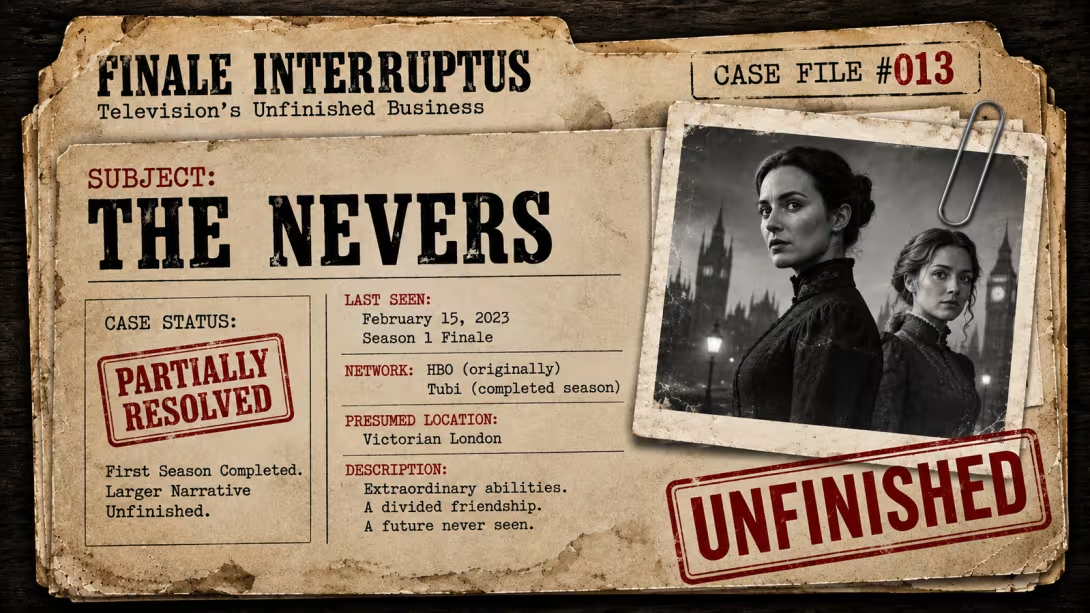
Finale Interruptus: Case File #013 - The Nevers
Every television series begins with a promise.
Give us your time. Your attention. Your imagination.
In return, we’ll tell you a story. And when it ends, we’ll bring it to its proper conclusion.
Most do.
Some don’t.
A Strange Day in Victorian London
On August 3, 1896, something extraordinary happened in London.
A mysterious object passed through the sky, scattering luminous particles across the city. Most people continued about their business, apparently unaware that anything unusual had occurred. But for certain individuals, the event would change everything.
Some acquired extraordinary abilities. Others experienced transformations that were considerably less convenient. And in a society already obsessed with class, propriety, and keeping people in their assigned places, the sudden appearance of individuals who could defy the natural order was not particularly welcome.
They became known as the Touched.
When HBO premiered The Nevers on April 11, 2021, it introduced audiences to an alternate Victorian England in which science fiction, supernatural mystery, and social commentary occupied the same crowded drawing room. Created by Joss Whedon, the series followed a growing population of people whose unusual abilities had made them objects of fascination, fear, exploitation, and outright hostility.
The premise offered a particularly intriguing variation on the superhero genre. Rather than placing extraordinary individuals in a modern world already accustomed to technological marvels, The Nevers situated them in a society where conventional expectations about gender and social standing were rigidly enforced.
A woman who could see glimpses of the future was not necessarily celebrated as a visionary. She might instead be regarded as unstable, dangerous, or in need of confinement.
And a woman capable of manipulating electricity could hardly expect polite society to applaud her scientific achievements.
At the center of the story stood Amalia True, played by Laura Donnelly, a formidable and frequently abrasive woman whose mysterious ability allowed her to experience brief visions of possible future events. These glimpses, which she called ripplings, provided warnings of approaching danger without necessarily explaining how to avoid it.
Amalia was neither an infallible prophet nor an especially reassuring guardian. She was a fighter, a survivor, and someone whose understanding of the world appeared to extend beyond what she was willing to tell even her closest associates.
Her closest ally was Penance Adair, played by Ann Skelly, an inventive young woman whose ability allowed her to perceive electrical energy and imagine technological applications far ahead of her time. Where Amalia approached danger with fists and grim determination, Penance responded with curiosity, ingenuity, and an almost irresistible urge to build something. Together, they operated St. Romaulda's Orphanage, a refuge for Touched individuals who had nowhere else to go.
The orphanage was more than a convenient headquarters. It represented the series' central moral proposition: people whose differences made them vulnerable deserved protection, even when the surrounding society considered those differences threatening.
Its residents included individuals with abilities that ranged from useful to deeply unsettling. Some could communicate through unusual means, others could manipulate matter or influence emotions, and still others possessed transformations that made ordinary life almost impossible. Not every Turn was a gift. Some were burdens that their recipients had never requested and could not escape.
The orphanage also provided the show with a natural ensemble, allowing its writers to explore how people responded differently to circumstances that had abruptly separated them from the rest of society. Some wanted acceptance, some wanted revenge, and others simply wanted to survive.
But The Nevers was not content to tell stories about unusual people seeking refuge from Victorian prejudice. Someone was hunting the Touched.
The most immediately recognizable threat was Maladie, played by Amy Manson, a violent and psychologically disturbed woman whose abilities and personal history made her one of the series' most dangerous figures. Her activities attracted the attention of the authorities and intensified public suspicion toward anyone associated with the mysterious transformations.
Meanwhile, Lord Massen, portrayed by Pip Torrens, represented a different kind of opposition. As an influential member of the British establishment, he viewed the Touched as a threat to the existing social order and sought to contain their growing influence.
His hostility was not merely personal. It reflected the fear that extraordinary abilities might undermine the institutions and hierarchies upon which his world depended. Other factions operated with motives that were considerably harder to decipher.
Dr. Edmund Hague conducted horrific experiments upon Touched individuals, while the enigmatic Lavinia Bidlow provided financial support to Amalia's orphanage even as her involvement in other activities raised troubling questions about her true objectives.
The result was a sprawling conspiracy in which the Touched were caught between political hostility, scientific exploitation, criminal violence, and forces whose ultimate intentions remained obscure. And beneath those conflicts lay a much larger mystery.
What had happened on August 3, 1896?
The series gradually revealed that the event responsible for the Touched was connected to something called the Galanthi. The nature of this mysterious presence, its relationship to the transformations, and the reasons certain people had been affected formed the central mythology of the show.
The question was not simply why some Londoners had acquired extraordinary abilities. It was whether those abilities had been bestowed for a purpose.
That distinction mattered because the story increasingly suggested that the Touched were part of something much larger than a collection of unrelated accidents.
Amalia herself seemed to know more than she admitted, and the unusual circumstances surrounding her past hinted that the apparent Victorian fantasy concealed a science-fiction narrative of considerably greater scope.
For several episodes, The Nevers encouraged viewers to interpret its world through the conventions of period adventure. There were elaborate costumes, horse-drawn carriages, clandestine meetings, brutal confrontations, and the occasional invention that looked as though it had escaped from a particularly ambitious steampunk workshop. Then the sixth episode, “True,” radically altered the audience's understanding of what it had been watching.
Without revealing every development just yet, the episode connected the events of Victorian London to a far more distant setting and provided a new perspective on Amalia's identity, the Galanthi, and the purpose behind the Touched.
What had initially appeared to be a story about extraordinary women in nineteenth-century England was revealed to be part of a much larger conflict.
It was an audacious expansion of the premise, one that transformed the questions audiences had been asking throughout the first five episodes. And it arrived at precisely the wrong moment.
“True” aired on May 16, 2021, bringing the first half of the season to a close. HBO had ordered twelve episodes, but only six were ready for the initial broadcast run, with the remaining installments expected to follow later.
For viewers who had just discovered that the show's Victorian mysteries were connected to an unexpectedly expansive science-fiction mythology, the interruption could hardly have been more frustrating.
The series had spent six episodes establishing its characters, factions, and central mystery. It had then delivered a revelation that promised to redefine everything that came before it. Naturally, audiences wanted to know what happened next. They would have to wait.
And while they waited, the future of The Nevers became considerably more uncertain than anything Amalia True might have glimpsed in one of her ripplings.
The first six episodes had opened the door to an enormous story. Whether HBO would allow the series to walk through it was another matter entirely.
The Creator Who Left Before the Premiere
When HBO announced The Nevers in July 2018, the network wasn't merely purchasing another science-fiction series. It was investing in a creator whose name had become closely associated with genre television, particularly stories involving extraordinary women, unconventional families, and characters fighting against institutions determined to control them.
Joss Whedon had created Buffy the Vampire Slayer, Angel, and Firefly, developed Dollhouse, and directed two enormously successful Avengers films for Marvel Studios. His reputation for combining supernatural or science-fiction concepts with ensemble storytelling made him an obvious candidate to develop a series about Victorian women who suddenly acquired extraordinary abilities.
HBO gave The Nevers a straight-to-series order, bypassing the traditional pilot-selection process. Whedon was attached as writer, director, executive producer, and showrunner, placing him at the center of both the creative development and production of the program.
For a network seeking another ambitious genre property in the aftermath of Game of Thrones, the arrangement offered a recognizable name and a premise with considerable potential.
It also meant that the production was unusually dependent upon one individual. By the time The Nevers reached television, that individual was no longer running it.
In November 2020, months before the series premiered, Whedon announced that he was leaving the production. In a statement, he attributed his departure to the physical demands of creating a large-scale series during a global pandemic, saying that the work required a level of energy he could no longer sustain. HBO acknowledged his departure and indicated that the series would continue.
The timing was significant. Production had already been disrupted by COVID-19, and only part of the planned first season had been completed. The show had not yet reached audiences, but it was already confronting the loss of its creator and the complications of an interrupted production schedule.
Those difficulties would have been substantial for almost any television program. For The Nevers, they were compounded by the increasingly controversial public reputation of the man who had developed it.
Whedon's departure occurred amid a period of renewed scrutiny concerning his conduct on previous productions. In July 2020, actor Ray Fisher publicly accused Whedon of abusive and unprofessional behavior during the reshoots of Justice League. WarnerMedia subsequently conducted an investigation into the film's production, announcing in December that remedial action had been taken. The company did not publicly disclose the full findings of that investigation.
In February 2021, Charisma Carpenter, who had worked with Whedon on Buffy the Vampire Slayer and Angel, made allegations concerning his treatment of her during those productions. Other performers expressed support for Carpenter or discussed their own experiences, contributing to a broader reassessment of Whedon's professional reputation.
These developments are relevant to the history of The Nevers, but they require a distinction that is too often lost when television controversies are summarized retrospectively.
Whedon's publicly stated reason for leaving The Nevers was the strain of production during the pandemic. His departure also occurred during a period of serious allegations and controversy surrounding his earlier work. The available public record does not establish that HBO removed him from The Nevers because of those allegations, and the two circumstances should not be presented as a proven cause-and-effect relationship.
Whatever the reasons behind the departure, the practical consequence was unmistakable.
The series had lost the person responsible for establishing its creative direction before the audience had seen a single episode.
In January 2021, HBO appointed British screenwriter Philippa Goslett as the new showrunner. Goslett, whose previous credits included the feature films Little Ashes and How to Talk to Girls at Parties, inherited a production that had already developed its elaborate mythology, principal characters, and distinctive visual identity.
Her assignment was not simply to create a new television series from an existing premise. She had to continue a program whose first six episodes were substantially established, while developing the remaining installments into a coherent continuation. That is a difficult undertaking under ordinary circumstances.
A television showrunner is responsible for far more than writing individual scripts. The position involves supervising the writers' room, coordinating the larger narrative, making creative decisions during production, and ensuring that individual episodes contribute to the intended direction of the series.
Replacing that person after production has begun can create complications even when everyone involved agrees upon the broad outlines of the story. In the case of The Nevers, those complications were magnified by the structure of its central mystery.
The series depended upon information being revealed gradually. Amalia True's identity, the origins of the Touched, and the nature of the Galanthi were not incidental background details that could be rearranged without consequence. They were interconnected elements of a mythology designed to change the audience's understanding of the story as it unfolded. The sixth episode, “True,” demonstrated just how dependent the series was upon that larger architecture.
Its revelations dramatically expanded the scope of the narrative, transforming what had appeared to be a Victorian fantasy into something with far-reaching science-fiction implications. Any continuation would have to account for those revelations while also advancing the numerous character conflicts already established.
Goslett therefore inherited not only an unfinished season but a story whose most important questions had just become considerably more complicated. The pandemic added another layer of difficulty.
The original production schedule had been interrupted, leaving HBO with six episodes available for broadcast while the remainder of the twelve-episode order still required completion. Rather than delay the entire premiere until the full season was ready, the network elected to release the completed installments in spring 2021. That decision created an unusual viewing experience.
Audiences were introduced to the Touched, the orphanage, the various factions competing for control of extraordinary individuals, and the mystery of the Galanthi. Then, just as the sixth episode substantially redefined the premise, the series disappeared from the schedule.
The interruption was initially presented as a division of the first season, not as the conclusion of the program.
There was every reason for viewers to expect that the remaining six episodes would eventually arrive. HBO had ordered twelve installments, and the production team was continuing work under its new showrunner.
But there was no simple guarantee that the series would receive a second season, particularly given the expense of its period setting and the increasingly uncertain circumstances surrounding its production. The program's critical reception also presented a mixed picture.
Reviewers frequently praised the performances of Laura Donnelly and Ann Skelly, the elaborate production design, and the ambition of the central premise. Others found the storytelling overcrowded, the mythology unnecessarily convoluted, or the series too dependent upon familiar elements of Whedon's earlier work.
The result was a program with considerable creative ambition but without the sort of overwhelming critical consensus that might have made its continuation an obvious priority.
It is worth emphasizing that mixed reviews do not establish why a network cancels a series. Audience performance, production costs, scheduling considerations, and corporate strategy can all influence renewal decisions, and the public rarely receives a complete accounting of those deliberations. Still, The Nevers entered its extended hiatus without the security of a confirmed long-term future.
The circumstances were particularly unfortunate because the first six episodes had effectively served as an elaborate introduction. They established the characters and conflicts, then used the midseason finale to reveal that the story was much larger than viewers had initially understood. That is a reasonable approach when a production expects to continue for several seasons.
It is considerably riskier when the series has already lost its original showrunner, experienced a major production interruption, and entered an uncertain period for the network distributing it. Yet none of those developments meant that the remaining episodes had been abandoned.
Philippa Goslett and the production team continued the work of completing the first season. Whatever happened to the program's longer-term prospects, there was still a substantial amount of story waiting to be told.
And that is what makes the eventual fate of The Nevers different from the familiar account of a television series canceled before its ending could be filmed. The missing episodes were not merely outlines in a writers' room or scripts that would never reach production.
They were on their way to becoming finished television. The question was whether the network would still want them when they were ready.
As it turned out, the next threat to The Nevers would not come from Victorian society, the Purists, or the mysterious forces surrounding the Galanthi.
It would come from a corporate restructuring that changed the priorities of the company responsible for putting the series in front of its audience.
Six Episodes and an Indefinite Intermission
When the sixth episode of The Nevers concluded on May 16, 2021, HBO had accomplished something that television networks generally consider desirable. It had left its audience with an enormous revelation and a compelling reason to return. Unfortunately, it had also left them without a return date. Instead, the series entered an extended hiatus.
HBO had ordered twelve episodes for the first season, but the COVID-19 pandemic had interrupted production, leaving only six ready for the spring 2021 premiere. The network divided the season into two parts, with the understanding that the remaining installments would follow once production was completed.
Under new showrunner Philippa Goslett, work continued on the remaining six episodes. The series retained its Victorian setting, extensive cast, and complicated combination of period drama and speculative fiction, all of which required substantial coordination even without the disruptions that had already affected filming. The production eventually completed the second half of the season.
The Nevers was not simply another television series canceled while its writers were developing stories that would never be filmed. The remaining installments existed, and the first season's twelve-episode order was no longer merely a promise awaiting fulfillment.
But having completed episodes and having a network willing to broadcast them are two different things. During the show's absence, the corporate environment surrounding HBO changed dramatically.
In April 2022, WarnerMedia and Discovery completed their merger, creating Warner Bros. Discovery. The new company inherited an enormous collection of television networks, film studios, streaming services, and programming commitments, along with significant financial obligations.
Chief executive David Zaslav and his management team began reassessing those operations, pursuing cost reductions and reorganizing the company's streaming strategy.
For subscribers, the changes became visible through programming cancellations, the removal of titles from HBO Max, and decisions that challenged the assumption that a streaming service would indefinitely retain everything it had previously offered.
Some productions were abandoned before release. Others disappeared from the streaming catalog despite having already been made available to audiences.
The company also began exploring opportunities to license certain programs to free, advertising-supported streaming television services, commonly known as FAST platforms.
A program that no longer fit the company's subscription-streaming priorities might still possess value as licensed content on another platform. Removing it from HBO Max did not necessarily mean that the company intended to bury it permanently.
On December 12, reports emerged that HBO had canceled The Nevers and would remove its existing episodes from HBO Max. The decision came alongside the removal of several other programs, including Westworld, which had also been canceled.
The circumstances made the cancellation particularly unusual. HBO was not merely declining to commission another season after the conclusion of the first. It was ending the program before releasing half of the season it had already ordered.
Imagine purchasing the first half of a mystery novel, reaching the chapter where the detective finally discovers the significance of the evidence, and then learning that the publisher has decided not to release the rest of the book.
The remaining episodes had not been destroyed or permanently shelved. Reports indicated that Warner Bros. Discovery intended to make the series available through another distribution arrangement, potentially including the unaired installments. The question was no longer simply whether The Nevers deserved another season.
It was whether the people who had watched the first half would ever receive a practical opportunity to see the second. Provided, of course, that you knew when to tune in.
The Finale That Escaped to Tubi
That somewhere was Tubi.
For viewers unfamiliar with the service, Tubi was a free, advertising-supported streaming platform owned by Fox Corporation. Unlike subscription services such as HBO Max, Tubi generated revenue primarily through advertising rather than monthly subscription fees. What made The Nevers unusual was that its new home would premiere episodes that HBO itself had never broadcast.
In February 2023, Tubi introduced The Nevers through one of its free, advertising-supported television channels, part of a programming arrangement involving Warner Bros. Discovery content.
Rather than simply placing the complete twelve-episode season in an on-demand library, the service scheduled the series in blocks of episodes across three consecutive days.
On February 13, Tubi aired episodes one through five. February 14 began with episode six, “True,” before premiering episodes seven through nine. The final three episodes followed on February 15, culminating in the twelfth installment, “I'll Be Seeing You.” They had to be watching at the right time.
The distinction between Tubi's on-demand library and its scheduled channels was crucial. Viewers accustomed to selecting an episode whenever they wished could not simply assume that the missing installments would be waiting for them under the show's title.
The premiere was arranged as a linear television event, with episodes appearing according to a predetermined schedule. Anyone who missed the designated broadcasts would have to wait for another scheduled opportunity rather than immediately selecting the next episode.
In effect, a series that had begun life as an expensive HBO production returned through a distribution model that resembled traditional television more than the on-demand streaming experience its audience had come to expect.
The Nevers had been a story about people suddenly confronted with extraordinary changes to the world around them. Its viewers now found themselves confronting an unexpected technological regression: after waiting almost two years for the next episode, they needed to consult a television schedule.
HBO had originally promoted The Nevers as one of its own prestige productions, supported by the visibility and marketing resources associated with a major premium television network. Its premiere attracted attention from entertainment publications, reviewers, and audiences interested in ambitious science-fiction programming.
By February 2023, the series had already been publicly canceled. Its original streaming home no longer carried it, and viewers who had interpreted the December announcement as the end of the program had little reason to expect that six new episodes were about to appear elsewhere.
A viewer who had watched the first six episodes on HBO Max might reasonably search that service for the continuation. Finding nothing, that viewer could conclude that the promised second half had never been released.
Another might discover that the episodes had premiered on Tubi, only to find that the initial scheduled broadcasts had already passed.
Anyone seeking a physical copy can check Amazon’s current listings for The Nevers, but should verify the episode count before purchasing; a listing for the first six episodes is not necessarily a complete twelve-episode edition.
The series did not simply vanish before its final episodes could be made. It vanished from the service that had introduced it, then reappeared on a different platform under distribution conditions that made its conclusion less accessible than its beginning had been. The story had not been withheld entirely. It had been displaced.
Warner Bros. Discovery ultimately permitted those episodes to reach the public, which distinguishes this case from productions whose completed material remains permanently unreleased. Nevertheless, releasing something and making it readily available are not identical achievements.
The Nevers was not a procedural drama in which each episode presented an independent mystery that could be understood without reference to earlier installments. Its narrative was cumulative, with events in one episode changing the significance of scenes that had appeared several episodes before. Still, our investigation cannot end with the difficulty of finding the episodes.
After all, Finale Interruptus is concerned with unfinished stories, not merely inconvenient television schedules.
The existence of a twelfth episode does not automatically establish that the narrative received a satisfactory conclusion. Nor does the cancellation of a series necessarily mean that its final installment failed to resolve the conflicts already underway.
To determine whether The Nevers truly belongs among television's unfinished business, we must examine what actually happened when the remaining episodes finally reached the screen.
Did the Galanthi mystery receive an answer? Did Amalia True accomplish what she had been sent to do? What became of the orphanage, the Touched, and the people determined to destroy them?
And did “I'll Be Seeing You” bring the story to a genuine conclusion, or merely prepare the audience for another season that would never exist?
The missing episodes had finally escaped. Now it was time to examine what they left behind.
Did “I'll Be Seeing You” Actually Finish the Story?
There is a fundamental difference between a television series that ends and a television series that concludes.
The first is a scheduling decision. The second is a storytelling achievement. And while networks can determine when a program stops appearing on their schedules, they cannot automatically transform its final episode into a satisfactory resolution merely by declaring that no more episodes will be produced.
That distinction brings us to the twelfth and final installment of The Nevers, appropriately titled “I'll Be Seeing You.”
The episode premiered on Tubi on February 15, 2023, nearly twenty-one months after HBO had broadcast the first half of the season. By then, the series had already been canceled, its original streaming home had removed it, and the audience that remained had been forced to work considerably harder than usual to discover how the story continued.
But the most important question was no longer where the episode could be found. It was what the episode actually accomplished.
The six installments produced under Philippa Goslett had expanded the conflict surrounding the Touched, bringing the mysterious Galanthi into more direct contact with the characters while exposing the increasingly dangerous ambitions of those who wanted to control or destroy it.
Dr. Edmund Hague's experiments had grown more grotesque, anti-Touched sentiment had become increasingly violent, and the competing loyalties within the orphanage were being tested by the realization that their extraordinary abilities might have originated from a source they did not fully understand.
The final episode brought several of those conflicts to a head. And, to its credit, it did not simply stop in the middle of the action.
The Purists launched a devastating assault against St. Romaulda's Orphanage, turning what had served as a sanctuary for the Touched into a battlefield. The attack came as the Galanthi itself was dying, causing the Touched to lose their abilities at precisely the moment when they most desperately needed them. The resulting confrontation was brutal.
Primrose, one of the orphanage's most distinctive residents, was killed. Lord Massen, whose hostility toward the Touched had helped fuel the violence, met his own end at the hands of Inspector Frank Mundi. Hugo Swann was also fatally wounded during the confrontation, bringing his complicated relationship with Mundi to a tragic conclusion.
These were not minor developments designed merely to create anticipation for another season. The episode was removing major characters and resolving conflicts that had been developing since the beginning of the series. Even Amalia True appeared to meet her end.
During the battle, she suffered a seemingly fatal wound while attempting to protect the people who had come to depend upon her. Her sacrifice brought her back into contact with the mysterious consciousness associated with the Galanthi, which had been attempting to communicate a lesson about the value of giving one's life for others. The Galanthi's own death then transformed the situation.
Rather than simply disappearing, the creature released its energy across London, restoring the abilities of the surviving Touched and scattering new particles capable of affecting additional people. Amalia returned to life, and the immediate threat to the orphanage was overcome. For a moment, it seemed possible that The Nevers had managed to deliver a genuine conclusion.
The principal sanctuary had survived. Several major antagonists were dead. The mystery surrounding the Galanthi had received a substantial explanation, and Amalia had finally understood something important about the purpose of her extraordinary circumstances.
A series ending with those developments might reasonably have claimed to have completed its central narrative. But The Nevers was not finished complicating matters.
The Galanthi's apparent sacrifice introduced a profound disagreement between the two women whose friendship had provided the emotional foundation of the entire series.
Amalia interpreted the creature's actions as an act of generosity, a decision to share its existence with humanity and offer the possibility of a better future. Penance Adair saw something considerably more troubling.
The Galanthi had altered human beings without their knowledge or consent. Its actions had produced suffering, violence, and social upheaval, and now its death threatened to spread those changes even farther.
For Penance, the creature's apparently benevolent intentions did not excuse its willingness to transform an entire population without asking permission.
The disagreement was not a trivial misunderstanding that could be resolved with an affectionate remark and a reassuring embrace. It struck at the moral foundation of the series.
From the beginning, The Nevers had presented the Touched as people whose differences did not diminish their humanity. Their abilities might be extraordinary, but they still deserved the freedom to determine their own lives.
Now Penance was questioning whether the force responsible for creating those abilities had violated the very principle the orphanage existed to defend.
Amalia and Penance, who had faced virtually every danger together, ended the season divided over the meaning of everything they had experienced. That alone would have provided a compelling foundation for a second season.
Unfortunately, there would not be one. The finale also left a particularly disturbing development involving Augustus Bidlow.
Throughout much of the series, Augie had appeared to be an awkward, gentle young man struggling against the expectations of his powerful sister, Lavinia. His growing relationship with Penance offered the possibility of a romance between two people who understood what it meant to be different. But the final episodes revealed a considerably darker aspect of his character.
Augie's resentment toward Lavinia, rooted partly in their troubled childhood and intensified by her treatment of him as an adult, culminated in his murdering her. The act was not presented as an accidental consequence of a battle or an unavoidable necessity.
He deliberately killed his sister. And shortly afterward, Penance, unaware of what he had done, found comfort in his embrace.
It was a chilling development, particularly because the audience possessed information that Penance did not. The apparent romantic refuge she had found might itself have become a source of danger.
Whether Augie's actions represented a psychological collapse, the emergence of a darker personality, or a destructive consequence of his abilities remained a question for a future season. One that would never arrive.
Then there was the mysterious orange energy associated with Dr. Hague's supposed communications with his dead mother.
The final episodes revealed that the phenomenon was connected to another consciousness from Amalia's future, one whose understanding of the Galanthi differed sharply from Amalia's own.
Although Hague himself was ultimately killed by Maladie, the energy did not simply vanish with him. Instead, the final moments suggested that the threat had found another means of continuing.
Myrtle, whose unusual linguistic abilities had made her one of the orphanage's most intriguing residents, became connected to the phenomenon. In a post-credits sequence, she walked through London singing “I'll Be Seeing You,” while streetlights illuminated in response to her presence.
The scene was atmospheric, unsettling, and unmistakably designed to suggest that something important was beginning. Unfortunately, it was beginning after the series had already ended.
This is perhaps the clearest evidence that the twelfth episode was conceived as a season finale rather than a definitive conclusion to the entire program.
The surviving characters had not merely been left with the ordinary uncertainties that accompany life after a major conflict. The writers had deliberately established new dangers, fractured central relationships, and expanded the implications of the Galanthi's arrival.
The immediate battle had been won. The larger war had barely begun. And the consequences of the Galanthi's final act were potentially enormous.
Until that moment, the Touched had been a relatively limited population concentrated within a particular historical and geographical setting. Their abilities had already provoked fear, exploitation, and organized persecution. Now the possibility existed that the phenomenon could spread far beyond London.
If the first generation of Touched had threatened Victorian society's understanding of human nature, what would happen when the transformations became more widespread?
Would governments attempt to control the newly affected? Would the Purists become an international movement? Would ordinary people embrace the Galanthi's supposed gift or regard it as an invasion?
And what, ultimately, had the Galanthi intended for humanity?
The finale offered a philosophical answer, suggesting that sacrifice and shared existence were central to the creature's purpose.
But that was not the same as explaining the full consequences of its actions, particularly when one of the show's principal characters remained unconvinced that those actions were morally defensible.
That disagreement might have become the most interesting element of the series had it continued. Instead, it became one more unresolved question.
Before the final episodes aired, showrunner Philippa Goslett argued that episode twelve brought the existing storylines to a natural, cathartic close, while acknowledging that certain character relationships and story elements were intended to continue into later seasons. Her assessment makes the distinction especially clear: the first season was designed to reach a stopping point, not to exhaust the possibilities of the series.
Contemporary responses to the final episodes reflected this peculiar mixture of resolution and frustration. TVLine's Kimberly Roots, reviewing the completed season in March 2023, found the second half uneven and criticized its increasingly complicated mythology, while acknowledging that the relationship between Amalia and Penance remained the show's strongest element.
Other viewers appreciated the opportunity to see the original season completed but recognized that its final scenes were clearly establishing conflicts intended for further exploration. And that brings us to the question at the center of this investigation.
Did The Nevers receive a finale?
Absolutely.
Did that finale resolve important storylines?
Yes. The orphanage survived its immediate crisis, several antagonists received definitive endings, and the Galanthi's apparent purpose became considerably clearer.
But did it conclude the story the series had been telling?
Not entirely.
Amalia and Penance were estranged. Augie's murderous actions remained undiscovered by the woman who trusted him. The mysterious intelligence associated with the orange energy appeared to have survived. Myrtle's final transformation introduced another disturbing development, and the Galanthi's dispersal suggested that the extraordinary events in London were only the beginning of a much larger transformation. These were not questions the audience invented after the fact.
They were deliberately placed in the final episode. The writers had completed a season, but they had not closed the book.
That distinction is important because it prevents us from overstating the injustice done to The Nevers. Warner Bros. Discovery did ultimately release all twelve episodes of the first season, even if it did so through an inconvenient and poorly publicized distribution arrangement. The company did not permanently suppress a completed series finale.
But neither did the existence of that twelfth episode provide the comprehensive conclusion that the show's mythology and character relationships appeared to demand. What audiences received was the ending of the first act of a potentially much larger story.
And, through circumstances beyond the fictional world of the Touched, it became the ending of the entire production. The result is a particularly unusual entry in the history of unfinished television.
The Nevers was not canceled before its final episode could be filmed. Its last episode was completed, released, and eventually seen by viewers willing to track it down. But that episode ended with the unmistakable promise of more.
Amalia True could glimpse possible futures, yet even she might have struggled to anticipate the one in which her story continued just long enough to establish its next great conflict before disappearing from television altogether.
The final episode was called “I'll Be Seeing You.” As it turned out, that was one promise the series could not keep.
Bill's Bottom Line: An Ending Nobody Could Find
It asks viewers to invest their time in characters they have never met, mysteries they do not yet understand, and a fictional world whose rules must be learned along the way. In return, the audience expects the opportunity to discover where those stories are going.
The Nevers completed its first season.
It did not complete its larger story.
But the record does not establish that a single executive, financial consideration, controversy, or production difficulty was solely responsible for the cancellation. There is another irony worth considering.
The fictional world of The Nevers was built around individuals whose extraordinary abilities made them inconvenient to the institutions controlling society. The Touched were feared, marginalized, exploited, and occasionally discarded because their existence challenged the expectations of those in power.
Their story ultimately suffered a less dramatic but curiously parallel fate. The program itself became inconvenient to the institution responsible for distributing it.
It was removed from its original home, relocated to a less prominent destination, and left to find whatever audience remained willing to follow it.
That parallel should not be stretched into an accusation of deliberate artistic punishment. Corporate restructuring and Victorian persecution are hardly equivalent circumstances. But as a final irony, it is difficult to ignore.
The Touched spent much of their existence searching for somewhere they belonged. So did their television series.
The Verdict
Case status: Partially resolved. Larger narrative unfinished. The Nevers earns its place in the Finale Interruptus files, but with an important qualification.
Unlike series whose final episodes were never produced, The Nevers received all twelve installments of its original season. Its immediate storylines reached substantial conclusions, and audiences were eventually given an opportunity to see them. What remained unfinished was the broader narrative those episodes had established.
The Galanthi's ultimate legacy, the future of the Touched, the consequences of Augie's actions, and the fractured relationship between Amalia and Penance were all left without definitive resolution. The twelfth episode closed a chapter while deliberately opening another. Then the book was taken away.
For viewers who followed the series from its HBO premiere, the experience was particularly frustrating. They waited nearly two years for the continuation, watched the program disappear from its original platform, and eventually discovered that the missing episodes had been broadcast elsewhere under circumstances that made them unusually easy to miss.
Even those who managed to see the finale found themselves confronting a familiar disappointment. The characters had survived their immediate ordeal, but their story had not reached its intended destination.
And that brings us back to the promise with which every television series begins. Give us your time. Your attention. Your imagination. In return, we'll tell you a story.
The Nevers kept part of that promise. Its creators completed the season they had been commissioned to produce, and the audience eventually received the episodes that had been missing.
But the greater story remained unfinished, and the path to its final chapter became a mystery almost as difficult to unravel as the Galanthi itself.
The series began with an extraordinary event that transformed Victorian London and left its inhabitants struggling to understand what had happened. It ended with another mystery.
Where had the television show gone?
For a time, the answer was almost as elusive as the future Amalia True kept trying to see.
Case File: THE NEVERS
Final disposition: FIRST SEASON COMPLETE. SERIES UNFINISHED.
The ending existed. The conclusion did not.
Case remains open.