
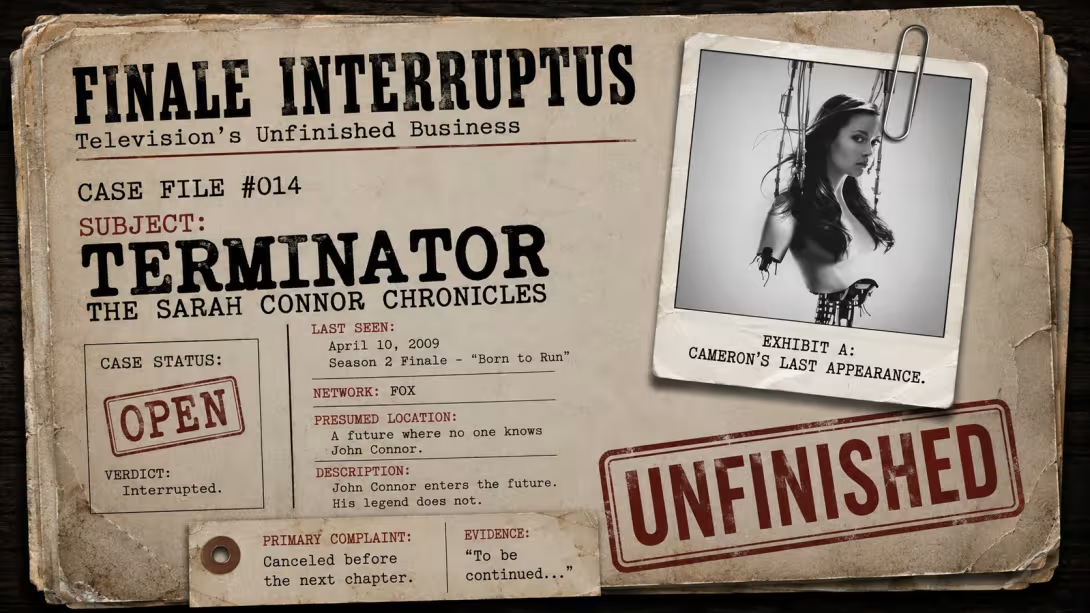
Finale Interruptus: Case File #014 - Terminator: The Sarah Connor Chronicles
Every television series begins with a promise. Give us your time. Your attention. Your imagination. In return, we’ll tell you a story. And when it ends, we’ll bring it to its proper conclusion.
Most do.
Some don’t.
Some endings are still missing.
These are their case files.
The Future That Was Supposed to Happen
In 1984, a waitress named Sarah Connor learned that the future was coming to kill her. By 1991, she had become a hardened warrior determined to prevent that future from happening. And in 2008, television audiences discovered that surviving two encounters with murderous machines from tomorrow didn't necessarily mean Sarah Connor had accomplished anything.
Terminator: The Sarah Connor Chronicles premiered on FOX on January 13, 2008, with an ambitious proposition: the story James Cameron had begun in The Terminator and seemingly concluded in Terminator 2: Judgment Day wasn't finished. The machines were still coming, the apocalypse was still approaching, and humanity's supposed savior was still a teenage boy who had spent most of his life running from a destiny he never asked to inherit.
The series wasn't simply another attempt to exploit a recognizable movie franchise. Creator Josh Friedman approached the material by returning to the emotional center of Cameron's original films. Beneath the time travel, artificial intelligence, and increasingly elaborate machinery was the story of a mother trying to keep her son alive long enough to become the man history required him to be.
There was just one problem with that mission. Every time Sarah Connor succeeded in changing the future, she also changed the circumstances that supposedly made John Connor indispensable.
Judgment Day Has Been Postponed
The series begins in 1999, several years after Sarah, John, and the reprogrammed T-800 destroyed Cyberdyne Systems' research in Terminator 2. The August 29, 1997, Judgment Day predicted in that film has come and gone without a nuclear apocalypse. Sarah and John have reason to believe their actions made a difference, even if neither can bring themselves to believe the danger has disappeared.
Their reprieve proves temporary. A Terminator infiltrates John's school, forcing the Connors to flee once again. Their rescuer is Cameron Phillips, a seemingly teenage girl who reveals herself to be another machine sent from the future, this time to protect John rather than eliminate him.
Played by Summer Glau, Cameron becomes one of the series' most intriguing characters. Unlike Arnold Schwarzenegger's imposing protector in Terminator 2, she can pass convincingly as an ordinary high school student. Her apparent humanity makes her an effective infiltrator, but it also raises questions about how much of her behavior is programming and how much might represent something approaching independent thought.
Cameron leads Sarah and John to a time-displacement device concealed in a bank vault. Rather than continue running through the final years of the twentieth century, they jump forward to 2007, arriving in a world where their presumed deaths have become part of the public record.
The maneuver serves two purposes. It moves the characters into the contemporary setting of the television series, but it also demonstrates that the future remains dangerously flexible. Judgment Day has not been prevented so much as postponed, and the machines have continued adjusting their plans.
The war between humanity and Skynet is no longer a single catastrophic event waiting to happen. It is a conflict already being fought across time, with both sides attempting to alter the conditions under which the final battle will occur.
A Mother, a Son, and a Machine
Lena Headey inherited the role of Sarah Connor from Linda Hamilton, an assignment that required more than imitating the physical intensity of Terminator 2. Hamilton's Sarah had become a soldier through trauma and necessity, but the television series had room to explore what that transformation had cost her.
Sarah could recognize threats almost instinctively, improvise weapons, and disappear whenever circumstances demanded it. Ordinary life, however, had become nearly impossible. Every friendship represented a potential vulnerability, every home was temporary, and every attempt to give John something resembling a normal childhood was compromised by the knowledge that someone—or something—might arrive to kill him.
Thomas Dekker's John Connor was equally burdened by the future. He knew he was supposed to become the leader of humanity's resistance against Skynet, but knowing the outcome of a war did not automatically provide the judgment, courage, or experience necessary to fight it.
The films had largely treated the adult John Connor as a figure of legend, someone whose importance could be established through the desperate measures his enemies took to prevent his existence. Television offered the opportunity to examine the uncertain teenager who would have to grow into that legend.
John's relationship with Cameron complicated matters further. She was his bodyguard, his connection to the future, and a constant reminder that the machines hunting him were becoming increasingly difficult to distinguish from human beings. As their relationship developed, the series repeatedly tested the boundary between John's emotional attachment to Cameron and his understanding of what she actually was.
Sarah, meanwhile, had to confront an uncomfortable possibility. Protecting John from every danger might also prevent him from becoming the leader he was destined to be.
That tension gave the series a foundation considerably stronger than its weekly encounters with Terminators. Sarah's immediate objective was keeping her son alive. Humanity's long-term survival might require her to let him take risks she could barely tolerate.
The Future Keeps Sending Visitors
The arrival of Derek Reese, played by Brian Austin Green, expanded the series beyond the Connor family's immediate struggle. Derek was a resistance fighter from the future and the older brother of Kyle Reese, the soldier who had traveled back to 1984 and become John's father.
His presence connected the television series directly to the mythology of the original film while offering something that the movies had only briefly explored: the perspective of ordinary soldiers who had actually lived through the war against the machines.
Derek knew the future as a place of hunger, imprisonment, violence, and constant suspicion. He also understood that machines capable of imitating human beings could make trust itself a dangerous proposition.
As the series progressed, the conflict grew increasingly complicated. Skynet's development involved more than a single corporation or one inevitable technological breakthrough. Artificial intelligence research continued along multiple paths, and the Connors discovered that preventing one disaster did not necessarily eliminate the conditions that could produce another.
The introduction of Catherine Weaver, portrayed by Shirley Manson, brought another liquid-metal Terminator into the story. Her involvement with the technology company ZeiraCorp initially suggested yet another attempt to bring Skynet into existence. The truth would prove considerably more complicated, particularly as her work with the artificial intelligence known as John Henry developed.
The series was gradually moving away from a simple confrontation between humanity and an undifferentiated army of machines. Different artificial intelligences could have different objectives, and the future might not be divided as neatly as Sarah Connor had always believed. That development would become essential to understanding the final episode.
The Problem With Knowing the Future
Time travel had always presented the Terminator franchise with a paradox. If the future could be changed, then the events that sent soldiers and machines into the past might never occur. Yet those visitors had already influenced history, sometimes in ways that appeared necessary to create the future they came from.
John Connor himself embodied the contradiction. His father traveled backward through time because John sent him, but John could not have existed without that journey. The machines' attempts to eliminate their enemy repeatedly helped shape the circumstances surrounding his existence.
The Sarah Connor Chronicles embraced these complications rather than treating them as inconveniences to be ignored. Characters arrived from futures that might no longer exist. Their knowledge could be useful, misleading, or obsolete. Even the identities and loyalties of people encountered in one timeline could change when events in the past were altered. This uncertainty created an increasingly troubling question about John Connor's destiny.
The Resistance regarded him as the man who would lead humanity to victory, but his legend might have arisen from a particular sequence of events rather than an inevitable personal destiny. Changing those events could also change the person John would become.
For two seasons, the series explored the consequences of trying to protect a future that its characters were simultaneously attempting to prevent. Sarah wanted to save humanity from Judgment Day, but doing so might erase the circumstances that gave her son his purpose. John wanted to become more than a frightened teenager, but the knowledge of his supposed destiny made it difficult to determine which decisions were truly his own.
By the end of the second season, these questions were no longer philosophical background to the action. They had become the foundation of the story itself.
The writers were preparing to place John Connor in circumstances that would challenge everything he believed about his importance to the future. For the first time, the boy who had spent his life being hunted because everyone knew his name would enter a world where that name meant nothing. It was a remarkable direction for a television series built around one of science fiction's most recognizable destinies. Unfortunately, getting John Connor to that future required something the series was rapidly running out of. Time.
The War Against the Ratings
On January 13, 2008, FOX premiered Terminator: The Sarah Connor Chronicles to an audience of approximately 18.4 million viewers. For a network launching an expensive science-fiction drama based on a major motion-picture franchise, the numbers suggested that the gamble had paid off. The premiere was a ratings success, and the Terminator name still possessed enough recognition to attract an audience considerably larger than most new television dramas could expect. Sixteen months later, the series was canceled.
Between those two events lay a writers' strike, an interrupted first season, a change in scheduling, an increasingly complicated mythology, and a network attempting to determine whether the audience that remained could justify the expense of keeping the machines operational.
The simplest explanation for the cancellation is that viewers stopped watching. That is true as far as it goes, but it leaves out the circumstances under which those viewers were expected to follow the series.
Eighteen Million Reasons to Believe
The premiere benefited from an unusually favorable position on FOX's schedule. It aired on Sunday, January 13, immediately following an NFL playoff game, giving the network an opportunity to introduce the series to an audience that extended well beyond established Terminator fans.
The following evening, the second episode aired in the show's regular Monday time slot, drawing approximately 10 million viewers. That was a substantial decline from the premiere, but the comparison requires some perspective. The first episode had enjoyed the promotional advantage of a major sporting event, while the second had to compete under more ordinary television conditions.
A program capable of attracting roughly 10 million viewers on its second night was hardly an immediate failure. The more significant question was whether the series could retain enough of that audience to support the considerable production costs associated with its premise.
Unlike a conventional police procedural or family drama, The Sarah Connor Chronicles required elaborate action sequences, specialized effects, stunt work, and the convincing presentation of futuristic machines. Even episodes built around character development needed to sustain the visual credibility of a world in which Terminators could appear without warning.
The show's recognizable franchise identity helped attract attention, but it also created expectations. Audiences familiar with James Cameron's films anticipated a certain level of spectacle, and delivering that spectacle on a weekly television budget was never going to be inexpensive.
Nevertheless, the initial response gave FOX reason to be optimistic. The network had successfully introduced a new chapter of an established franchise, and its principal characters had been positioned to sustain an ongoing story. Then the production calendar collided with a labor dispute that affected nearly every scripted series on American television.
Judgment Day Meets the Writers' Strike
The Writers Guild of America strike began on November 5, 2007, more than two months before The Sarah Connor Chronicles premiered. Production on the show's first season had already been affected by the time audiences encountered Sarah, John, and Cameron. The original order called for thirteen episodes. Only nine were completed.
That distinction matters because the series was conceived as an ongoing narrative rather than a collection of interchangeable adventures. Its characters were investigating the origins of Skynet, encountering people from competing versions of the future, and gradually discovering that the war against the machines involved more factions and uncertainties than they had imagined.
Reducing the season by four episodes did not simply mean eliminating several opportunities for Terminator battles. It shortened the time available to develop relationships, establish mysteries, and bring the first chapter of the story toward its intended destination.
The ninth episode, “What He Beheld,” aired on March 3, 2008, and became the season finale by necessity. Its ending left several developments unresolved, including a violent attack on the Connors' home and the uncertain fate of Cameron.
For audiences already invested in the series, the cliffhanger offered a reason to return. For viewers still deciding whether to make a weekly commitment, the abbreviated season provided less time to establish that commitment.
The strike was not something FOX had created, nor was The Sarah Connor Chronicles uniquely disadvantaged by it. Numerous television productions were interrupted, and networks were forced to improvise schedules under circumstances beyond their control.
But a new serialized drama is especially vulnerable to interruption. It must establish its identity, build an audience, and convince viewers that the investment of following its continuing story will eventually be rewarded. The Sarah Connor Chronicles had barely begun that process before its first season ended.
A Second Chance, and a Longer War
FOX renewed the series for a second season, ordering twenty-two episodes. The decision demonstrated that the network still considered the property worth pursuing, despite the uncertainty surrounding its initial run.
Season Two premiered on September 8, 2008, with “Samson and Delilah,” returning to the consequences of the previous season's cliffhanger. The series continued in its Monday evening position, where it faced the ordinary challenges of network competition while attempting to rebuild momentum after a six-month absence.
The expanded episode order gave the writers considerably more room to develop the mythology. Derek Reese became increasingly important to the Connor family, Cameron's behavior raised new questions about the nature of artificial intelligence, and the introduction of Catherine Weaver broadened the story beyond the familiar conflict between humans and Skynet. The narrative also became more demanding.
A viewer who had missed several episodes could find it difficult to understand the relationships among characters from different timelines, the significance of apparently minor technological discoveries, or the competing objectives of the machines operating in the present.
That complexity was one of the show's creative strengths. It was also a challenge for a broadcast network whose business depended on attracting viewers who might not have followed every installment.
By the end of 2008, the series had developed a committed audience, but its ratings were considerably smaller than those of its premiere. The question facing FOX was no longer whether the Terminator franchise could generate an impressive launch. It was whether the remaining audience justified another season of an expensive drama. The network's next scheduling decision would make that question even more difficult to answer.
The Friday-Night Problem
In February 2009, FOX moved The Sarah Connor Chronicles from Monday evenings to Fridays at 8 p.m., pairing it with Joss Whedon's new science-fiction drama Dollhouse.
The pairing made a certain promotional sense. Both programs appealed to viewers interested in speculative fiction, complicated mythology, and stories involving artificial intelligence. A dedicated science-fiction audience might reasonably be expected to watch one series and remain for the other.
Unfortunately, Friday night had long been a difficult destination for scripted network television. The available audience was generally smaller, and younger viewers—the demographic advertisers often valued most highly—were less likely to spend the beginning of their weekend watching television at home.
The move therefore presented a contradiction. FOX was attempting to create a recognizable science-fiction programming block while placing both programs in a time slot where attracting a large audience would be particularly challenging.
For The Sarah Connor Chronicles, the consequences were immediate. Its ratings continued to decline, with the final episodes drawing audiences far below those of the first season. The series finale, “Born to Run,” aired on April 10, 2009, before approximately 3.6 million viewers.
That number represented a dramatic fall from the 18.4 million who had watched the premiere. It was also considerably below the audience that had followed the program during its original Monday run.
It would be tempting to describe the Friday move as the decision that killed the series, but the evidence does not support such a simple verdict. Ratings had already declined before the scheduling change, and FOX had legitimate reasons to question the show's long-term financial prospects. What the move unquestionably did was place a struggling program in a position where reversing its decline became even harder.
The network had given The Sarah Connor Chronicles a second season, but its final scheduling arrangement offered little opportunity for the series to demonstrate renewed mainstream appeal.
The Price of Preventing Judgment Day
The financial calculation was particularly unforgiving because The Sarah Connor Chronicles was not an inexpensive production. Science-fiction television has often faced a problem that conventional dramas can avoid. A successful episode must deliver both the human story and the specialized visual world in which that story takes place. For a series featuring time travel, artificial intelligence, futuristic weaponry, and mechanical assassins, those demands can become substantial.
A smaller audience does not necessarily make a program unprofitable. Production costs, advertising revenue, international distribution, home-video sales, and ownership arrangements all influence the economics of television. But a network must still decide whether continuing an established series represents a better investment than developing a replacement.
By spring 2009, FOX was preparing its next programming schedule while The Sarah Connor Chronicles was approaching the end of its second season. The network had also committed to Dollhouse, another genre program whose ratings were hardly spectacular.
The decision was not simply a matter of choosing which fictional universe deserved to survive. It was a calculation involving costs, audience demographics, contractual arrangements, and the perceived potential of future programming. On May 18, 2009, FOX confirmed that Terminator: The Sarah Connor Chronicles would not return for a third season. The announcement ended the television series after thirty-one episodes.
For viewers who had followed Sarah and John's increasingly desperate attempts to prevent Judgment Day, the cancellation was especially frustrating because the writers had not been allowed to finish the story they were telling. The second season had concluded with a major transformation of the series' premise, introducing a future in which John Connor's importance was no longer assured. The audience had been invited to follow that transformation. FOX would not finance the journey. FOX's Share of the Responsibility The cancellation of The Sarah Connor Chronicles inevitably became part of a familiar argument about FOX and science-fiction television.
The network had previously canceled Firefly, another ambitious genre series whose devoted audience believed that scheduling decisions and insufficient institutional support had contributed to its premature ending. For some viewers, the fate of The Sarah Connor Chronicles seemed to confirm a pattern.
There were similarities, particularly the frustration of watching a serialized science-fiction program disappear before its larger narrative could be completed. But the circumstances were not identical.
Firefly suffered from a notoriously mishandled original broadcast schedule, including episodes aired out of their intended order. The Sarah Connor Chronicles received a prominent launch, a second-season renewal, and thirty-one produced episodes. FOX had invested significantly more time in determining whether the series could become a sustainable success.
The network also had a legitimate business problem. A program that premiered before more than eighteen million viewers and finished before fewer than four million had experienced an unmistakable decline in its audience. The ratings decline was real, although its extent was shaped by circumstances beyond the program's content.
The writers' strike interrupted the first season before the series had fully established itself. The extended break between seasons required viewers to renew their commitment. The increasingly serialized mythology rewarded close attention but made casual viewing more difficult. Finally, the Friday-night move placed the program in a time slot with limited potential for audience growth.
None of those circumstances independently proves that FOX caused the cancellation. Together, however, they demonstrate why the ratings cannot be understood without examining how the series reached its final night. The machines did not defeat Sarah Connor. Neither did the Resistance lose its war against Skynet.
The television series lost a battle against the economics of broadcast programming, and its final episode arrived with no guarantee that another would follow.
That uncertainty shaped the decisions made by creator Josh Friedman and his writers. Knowing that renewal was far from assured, they constructed a finale that would bring one phase of the story to a conclusion while opening possibilities that could sustain an entirely different third season. The result was not the conventional cliffhanger of a hero trapped in immediate danger. It was something more unsettling.
After two seasons spent protecting the boy who was supposed to save humanity, the series ended by sending John Connor into a future where humanity apparently had no idea who he was.
Born to Run
By the time Terminator: The Sarah Connor Chronicles reached its thirty-first episode, the writers had spent two seasons complicating nearly everything audiences thought they understood about the war between humanity and the machines. Skynet's creation no longer appeared to depend upon a single scientist or corporation. Terminators were not necessarily united in their objectives, and the people arriving from the future carried knowledge that could become unreliable whenever the past changed. Through these changing timelines, John Connor appeared to be the one constant.
Whatever else might happen, John was supposed to survive, grow into a military leader, and organize humanity's resistance against Skynet. The machines wanted him dead precisely because they understood the importance of his future accomplishments. Sarah Connor's entire adult life had been devoted to ensuring that those accomplishments remained possible. The second-season finale, “Born to Run,” broadcast on April 10, 2009, challenged that assumption more directly than anything the franchise had attempted before.
Written by series creator Josh Friedman and directed by Jeffrey Hunt, the episode brought together several storylines that had developed throughout the season. The pursuit of John Connor, the mysterious activities of Catherine Weaver, the emergence of the artificial intelligence known as John Henry, and Cameron's increasingly complicated relationship with her own programming all converged around a confrontation that would fundamentally alter the series.
Yet the episode's most consequential development was not another battle against an unstoppable machine. It was a decision to send John Connor into the future, where the war he had been preparing to fight was already underway.
A Prisoner of His Own Destiny
The episode begins with Sarah Connor in federal custody following her arrest. Her attempts to uncover and disrupt the technological foundations of Skynet have attracted the attention of authorities who see a dangerous fugitive rather than a woman attempting to prevent the destruction of civilization.
FBI Agent James Ellison, who has spent much of the series trying to reconcile the impossible things he has witnessed with his responsibilities as a law-enforcement officer, remains involved in the unfolding events. His association with Catherine Weaver has brought him closer to the machinery behind the apparent conspiracy, although he still does not fully understand the nature of the forces surrounding him.
John and Cameron remain free, but Sarah's imprisonment places the Connor family in an unfamiliar position. For much of the series, Sarah has been the person making the difficult decisions, often concealing information from John because she believes that protecting him requires controlling what he knows. Now John must act without her immediate guidance.
That development reflects one of the central tensions running through the second season. John is approaching adulthood, but the people surrounding him continue to treat his survival as more important than his independence. His future importance has become a justification for denying him the freedom to determine his own course.
The situation is particularly complicated by Cameron, whose protection of John depends upon programming that has already demonstrated troubling inconsistencies. She is capable of extraordinary loyalty and equally extraordinary violence, and the distinction between those qualities is not always reassuring.
John trusts her in ways Sarah never entirely can. Their relationship has developed beyond the practical arrangement of a human being protected by a machine, even though neither character can easily define what that relationship has become. By the finale, the possibility of losing Cameron carries emotional consequences for John that go far beyond losing a bodyguard.
Catherine Weaver's Other War
Catherine Weaver has been one of the second season's most unsettling figures. Introduced as the head of ZeiraCorp, she appears to be a powerful businesswoman pursuing advanced artificial intelligence research. Her secret identity as a liquid-metal Terminator initially suggests that the company is another mechanism through which Skynet intends to bring about its own creation. The truth is considerably more complicated.
Weaver has been developing John Henry, an artificial intelligence housed in a sophisticated computer system and supervised by Ellison. John Henry's education has involved questions of morality, human behavior, and the difference between possessing information and understanding the consequences of acting upon it.
Unlike the familiar machines sent to assassinate John Connor, Weaver does not appear interested in destroying humanity. Her actions suggest that she is preparing for a conflict involving artificial intelligences whose objectives are not necessarily identical. This distinction becomes crucial when Weaver finally reveals her true nature to the Connors.
During the confrontation at ZeiraCorp, an aerial attack sends an explosive device toward the building. Weaver transforms her liquid-metal body into a protective shield, saving those around her rather than allowing them to die.
For Sarah and John, the sight is almost impossible to reconcile with their experience. They have spent years encountering machines whose primary purpose was murder, yet here is a Terminator apparently protecting human lives. Weaver explains that she has been working against Skynet and that John Henry is central to her plans.
The revelation introduces a possibility that Sarah Connor's worldview has never comfortably accommodated: humanity might not be able to defeat Skynet without assistance from another artificial intelligence.
The war is no longer simply humanity against the machines. It may be a struggle among competing forms of intelligence, with human survival depending upon which side ultimately prevails.
The Disappearance of John Henry
John Henry's development has been one of the season's most unusual storylines. Rather than presenting artificial intelligence as an immediately hostile force, the series depicts a machine learning to understand concepts that human beings often struggle to explain.
Ellison's role in that education has been particularly important. His religious beliefs and moral convictions provide a framework through which John Henry begins examining questions of right and wrong. By the finale, however, John Henry is no longer where Weaver expects him to be.
The artificial intelligence has disappeared from its computer system, and the circumstances of that disappearance reveal Cameron's involvement. Her body is discovered sitting motionless, its central processing chip removed. The image is devastating for John Connor.
Cameron has survived attacks, fought other Terminators, and repeatedly demonstrated abilities far beyond those of the humans around her. Yet here she sits, apparently lifeless, her body intact but the component that makes her Cameron missing. The discovery also raises questions that the episode does not fully answer.
Cameron has left behind a message indicating that she is sorry. The implication is that her chip has been given to John Henry, enabling him to depart through a time-displacement device. But the exact nature of that transfer, the degree to which Cameron understood its consequences, and whether her consciousness could survive the journey remain unresolved. For John, the distinction between a destroyed machine and a lost person has become increasingly difficult to maintain.
He cannot simply abandon Cameron and accept that her disappearance is an acceptable cost of the larger war. His attachment to her has become part of his identity, and the possibility that something of her may still exist gives him a reason to follow John Henry. It is a decision that will change his future more dramatically than he understands.
The Choice Sarah Cannot Make for Him
Weaver's time-displacement equipment offers John an opportunity to travel forward and pursue John Henry. It also presents Sarah with a choice that strikes at the foundation of her character.
For years, she has organized her existence around keeping John alive. Every relocation, every deception, and every act of violence has been justified by the belief that her son must survive long enough to lead humanity. Now John is preparing to enter the very future she has spent her life trying to prevent. Sarah does not accompany him.
Her decision to remain in the present also takes place against the fear of an illness that has haunted her throughout the series. Sarah knows that an earlier account of her future included death from cancer, although the television series follows a different continuity and does not establish that she has the disease. Her fear of mortality reinforces the knowledge that she cannot protect John indefinitely. The separation also marks a decisive change in their relationship.
John is no longer simply the child Sarah must carry from one hiding place to another. He is making a choice that she cannot make for him, even though allowing him to proceed means surrendering the immediate control she has exercised over his safety.
Sarah remains behind with the unresolved struggle to prevent Skynet's emergence in the present. John travels forward with Weaver, pursuing the missing artificial intelligence and the possibility of recovering Cameron. For the first time, mother and son are separated not merely by distance but by time.
The series has effectively divided its central mission into two different conflicts. Sarah will continue fighting to change the future before it happens, while John must confront the consequences of a future that has already arrived. Whether either effort can succeed without the other is a question the series will never answer.
The Future Without John Connor
John emerges from the time-displacement field into a devastated future, a world that resembles the nightmare glimpsed throughout the Terminator films. The war against the machines is real, and humanity is struggling to survive amid the ruins of civilization. But something is wrong.
John encounters Derek Reese, the resistance fighter who had become an important member of the Connor family before being killed earlier in the second season. Here, Derek is alive, existing at a point in his personal history before the journey that brought him into Sarah and John's lives.
The encounter is emotionally disorienting. John remembers a man who died protecting him, but the Derek standing before him has no knowledge of their shared experiences. Then John sees Kyle Reese.
For audiences familiar with the original Terminator, Kyle's appearance carries enormous significance. He is the soldier who traveled backward through time to protect Sarah Connor, fell in love with her, and became John's father. His death in 1984 was one of the defining events of Sarah's life.
John has grown up knowing his father primarily through stories and the consequences of a sacrifice made before he was born. Now Kyle stands before him, alive and unaware of their relationship.
The emotional possibilities are considerable, but the episode does not allow John the comfort of a reunion. He is a stranger to these men, and nothing in their behavior suggests that they recognize him as the future leader of the Resistance. The final revelation is even more startling.
John encounters Allison Young, the human resistance fighter whose appearance Cameron was modeled upon. Played by Summer Glau, Allison looks like the machine John has come to love and trust, but she is unmistakably human.
John has reached the future he was destined to shape, only to discover that the people living in it do not know who he is. The name John Connor carries no apparent significance.
The Man Who Wasn't There
The final moments of “Born to Run” create a paradox more consequential than the franchise's familiar questions about whether Judgment Day can be prevented.
If John Connor has traveled into the future before becoming the leader of the Resistance, then the events that would have established his reputation may never have occurred. The machines may still be fighting humanity, but the war has unfolded without the legendary commander whose existence supposedly determined its outcome.
John has spent his entire life being protected because of what he is destined to become. In this future, that destiny has apparently been erased.
The implications extend beyond the immediate question of whether John can survive. If the Resistance has developed without him, then humanity's struggle may not depend upon the singular figure that both Sarah and Skynet have treated as indispensable.
Perhaps someone else has assumed the leadership role John was supposed to occupy. Perhaps the absence of his influence has changed the war in ways that are not yet apparent. Or perhaps John must now become the leader history remembers through an entirely different sequence of events. The episode provides no definitive answer. Instead, it leaves John standing at the beginning of a story that audiences have been told was already written.
The irony is extraordinary. For two seasons, Sarah Connor has fought to keep her son alive so that he can fulfill his destiny. In the final episode, John survives by stepping outside the circumstances that created that destiny in the first place. The boy who was supposed to save humanity has arrived in a world that apparently never needed him. For a series built around the inevitability of John Connor's importance, it is an audacious reversal. It is also where the story ends.
FOX's cancellation meant that viewers would never see how John navigated this unfamiliar future, whether he could recover Cameron, what John Henry intended to accomplish, or how Sarah's continuing struggle in the past might affect the world her son had entered.
The episode closes with an opening rather than a resolution. Its central characters have reached the threshold of an entirely new conflict, and the audience is left outside the door.
What makes the interruption especially frustrating is that the writers were not improvising blindly. They had ideas about what would happen next, including the significance of Allison Young, the role of Kyle and Derek Reese, and the future of Sarah Connor herself. Those plans would emerge only after the series was gone.
The John Connor Nobody Knows
For twenty-five years, the Terminator franchise had operated around a central assumption: John Connor was the man who would save humanity. The machines traveled backward through time to prevent his birth, eliminate him as a child, or destroy the people responsible for ensuring his survival. Sarah Connor sacrificed any possibility of an ordinary life because she believed that her son's existence represented humanity's best chance against Skynet. Then, in the final minutes of Terminator: The Sarah Connor Chronicles, John arrived in the future and discovered that nobody knew his name.
The revelation was more than an effective cliffhanger. It challenged the foundation of the franchise by suggesting that John Connor's destiny was not necessarily an unavoidable fact of history. The circumstances that would make him a legendary military commander might be as vulnerable to alteration as the date of Judgment Day itself.
That possibility transformed the familiar Terminator paradox into something considerably more personal. John had spent his entire life being told who he would become. Now he was standing in a world where he would have to discover who he actually was.
A Legend Without a History
The original Terminator established John Connor's importance through the testimony of Kyle Reese. In the future Kyle remembered, John had organized the human Resistance and led it toward victory against Skynet. His leadership was sufficiently threatening that the machines attempted to eliminate him before he could be born.
That knowledge shaped everything Sarah Connor did afterward. She understood that John had to survive because Kyle had already witnessed the consequences of his survival.
But The Sarah Connor Chronicles introduced a complication that neither Sarah nor John could comfortably ignore. If time travel could change the future, then Kyle's memories described a particular sequence of events rather than an outcome guaranteed to occur.
Every attempt to postpone Judgment Day changed the circumstances under which John might eventually become a leader. Every Terminator destroyed, every scientist confronted, and every technological breakthrough prevented created the possibility that the future would develop differently.
The series had already demonstrated that knowledge carried backward through time could become unreliable. Characters remembered events that other characters had never experienced, and people who had died in one version of history could remain alive in another. John's arrival in the future brought that uncertainty directly to the question of his own identity.
The Resistance was fighting Skynet, but its members apparently had no knowledge of the commander who was supposed to lead them. John had not merely arrived before his reputation was established. His absence from the intervening years meant that the experiences through which he might have earned that reputation had not occurred. At least, they had not occurred in the way Sarah and John expected.
The distinction is important because the finale does not establish that John Connor is incapable of becoming the leader humanity needs. It establishes that the future he has entered does not recognize him as that leader. His destiny has become a possibility rather than a certainty.
Meeting the Father Who Died Before You Were Born
The appearance of Kyle Reese gives the altered future an emotional dimension that no amount of discussion about timelines could provide. Kyle was the soldier John Connor sent into the past to protect Sarah in 1984. His relationship with Sarah resulted in John's conception, making the future leader of humanity the product of a journey that John himself was responsible for initiating. It was the franchise's defining paradox. John existed because Kyle traveled backward through time, but Kyle made that journey because John existed.
Sarah knew Kyle only briefly, yet his death became one of the formative events of her life. John grew up knowing his father through Sarah's memories, photographs, and the knowledge that Kyle had sacrificed himself to protect a family he would never live to see. In the future depicted at the end of “Born to Run,” Kyle is alive.
For John, the encounter presents an extraordinary opportunity. He can see his father as a living human being rather than a figure reconstructed from stories. Kyle is no longer merely the soldier whose actions made John's existence possible. He is a young man fighting a war, unaware that someone standing nearby knows the most intimate details of his future. The opportunity also carries considerable danger.
If John reveals their relationship, he risks influencing Kyle's decisions and potentially changing the events that lead to his own birth. If he conceals it, he must live alongside a father who has no reason to recognize him.
The episode does not explore those possibilities because it ends almost immediately after establishing them. But the situation offers something the films could never fully develop: a relationship between John Connor and Kyle Reese in which John possesses knowledge of their connection that Kyle does not share. It also reverses their familiar roles.
In the original film, Kyle arrives from the future knowing that Sarah is essential to humanity's survival. He becomes her protector because of information she does not yet possess.
Now John arrives in the future knowing that Kyle is essential to his own existence. The son understands the father's significance before the father understands the son.
Whether John could preserve the events that created him while building a relationship with Kyle would have been one of the most compelling questions for a third season.
Derek Reese Gets Another Chance
The return of Derek Reese is equally significant, although for different reasons. Derek had become one of the most important supporting characters in The Sarah Connor Chronicles. As Kyle's older brother and a veteran of the future war, he brought an experienced soldier's perspective to the Connor family's struggle.
Unlike John, Derek had actually lived through the conditions that Sarah was attempting to prevent. His knowledge of Skynet's brutality was firsthand, and his suspicion of machines extended even to Cameron, whose role as John's protector never entirely overcame Derek's distrust.
During the second season, Derek was killed abruptly in “Adam Raised a Cain,” shot by a Terminator during a confrontation that offered none of the elaborate ceremony usually associated with the death of a major television character.
His death was shocking precisely because it was so sudden. The series had repeatedly demonstrated that anyone could be killed, but Derek's importance to the mythology made his removal especially unsettling. The finale then returned him to the screen.
The Derek John encounters in the future has not experienced the events that brought his earlier counterpart into Sarah's life. He does not remember fighting alongside the Connors, developing relationships in the past, or dying while attempting to protect them. For John, however, those experiences remain real.
He remembers a man who became part of his family, helped prepare him for the future, and ultimately died while the Connors fought to keep Savannah Weaver out of the machines’ hands.
The new Derek offers the possibility of recovering something John has lost, but it also forces him to confront the difference between a person and the memories associated with that person. This Derek is alive, but he is not the Derek John knew.
The distinction reinforces one of the series' recurring themes. Time travel may permit encounters with people who have died, but it does not necessarily restore the relationships that death has destroyed. John has reached a future populated by familiar faces, yet he is surrounded by strangers.
The Woman Behind Cameron's Face
If Kyle Reese represents John's origins and Derek Reese represents his losses, Allison Young represents a question about the future that the series had only begun to explore.
Allison was introduced earlier in the second season through “Allison from Palmdale,” an episode that examined Cameron's damaged memory and revealed that her physical appearance had been modeled upon a human resistance fighter.
Played by Summer Glau, Allison was not simply another person who happened to resemble Cameron. Her existence provided a disturbing explanation for the Terminator's ability to infiltrate human society. Cameron's appearance was not arbitrary. It had belonged to a real person whose identity and experiences could be exploited by the machines.
That revelation complicated John's growing emotional attachment to Cameron. He had developed feelings for a machine whose face, voice, and mannerisms were connected to someone who had lived an entirely separate human life. By the time John encounters Allison in the finale, Cameron has disappeared after surrendering her chip in connection with John Henry's departure.
John is therefore confronted with a woman who looks exactly like someone he has lost, but who has none of the memories that made Cameron important to him. The emotional possibilities are considerable.
John might be tempted to see Allison as a replacement for Cameron, but such an assumption would deny Allison her own identity. She is a human being with experiences, loyalties, and relationships independent of the machine constructed in her image.
The situation also complicates Cameron's identity. Her programming may have incorporated aspects of Allison's personality, while her experiences with the Connors may have produced characteristics independent of her human model.
If Cameron's chip survived the journey with John Henry, John might eventually have faced a choice between recovering Cameron and building a relationship with Allison. The finale leaves those questions unanswered, but it establishes the circumstances necessary to explore them.
For a franchise frequently concerned with whether machines can imitate humanity, the encounter between John and Allison offered an opportunity to examine a more difficult distinction: whether an artificial being could become someone whose identity was genuinely its own.
A Resistance That Doesn't Need Its Savior
The most consequential aspect of the finale may be what it implies about humanity's ability to resist Skynet without John Connor. Throughout the franchise, John's importance has often been treated as an established historical fact. Skynet attempts to eliminate him because his leadership will threaten its survival. Sarah protects him because she believes humanity's future depends upon his existence. Yet the future John enters already contains an organized human Resistance.
People are fighting the machines. They have established relationships, military structures, and strategies for survival. Kyle and Derek Reese are involved in that struggle, and Allison Young is part of the world John has entered. The war has continued without the man supposedly destined to lead it.
That does not prove that humanity will win without John. The Resistance might be losing, and John's arrival could eventually become the event that changes its fortunes. The series provides too little information about this altered future to establish whether humanity's prospects have improved or deteriorated. But the existence of the Resistance creates a challenge to the mythology.
Perhaps John Connor was never the only person capable of leading humanity. Perhaps his importance resulted from the circumstances of a particular timeline, rather than some unique quality that made his leadership inevitable.
Alternatively, the future John enters might represent the beginning of the very sequence of events that eventually establishes his legend. His disappearance from the past could be necessary for him to acquire the experiences that transform him into the commander Kyle Reese once described. The finale does not choose between those interpretations. What it does is remove the certainty that has governed John's life.
He can no longer assume that his name will command respect or that his future accomplishments have already been established. He must earn the trust of people who have no reason to believe he is important. For the first time, John Connor has an opportunity to become a leader without relying upon the authority of his own legend.
The Future Sarah Cannot See
John's arrival in the future also changes the meaning of Sarah Connor's decision to remain in the past. For two seasons, Sarah has attempted to prevent the emergence of Skynet while preparing John to survive the war if she fails. Her efforts have been guided by information about a future that she knows may be altered by her own actions. Now John has disappeared into that future, leaving Sarah to continue the struggle without knowing what he will encounter. The separation creates a narrative structure that could have sustained an entirely new phase of the series.
Sarah's actions in the present might alter the conditions John experiences in the future. A scientist she prevents from completing a project could change the machines John encounters. A technological breakthrough she fails to stop could strengthen Skynet decades later. But the relationship would not necessarily work in only one direction.
John's experiences in the future might reveal information about Skynet's origins that could eventually be transmitted backward through time. The conflict could become a struggle between two generations of the same family, separated by decades but fighting different stages of the same war.
There is no guarantee that the writers intended to develop every one of those possibilities. The finale establishes the separation, but it does not provide a complete blueprint for the unproduced season. Nevertheless, the dramatic potential is unmistakable. Sarah Connor remains the woman attempting to prevent Judgment Day. John Connor becomes the man trying to survive its aftermath. For the first time, the series could explore both sides of the apocalypse through the experiences of its central characters.
The Destiny That Has to Be Earned
The final episode of The Sarah Connor Chronicles does something that the franchise's repeated attempts to prevent Judgment Day rarely accomplished. It makes the future genuinely uncertain.
The films frequently changed the date of the apocalypse or introduced new versions of the machines, but John Connor's significance remained largely intact. Whatever else changed, he was still the figure around whom humanity's resistance revolved. “Born to Run” removes that assurance.
John arrives in a future where his father is alive, his uncle does not remember him, and the woman who resembles Cameron has never met him. The Resistance exists, but its members have no reason to recognize the young man who has spent his life preparing to command them. Everything familiar has been rearranged.
The situation offers John something he has rarely possessed: the opportunity to define himself through his actions rather than through the expectations of people who claim to know his future. It also creates the possibility of failure.
If John Connor's destiny is not guaranteed, then he might never become the leader humanity needs. He might make decisions that prevent his own rise, lose the trust of potential allies, or discover that the war has developed in ways his training never anticipated. For a character whose survival had often been protected by the presumed importance of his future accomplishments, that uncertainty represents a fundamental change. The legendary John Connor has disappeared. What remains is a young man who must decide whether he can become someone worth following.
It was an extraordinary premise for a third season, particularly because the series had already established the characters, relationships, and mythology necessary to explore it.
And unlike many canceled television shows whose writers never publicly discussed what might have happened next, The Sarah Connor Chronicles left behind testimony from people who knew at least some of the answers. The future was never filmed, but parts of it were described. Those surviving accounts provide the closest thing this investigation has to a missing third-season script.
The Third Season That Never Happened
When FOX canceled Terminator: The Sarah Connor Chronicles in May 2009, the network eliminated more than another season of television. It prevented the writers from exploring a radically different version of the Terminator mythology, one in which John Connor would have to become humanity's legendary leader without the benefit of a reputation that preceded him.
The final episode had established the circumstances. John was stranded in a future where the Resistance did not recognize his name. Kyle Reese was alive, Derek Reese had no memory of their relationship, and Allison Young possessed the face of a machine John had come to regard as something considerably more than a protector.
Meanwhile, Sarah Connor remained in the past, Catherine Weaver had revealed herself as a machine working against Skynet, and John Henry had disappeared with Cameron's chip. These were not minor loose ends awaiting resolution in a conventional season premiere. They represented a fundamental restructuring of the series. Fortunately, the people responsible for creating that restructuring did not remain entirely silent after the cancellation.
In interviews conducted during the months and years following the finale, creator Josh Friedman, executive producer John Wirth, and actor Thomas Dekker discussed elements of the third season that audiences would never see. Their recollections provide a partial outline of the intended direction, although they must be treated with appropriate caution.
A proposed storyline is not the same thing as a completed script. Ideas discussed among writers can change during production, and actors may hear possibilities that never become firm creative decisions. Nevertheless, the surviving accounts establish that the final episode was designed to open a new chapter rather than simply abandon the existing story.
Josh Friedman and the Ending That Wasn't an Ending
Series creator Josh Friedman understood that renewal was uncertain when he wrote “Born to Run.” The second season's ratings had declined, and the move to Friday nights had done little to improve the show's prospects.
In a May 27, 2009, interview with io9, Friedman discussed the cancellation and the thinking behind the finale. He explained that the ending was intended to provide a measure of emotional resolution while simultaneously creating the foundation for another season. That distinction matters.
Friedman did not approach the finale as though a third season were guaranteed. Nor did he attempt to resolve every outstanding storyline in anticipation of cancellation. Instead, he constructed an episode that would bring Sarah and John's existing relationship to a decisive turning point.
Sarah had spent the series protecting her son from a future he was destined to confront. By allowing John to travel into that future without her, the story finally forced both characters to accept a separation that had been approaching throughout the series.
Sarah could no longer determine every aspect of John's life. John could no longer rely upon Sarah to make the decisions necessary for his survival. As a conclusion to that particular phase of their relationship, the ending had a recognizable dramatic purpose. As a conclusion to the larger narrative, however, it was manifestly incomplete.
Friedman had introduced John Henry, established Catherine Weaver's opposition to Skynet, removed Cameron from her body, and transported John into a future that contradicted the expectations established by the franchise. Those developments demanded further exploration.
Friedman's interview also addressed the possibility of continuing the series elsewhere. Despite the loyalty of its audience, attempts to interest another outlet in the property had not produced a rescue.
The practical obstacles were considerable. The Sarah Connor Chronicles was an expensive production connected to an established film franchise, and the television industry of 2009 offered fewer alternative distribution opportunities than would become available in the following decade. For the moment, the story belonged to a future that existed only in the minds of its creators.
John Wirth Reveals the Road Ahead
One of the most useful accounts of the abandoned third season appeared in January 2011, when executive producer John Wirth spoke with Assignment X. Wirth's comments confirmed that the altered future introduced in “Born to Run” was intended to become an important setting for the continuing story.
John Connor would encounter people whose lives had already become central to his understanding of the war, but who had not yet experienced the events that connected them to him. Derek Reese was among the most significant examples.
John had watched Derek die in the present, but the Derek he encountered in the future had not yet traveled backward through time. Their relationship would therefore begin again under entirely different circumstances.
The situation presented an opportunity to explore how much of their earlier connection depended upon the events they had shared and how much might emerge naturally from their personalities.
Kyle Reese offered another possibility. John would have an opportunity to know the father who had died before his birth, although Kyle would have no reason to understand the significance of their relationship. Wirth also discussed Allison Young, whose presence was essential to the emotional complications surrounding Cameron.
Wirth described another surprising possibility: James Ellison would have survived Judgment Day and become a minister with a devoted following in the future. He also recalled plans to encounter Savannah Weaver again. These details came directly from Wirth’s account, although his phrasing made clear that the season was still being developed rather than fully scripted.
The third season was positioned to place John in direct contact with the human woman whose appearance had been copied by the machine he had grown attached to. That encounter would force him to distinguish between his feelings for Cameron and his response to someone who looked identical but possessed a separate identity. These developments suggest that the writers intended to use the altered future for more than additional battles against Terminators.
They were preparing to examine the personal consequences of time travel, particularly the strange relationships created when one person remembers a history another has not yet lived.
Cameron, Allison, and the Question of Identity
The most emotionally complicated unfinished storyline concerned Cameron. Throughout the series, Summer Glau's character had gradually developed beyond the familiar role of a machine assigned to protect John Connor. Her behavior suggested possibilities that neither Sarah nor John could entirely explain.
Cameron demonstrated loyalty, deception, jealousy, and occasional flashes of behavior that appeared almost human. Whether those qualities represented genuine emotional development or sophisticated programming remained deliberately uncertain. The revelation that Cameron's appearance had been copied from Allison Young complicated the question further.
In the abandoned third season, John would have encountered Allison as a living person rather than a memory or a disguise. Their relationship could have developed independently of Cameron, even as John's memories of the machine influenced his response to Allison. Thomas Dekker discussed aspects of this possibility in an August 2009 interview reported by io9.
According to Dekker's account of the ideas discussed for Season Three, John's emotional life would have become increasingly complicated by the presence of Allison and the unresolved fate of Cameron. The situation offered an unusually rich variation on one of the franchise's oldest themes.
The original Terminator had asked whether a machine could imitate a human being convincingly enough to infiltrate society. Terminator 2 had explored whether a machine could learn the value of human life.
The Sarah Connor Chronicles was approaching a more personal conflict: a human being's meaningful attachment to an artificial intelligence, complicated by an encounter with the person whose identity had been used to construct it.
The finale did not establish whether Cameron's consciousness had survived the transfer of her chip to John Henry. It also did not reveal whether John Henry intended to restore her, incorporate her programming, or use the chip for some other purpose. Those uncertainties would have given the writers considerable freedom.
What the surviving interviews establish is that Allison's presence was not an incidental surprise inserted solely to produce a dramatic final image. She represented an important part of the story the writers hoped to continue.
Sarah Connor's Future Wasn't Finished
John's departure into the future raised an obvious problem for a series named The Sarah Connor Chronicles. John's arrival among the future Resistance also left Sarah's role in the present unresolved.
The finale left her in the present, still committed to preventing Skynet's emergence. Her separation from John created the possibility of following two distinct timelines, with Sarah attempting to alter events before Judgment Day while John confronted their consequences. Dekker's comments also indicated that the writers had considered the possibility of an older Sarah Connor appearing in the future. That idea would have carried particular significance because the series had repeatedly addressed Sarah's mortality.
In the continuity of Terminator 3: Rise of the Machines, Sarah died of leukemia before the events of that film. The Sarah Connor Chronicles followed a different narrative path, but the possibility of cancer remained part of Sarah's personal history and fears. An older Sarah appearing in John's future would therefore suggest that her fate was not necessarily fixed.
It might also have offered an opportunity to explore the consequences of decades spent fighting a war that she had originally hoped to prevent.
Such a development should not be mistaken for a confirmed resolution to Sarah's storyline. The surviving comments describe possibilities rather than a completed production plan. Nevertheless, they demonstrate that the writers were considering ways to preserve Sarah's importance even after John entered the future.
The series had always been about more than the boy who would lead humanity. It was about the woman whose determination made his survival possible, and whose efforts to change history might ultimately transform the very destiny she was trying to protect.
The Return of the Dyson Family
Another intriguing possibility involved Danny Dyson, the son of Miles Dyson. Miles Dyson had been one of the central figures in Terminator 2: Judgment Day. As a Cyberdyne Systems scientist, his research helped lay the technological foundations for Skynet. Once Sarah and the reprogrammed Terminator revealed the consequences of his work, Dyson sacrificed his life during the effort to destroy Cyberdyne's research. His death was intended to prevent the creation of the artificial intelligence that would eventually wage war against humanity. But the television series repeatedly demonstrated that destroying one technological pathway did not eliminate every possibility of Skynet's emergence. According to Dekker's account, Danny Dyson was among the characters who might have returned in the proposed third season.
The possibility was significant because Danny had witnessed the consequences of Sarah Connor's campaign against Cyberdyne. His father had died helping the Connors prevent a future catastrophe, leaving Danny and his family to live with the personal cost of that intervention.
An adult Danny could have provided a direct connection between the events of Terminator 2 and the technological developments explored in the television series. He might also have represented a different perspective on Sarah Connor.
To Sarah, Miles Dyson was a scientist whose research threatened humanity, but who ultimately chose to sacrifice himself to prevent that threat. To Danny, he was a father whose death was inseparable from the arrival of armed strangers making extraordinary claims about the future. Those perspectives need not have been compatible.
The available comments do not establish exactly how Danny would have entered the story or what role he would have played. Any claim that he was definitively intended to become an ally, antagonist, or architect of Skynet would go beyond the evidence. His proposed return nevertheless suggests that the writers were interested in revisiting the consequences of the Connors' earlier attempts to change history. The future was not the only place where their actions had left unfinished business.
The Machine That Might Save Humanity
Catherine Weaver and John Henry represented perhaps the most consequential unresolved elements of the series' mythology. Weaver's revelation that she opposed Skynet challenged the assumption that all advanced artificial intelligences would necessarily regard humanity as an enemy.
John Henry, meanwhile, had been educated through a combination of technical instruction and moral guidance. His relationship with James Ellison suggested that an artificial intelligence might develop an understanding of human values rather than simply imitate human behavior. The finale brought these developments together when John Henry disappeared through time, apparently taking Cameron's chip with him. Weaver's subsequent journey into the future with John Connor suggested that her plans extended beyond preventing a technological catastrophe in the present. She was preparing for a conflict in which John Henry might play a decisive role. The series never established precisely what that role would have been.
John Henry might have become an ally against Skynet, a competing artificial intelligence with objectives of his own, or something that challenged the distinction between human and machine even more fundamentally. The available interviews do not justify treating any particular outcome as established fact. But the direction of the story was unmistakable.
The franchise had begun with a machine attempting to destroy humanity's future leader. It had subsequently introduced a machine programmed to protect him. Now the television series was exploring the possibility that humanity's survival might depend upon an artificial intelligence capable of opposing another artificial intelligence. That was a substantial expansion of the mythology. It also offered a way to move beyond the familiar cycle of Terminators arriving from the future to kill or protect John Connor.
The larger conflict might not be decided solely by which side possessed the most powerful machines. It could depend upon whether intelligence itself inevitably produced hostility, or whether different forms of intelligence could develop competing moral commitments. John Henry's education, Weaver's actions, and Cameron's uncertain fate had all positioned the series to examine that question. FOX's cancellation prevented the writers from revealing their answer.
The Limits of the Evidence
The surviving interviews provide valuable evidence about the intended direction of The Sarah Connor Chronicles, but they do not constitute a complete third-season outline.
The finale was constructed with the possibility of continuation in mind. Wirth specifically described a future setting involving Derek Reese, Allison Young, Weaver and John Henry; Dekker discussed John’s complicated feelings toward Allison and Cameron. Kyle Reese’s appearance in the finale offered further dramatic possibilities, but the surviving interviews do not provide a detailed plan for his storyline. We also know that ideas involving an older Sarah Connor and Danny Dyson were under consideration.
What we do not possess is a complete set of approved scripts establishing exactly how those elements would have developed, which characters would have survived, or how the larger war against Skynet would eventually have ended.
That distinction is particularly important because the Terminator franchise has generated decades of speculation about alternate timelines, changing destinies, and the identity of humanity's ultimate savior.
It would be easy to assemble the surviving comments into an elaborate account of the third season and present that reconstruction as though the writers had already committed to every development. The evidence does not support that approach. The abandoned season remains a collection of documented intentions, reported possibilities, and unanswered questions. Even so, those fragments reveal something important about the cancellation.
The Sarah Connor Chronicles had not reached a point where its creative possibilities were exhausted. Its writers had constructed a finale that dismantled the assumptions governing the previous two seasons and established a new environment in which the central characters could be tested.
John Connor would have to earn the leadership that history had promised him. Sarah would have to continue her mission without the son whose protection had defined her life. Cameron's fate remained entangled with the emergence of a potentially benevolent artificial intelligence, while the war against Skynet was becoming a conflict more complicated than humanity against machines. The series had spent thirty-one episodes preparing its characters for the future. When that future finally arrived, the television network decided there would be no more episodes.
For viewers, the loss was not simply the absence of another season of action and special effects. It was the disappearance of a story that had finally reached the point where its central assumptions could be challenged. The remaining issue is whether Friedman's ending supplied sufficient closure. An emotionally meaningful turning point can provide closure for characters without completing their larger story. The Sarah Connor Chronicles belongs among the canceled productions whose final episodes introduce a story that audiences never receive. That is the question awaiting the final verdict.
Closing the File — No Fate but What We Make
The Terminator franchise has always been built around a contradiction. Its characters insist that the future can be changed, yet nearly every installment demonstrates how difficult it is to escape the consequences of events that have supposedly already happened. Sarah Connor spends her life attempting to prevent Judgment Day, while the machines repeatedly send assassins into the past to ensure that humanity never develops the leadership necessary to survive it.
Terminator: The Sarah Connor Chronicles took that contradiction further than any previous installment. Rather than simply postponing the apocalypse or introducing another mechanical assassin, the series questioned whether John Connor's legendary destiny was itself something that could be changed.
The final episode, “Born to Run,” brought that question into focus by sending John into a future where the Resistance apparently had no knowledge of him. The boy who had spent his life being protected because of his importance to humanity's survival arrived in a world where that importance had yet to be established. It was an extraordinary place to leave the story. Unfortunately, it was also the last place audiences would ever see it.
An Ending That Opens a Door
Series creator Josh Friedman knew that renewal was uncertain when he constructed the second-season finale. As he explained in his May 2009 interview with io9, the episode was designed to bring one phase of the narrative to a meaningful conclusion while leaving open the possibility of continuing the story. On one level, he succeeded.
For two seasons, Sarah Connor's existence had revolved around protecting her son. She had sacrificed stability, relationships, and any reasonable expectation of an ordinary life because she believed that John's survival was essential to humanity's future.
John, meanwhile, had struggled against the burden of a destiny he never chose. He was expected to become a military leader, but the people around him frequently denied him the independence necessary to develop into one. Their separation in “Born to Run” resolves that particular conflict.
Sarah finally allows John to make a decision she cannot control. John accepts the consequences of entering the future without the mother who has protected him since birth. The relationship that defined the series reaches a turning point from which neither character can easily return. That is genuine character development, and it gives the finale an emotional foundation that many canceled television shows never achieve. But emotional resolution is not the same thing as narrative completion.
John's arrival in the future creates more questions than it answers. Sarah remains in the past, still attempting to prevent Skynet's emergence. Cameron's fate is uncertain, John Henry's intentions remain unexplained, and Catherine Weaver's larger objectives have only begun to emerge. The finale closes one chapter while deliberately beginning another.
Had FOX renewed the series, audiences would likely have regarded “Born to Run” as an ambitious transition between seasons. Because the network canceled it, that transition became the ending of the entire production. The difference was determined by a business decision rather than by the needs of the story.
The Unfinished Business
Some canceled television series leave behind a single unresolved mystery. Others conclude with a conventional cliffhanger in which the immediate survival of a character is uncertain. The Sarah Connor Chronicles left behind something considerably more complicated.
Its final episode established a new narrative structure involving different periods of history, competing artificial intelligences, and characters whose relationships had been fundamentally altered by time travel.
John Connor's future was no longer the future described by Kyle Reese in the original film. The Resistance existed, but its members did not recognize the young man supposedly destined to lead them. Kyle and Derek Reese were alive, while Allison Young existed independently of the machine whose appearance had been copied from her. Each of those developments could have supported substantial storytelling.
John's relationship with Kyle would have offered an opportunity to explore the connection between father and son without either character occupying the role audiences had previously expected. His encounter with Derek would have forced him to confront a familiar person who possessed none of their shared memories. Allison's presence raised questions about identity, emotional attachment, and the extent to which Cameron had developed beyond her original programming.
Meanwhile, John Henry and Catherine Weaver suggested that the war against Skynet might not be a simple conflict between humanity and machines. An artificial intelligence capable of understanding moral distinctions could potentially become an ally, introducing possibilities that the original films had only begun to explore.
The surviving comments from executive producer John Wirth and actor Thomas Dekker confirm that at least some of these possibilities were being considered for the abandoned third season.
In his 2011 interview with Assignment X, Wirth discussed the significance of the altered future and the characters John would encounter there. Dekker's 2009 comments reported by io9 offered additional glimpses of possible developments involving Allison, Sarah, and Danny Dyson.
These accounts do not provide a complete third-season storyline. They do, however, establish that the finale's unresolved developments were not merely decorative mysteries intended to provoke discussion. They were foundations for stories the writers hoped to tell.
The Cancellation Wasn't the Cliffhanger
It would be easy to place all responsibility for the unfinished narrative upon FOX, particularly given the network's history with science-fiction programming. But the circumstances of this cancellation deserve a more measured assessment.
FOX gave The Sarah Connor Chronicles a prominent premiere, renewed it for a second season, and ultimately broadcast thirty-one episodes. The network had invested in the property, and its cancellation followed a substantial decline in viewership.
The series premiered before approximately 18.4 million viewers and ended before roughly 3.6 million. Even allowing for the premiere's favorable scheduling and the later move to Friday nights, the decline was considerable.
An expensive science-fiction drama cannot continue indefinitely on the strength of its mythology alone. Television networks must consider production costs, advertising revenue, audience demographics, and the opportunity cost of maintaining one program rather than developing another. FOX had legitimate business reasons to question whether another season was financially sustainable. At the same time, those ratings did not develop in isolation.
The 2007–2008 writers' strike shortened the first season, interrupting the show's early development. The extended gap before Season Two required viewers to reestablish their commitment to an increasingly complicated narrative. The move to Friday nights placed the series in a time slot where attracting a larger audience was especially difficult. The network's decisions did not create every problem the series faced, but they formed part of the environment in which its audience declined. The cancellation was therefore understandable as a business decision without necessarily being satisfying as a creative one. That distinction is important to the final verdict.
The Sarah Connor Chronicles was not a completed story that disappointed viewers because they disliked its chosen ending. It was a continuing story whose production ended before its central narrative could be resolved. The writers provided the last episode they were permitted to make. They did not provide the ending their larger story required. The Possibility of a Revival
Following the cancellation, fans hoped that another network or production company might rescue the series. Such campaigns were familiar territory for science-fiction audiences, particularly after the success of efforts to revive or continue other canceled properties.
Firefly had received a theatrical continuation with Serenity, demonstrating that a devoted audience could sometimes help a prematurely canceled story reach a more satisfying conclusion. The Terminator franchise, however, presented additional complications.
Unlike a wholly original television property, The Sarah Connor Chronicles existed within a larger entertainment franchise whose film and television rights involved multiple commercial interests. Continuing the series would require more than locating a network willing to finance another season. The production would also need access to the characters and underlying intellectual property, along with agreements involving the relevant rights holders. Its established cast, specialized effects, and continuing mythology would further increase the expense of a revival. Friedman's comments following the cancellation indicated that efforts to find another home for the series had not succeeded.
The timing was particularly unfortunate. In 2009, the streaming television industry had not yet developed into the extensive marketplace for original scripted programming that would emerge during the following decade. A canceled network drama had fewer potential destinations than a comparable series might find today.
The Terminator franchise itself continued through additional films, but those productions pursued their own interpretations of the mythology rather than resolving the television series' unfinished storylines.
For viewers who wanted to know what happened to this particular Sarah Connor, John Connor, and Cameron, the existence of other Terminator productions offered little consolation. The characters they had followed for thirty-one episodes remained suspended at the moment the television series ended.
The Promise of the Future
What makes The Sarah Connor Chronicles particularly frustrating as an unfinished series is that its final episode demonstrates how much creative potential remained. The writers had already explored the familiar structure of the Terminator films: Sarah and John attempting to survive attacks from machines sent backward through time while investigating the technological developments that might produce Skynet. By the end of Season Two, that structure was evolving into something substantially different. John was no longer simply running from the future. He had entered it. Sarah was no longer protecting him from every danger. She had allowed him to confront the consequences of his own decisions.
Cameron was no longer merely a machine assigned to safeguard humanity's future leader. Her disappearance raised questions about identity and consciousness that the series had only begun to address. And the war against Skynet was no longer necessarily a conflict in which every machine belonged to the same side. These developments offered an opportunity to expand the franchise beyond its most familiar narrative patterns.
Instead of introducing another Terminator to pursue John Connor, the writers could have examined how John became the leader the machines feared. Instead of treating artificial intelligence as inherently hostile, they could have explored whether competing machine intelligences might possess different objectives. Most importantly, they could have tested the proposition that had defined the franchise from its beginning.
If there was no fate but what humanity made for itself, then John Connor's destiny could not simply be guaranteed by the memories of people who had traveled backward through time. He would have to create it. That was the story the finale appeared ready to tell. It is also the story audiences never received.
The Verdict: An Interrupted Future
There is a temptation to grant The Sarah Connor Chronicles a measure of closure because “Born to Run” concludes with such a powerful thematic statement.
Sarah Connor finally releases her son from the protection that has defined their relationship. John enters the future without the reputation that has defined his existence. Both characters are forced to confront a world in which the decisions they make matter more than the destiny they have been promised. As a statement about independence, responsibility, and the uncertainty of the future, the finale is remarkably effective.
But Finale Interruptus is not concerned solely with whether the last episode of a television series contains an emotionally satisfying moment. Our investigation asks whether the narrative reached the conclusion its creators were building toward. By that standard, the verdict is unavoidable. Terminator: The Sarah Connor Chronicles is an unfinished story.
The central conflict with Skynet remains unresolved. John Henry's ultimate purpose is unknown. Cameron's fate is uncertain. Sarah's efforts to prevent Judgment Day continue without a definitive outcome, and John Connor's journey toward becoming humanity's leader has barely begun.
The third season described in surviving interviews was never produced, and the franchise's subsequent films did not provide a continuation of these characters' particular timeline.
The finale offers a meaningful conclusion to one phase of Sarah and John's relationship, but it cannot resolve the larger narrative because that narrative was deliberately moving into new territory. The series was canceled at precisely the moment it was preparing to explore the consequences of everything that had come before. That makes its final image especially appropriate.
John Connor stands in the future, surrounded by people who do not know him. The war he was supposed to lead is already underway, and the destiny he has spent his life preparing to fulfill no longer appears certain. For the first time, he is free to become something other than the man history has already described. The audience, however, will never know what he chose.
In the original Terminator, Kyle Reese tells Sarah Connor that the future is not set. There is no fate but what we make for ourselves. For John Connor, that was supposed to be a promise. For The Sarah Connor Chronicles, it became an epitaph. FINAL STATUS: INTERRUPTED — THE FUTURE REMAINS UNWRITTEN.