


Recent social-media posts have accused Critical Blast Publishing of leaking a former client's unpublished book after the client ended a production engagement with us. That accusation is false.
Finale Interruptus: Case File #007 - Journeyman
FTC Statement: Reviewers are frequently provided by the publisher/production company with a copy of the material being reviewed.The opinions published are solely those of the respective reviewers and may not reflect the opinions of CriticalBlast.com or its management.
As an Amazon Associate, we earn from qualifying purchases. (This is a legal requirement, as apparently some sites advertise for Amazon for free. Yes, that's sarcasm.)
Submitted by Bill Casticart on Tue, 09/08/2026 - 06:00
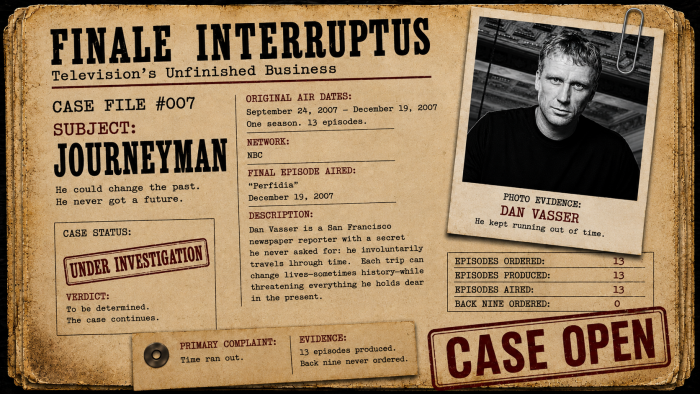
Every television series begins with a promise.
Give us your time. Your attention. Your imagination. Invite these characters into your home, follow their lives, and return each week to see what happens next.
In return, we'll tell you a story. And when it's over, we'll bring it to its proper end. We'll answer the questions, settle the conflicts, and give the characters—and the audience—a chance to say goodbye.
Most series keep that promise.
Some don't.
Some disappear between seasons, leaving their characters suspended in place and their audiences waiting for a conclusion that never arrives.
Some endings are still missing.
These are their case files.
HE COULD CHANGE THE PAST
Dan Vasser had a problem with time. One moment, he was a newspaper reporter in San Francisco in 2007, with a wife, a son, a mortgage and all the ordinary complications that come with building a life. The next, without warning or permission, he could find himself years—or decades—in the past. There was no machine. No glowing portal. No eccentric scientist explaining the rules. Dan simply disappeared from the present and arrived somewhere else in time, usually with no immediate idea why he had been sent there.
Soon enough, however, a pattern emerged. There was always someone whose life intersected with his arrival. Dan would encounter that person at a particular moment, disappear again, then return at another point in the same person's life. His job was never explicitly explained to him, but the implication was hard to miss: something had put Dan there because something needed to change. That made NBC's JOURNEYMAN sound, at first glance, like a familiar kind of television series. Give the protagonist a strange ability, send him on a new mission every week, and let the audience watch him repair somebody else's life before the credits roll. But creator Kevin Falls built something considerably more dangerous around that formula.
Every time Dan vanished into somebody else's past, he abandoned his own present. His wife, Katie, was left wondering where her husband had gone. His young son couldn't understand why his father kept disappearing. Dan missed appointments, vanished from work and behaved in ways that looked increasingly inexplicable to anyone who didn't know that time itself had apparently drafted him into service. And Dan had history before the time travel began. Before Katie, there had been Livia Beale.
Livia had been the great love of Dan's life, and she was dead—or at least that was what Dan had spent years believing. Her apparent death had helped send him into a period of gambling and self-destruction before he eventually rebuilt his life. Katie had once been involved with Dan's brother, Jack, further complicating a family history that already had enough emotional wreckage without temporal displacement entering the picture. Then Dan traveled into the past and saw Livia. Alive. Worse—or perhaps better—she knew exactly what was happening to him. Livia was a traveler, too.
That revelation changed the shape of JOURNEYMAN. Dan wasn't simply experiencing an unexplained phenomenon. Someone else had experienced it before him. Livia understood things Dan didn't, appeared at critical moments and demonstrated that whatever was happening to him was part of something larger. Suddenly the obvious questions multiplied. Why Dan? Why Livia? Who—or what—decided where they went? Why did certain lives need to be changed? Was history correcting itself, or was someone correcting history? And what happened when a traveler changed too much?
Those questions supplied JOURNEYMAN with its mythology, but the series' real strength was what the mythology did to Dan's present. He wasn't a bachelor who could disappear for three days and return with a funny story. He was a husband and father whose unexplained absences could destroy the very life he was presumably meant to return to. Katie therefore became as important to the premise as the time travel itself. For Dan, the evidence was overwhelming. He knew where he had been. For Katie, the evidence initially looked very different: a husband with a troubled past was disappearing without explanation, behaving erratically and insisting that the reason was physically impossible. The audience knew Dan was telling the truth.
Katie had to decide whether she could believe him. That distinction gave JOURNEYMAN something many high-concept dramas never find. The extraordinary premise didn't replace the ordinary stakes. It intensified them. Dan might be trying to save a stranger's future in 1987 while simultaneously destroying his own marriage in 2007. And hanging over all of it was Livia—the woman Dan had mourned, standing alive in front of him in the past, carrying answers she wasn't yet prepared to give him. There was clearly a larger story here. NBC gave JOURNEYMAN thirteen episodes to begin telling it. Then time ran out.
THIRTEEN TRIPS AND A DEADLINE
JOURNEYMAN arrived on NBC with a valuable piece of television real estate. The network scheduled the new drama Monday nights at 10 p.m., immediately following HEROES, then entering its second season as one of NBC's biggest successes. The September 24, 2007 premiere drew roughly nine million viewers. A week later, the audience was down to about 8.4 million. By early November, episodes were drawing closer to five or six million. Those weren't invisible numbers. They simply weren't the numbers NBC needed from a new drama occupying the hour after HEROES.
There was another warning sign in the audience JOURNEYMAN inherited. On October 1, HEROES drew nearly 12 million viewers; JOURNEYMAN retained about 8.4 million of them. By November 26, HEROES was approaching 12 million again while JOURNEYMAN attracted a little over six million. Dan Vasser was having trouble holding onto people in the present. Behind the scenes, however, JOURNEYMAN was approaching a much more unusual problem. NBC had ordered thirteen episodes. Under normal circumstances, a successful freshman network drama could expect a "back nine" order, bringing its first season to the traditional 22 episodes. On November 28, NBC gave exactly that vote of confidence to two other new dramas, CHUCK and LIFE. JOURNEYMAN wasn't among them.
NBC hadn't officially canceled it. The network instead adopted a wait-and-see position while JOURNEYMAN remained on its original thirteen-episode order. Under ordinary circumstances, that might simply have meant a few anxious weeks while executives watched the ratings and decided whether Dan Vasser deserved another nine hours. These weren't ordinary circumstances. On November 5, 2007, members of the Writers Guild of America went on strike. Television production across Hollywood began running on whatever completed scripts were already available. Shows shortened seasons, halted production or scrambled to determine how many episodes they could actually finish.
JOURNEYMAN was unusually fortunate in one respect: its original order survived. All thirteen episodes were ultimately completed. But the strike made the question of a back nine considerably more complicated. NBC had ordered additional episodes of CHUCK and LIFE even though new scripts couldn't be written until the strike ended. JOURNEYMAN received no such commitment. By December, creator Kevin Falls could see where things were heading. When Premium Hollywood asked him about reports that the series was finished, Falls said JOURNEYMAN wasn't getting a back nine "this year," although he stopped short of declaring the show dead. His description of its condition was considerably less reassuring. "Life support." There were still two episodes left to air.
There was also still a theoretical path to survival. NBC had not formally announced that JOURNEYMAN was canceled, and Falls held out hope that the network might retain the actors and reconsider the series after the strike. Fans began organizing their own rescue effort, borrowing a page from the campaign that had helped save JERICHO. Instead of sending peanuts to CBS, JOURNEYMAN viewers sent NBC boxes of Rice-A-Roni—the "San Francisco Treat" for a series set in San Francisco. Falls acknowledged the campaign and encouraged viewers not to give up. But he also knew what the numbers on the case file were beginning to say. Thirteen episodes ordered. Thirteen episodes produced. Thirteen episodes aired. Back nine: zero.
There is an important distinction here, because it would be easy to make the 2007 writers' strike the culprit in JOURNEYMAN's disappearance. The evidence doesn't quite support that verdict. The strike unquestionably transformed the television season in which JOURNEYMAN was fighting for survival, and it complicated any possibility of extending the first season. But NBC was still willing to commit to additional episodes of other freshman dramas during the strike. CHUCK and LIFE got their back-nine orders. JOURNEYMAN didn't. The more uncomfortable explanation is also the more ordinary one: JOURNEYMAN's ratings had not convinced NBC to make the same investment. The strike didn't create that problem.
Years later, Kevin McKidd remained unusually affectionate toward the series. “I loved that show, and I miss that show,” he said, calling JOURNEYMAN “brilliantly written” and concluding that it simply “didn't get the traction it needed.”
It simply arrived at almost exactly the worst possible moment. There was, however, one enormous difference between JOURNEYMAN and many series that suddenly discover their thirteenth episode has become their last. Kevin Falls knew the clock was running. That meant the final hours could be written with the possibility of cancellation in mind. The writers could answer questions. They could move relationships forward. They could give Dan somewhere meaningful to stand if NBC never allowed him to take another trip. And that creates the central problem in this case. JOURNEYMAN unquestionably had more story to tell. But unfinished story is not necessarily the same thing as an unfinished television series.
Before we can decide whether NBC interrupted Dan Vasser's journey, we need to determine exactly how much Dan—and the audience—actually understood when the clock reached Episode Thirteen.
WHAT DID DAN ACTUALLY KNOW?
By the time JOURNEYMAN reached its final stretch, Dan Vasser had learned enough to know that his travels were not random. Unfortunately, knowing that something has a pattern is not the same as knowing who designed it. The earliest journeys establish what appears to be Dan's assignment. He is repeatedly drawn into the life of a particular person, often returning at different points over a period of years. Sometimes the intervention seems insignificant when it happens. Only later does Dan discover how one altered moment produces another, eventually leading toward an outcome he could not have anticipated when he first arrived.
He isn't being sent back to assassinate dictators or prevent famous disasters. Most of the people whose lives intersect with his are ordinary people. That matters. Whatever force is moving Dan through time seems less interested in rewriting history than in changing individual lives within it. Dan can affect the past, but he isn't handed an instruction manual explaining how much he is permitted to change, what constitutes success, or what happens if he gets it wrong. Livia knows more. Her reappearance had already shattered one of the central facts of Dan's life. She had not died in the plane crash that supposedly killed her. She had disappeared from the present because she, too, was a traveler.
More importantly, Livia has been doing this longer than Dan. She understands the rhythm of the jumps. She recognizes that they are being sent somewhere for a reason. She occasionally warns Dan against interfering with events outside whatever task has brought him into the past. But Livia isn't the person running the operation. She doesn't possess the master plan either. That distinction becomes increasingly important as Dan searches for something more concrete than another traveler's experience. If this phenomenon has rules, somebody should understand them. If it has a purpose, somebody should be able to explain it. Eventually Dan finds someone who might.
Professor Elliot Langley is a physicist whose work involves tachyons—hypothetical faster-than-light particles that, within the series' science-fiction framework, offer a possible explanation for Dan's temporal displacement. Langley is not simply another bewildered scientist listening politely to an impossible story. When Dan finally confronts him, it becomes apparent that Langley knows considerably more about what is happening than he initially admits. That should be the moment when JOURNEYMAN opens the filing cabinet and hands us the answers. It isn't.
Langley can detect the phenomenon. He has studied it. He recognizes Dan as a traveler. His research gives the series its closest approach to a scientific explanation for why Dan vanishes from one time and appears in another. But detecting the machinery isn't the same thing as identifying the mechanic. Langley doesn't tell Dan who is choosing his destinations. He doesn't explain why particular people have been selected for intervention. He doesn't reveal why Dan and Livia became travelers. He doesn't establish whether some intelligence is directing the journeys or whether Dan is experiencing a natural phenomenon governed by rules nobody fully understands.
In other words, JOURNEYMAN finally introduces a man who knows something about time travel—and uses him to demonstrate how much remains unknown. The personal questions are just as complicated. Dan learns that Livia belongs to another time. She was born decades before him and had been traveling forward when their lives intersected. What Dan experienced as a long-term relationship was, from Livia's perspective, part of a life repeatedly interrupted by journeys into her future. Eventually her travels stop taking her to Dan's present. She hasn't abandoned him. Time has.
That revelation gives their relationship an unexpectedly cruel logic. Dan had spent years grieving a woman he believed was dead. Livia had loved a man who belonged to a future she could no longer reach. Neither had deliberately left the other, yet both were forced to continue living after the relationship had effectively been taken away from them. Dan continued with Katie. Livia continued in her own time. And then Dan began traveling.
The triangle could easily have become the engine for years of manufactured romantic indecision, but JOURNEYMAN gradually moves toward something more mature. Dan's journeys force him to confront what Livia meant to him without pretending his marriage to Katie is merely the consolation prize he accepted after Livia disappeared. Katie, meanwhile, has undergone her own journey without ever leaving 2007. At first, Dan's explanation sounds absurd. It should. Her husband has a history of gambling problems, disappears for unexplained stretches and returns with stories about being somewhere decades earlier. Believing him requires Katie to reject the most reasonable explanations available to her. Dan therefore begins bringing evidence home.
Objects travel with him. Changes in the past affect the present. Information appears that he could not reasonably possess. Eventually Katie stops asking whether Dan is telling the truth. The question becomes whether their marriage can survive the truth. That is one of the most important developments in evaluating whether JOURNEYMAN ultimately received an ending. The series does not spend thirteen episodes holding Katie permanently outside the premise. She learns. She adapts. She becomes part of Dan's reality. Jack Vasser has a harder time.
Dan's brother is a police detective, which makes Dan's increasingly impossible behavior particularly difficult to ignore. Jack has his own history with Katie—she was once his girlfriend before she married Dan—and that unresolved emotional connection adds another layer of suspicion whenever Dan appears to be endangering his family. From Jack's perspective, protecting Katie and Zack can sometimes mean protecting them from Dan. Again, the time travel doesn't replace the family drama. It weaponizes it. By Episode Twelve, JOURNEYMAN has therefore answered more questions than its reputation as a prematurely canceled mythology series might suggest. Dan knows his journeys have purpose. He knows he is expected to affect particular lives.
He knows Livia is another traveler. He understands why she disappeared from his life. Katie knows Dan is telling the truth. Dan has found a scientist who can at least detect and study the phenomenon. Those aren't trivial revelations. A series determined merely to keep its mystery box locked could have stretched several of them across multiple seasons. But look at what Dan still doesn't know. He doesn't know what sends him. He doesn't know why he was chosen. He doesn't know who selects the people he is supposed to help. He doesn't know whether the journeys are controlled by an intelligence, a natural force, fate, God, physics—or something the series hasn't shown us yet.
He doesn't know whether there is a larger objective beyond the individual lives he changes. And he has no idea when, or whether, the traveling will stop. Those aren't incidental questions surrounding JOURNEYMAN. They are embedded in its premise. With one episode remaining, NBC had given Kevin Falls one final hour. He could use it to reveal the machinery behind Dan Vasser's life. He could leave the machinery unexplained but resolve the life Dan had built around it. Or he could end Episode Thirteen exactly as he would have ended it if Episode Fourteen were already waiting. The episode was called “Perfidia.” And everybody involved had reason to suspect it might be the last trip Dan Vasser ever took with us.
“PERFIDIA”
If JOURNEYMAN had ended one episode earlier, the prosecution in this case would have had a much easier job. “Perfidia,” the thirteenth and final episode, aired on December 19, 2007. By then, Kevin Falls knew the back nine was a long shot and that the series might never return. That knowledge matters, because the episode was shaped with the possibility of goodbye in mind. Dan's final televised assignment brings him face to face with Evan Patterson, a psychiatric patient who claims to be another time traveler. At first Dan has every reason to doubt him. Then Evan produces proof: a videotape showing that, in another version of history, he and a woman named Lauren were husband and wife.
Evan's tragedy is not that he is trying, during this episode, to rewrite history so Lauren will live. He has already done it. His travels had devastated their marriage, and after Lauren died he repeatedly tried to save her. Eventually he went farther: he changed the day they met so that they never became a couple at all. Lauren lived, but she no longer knew him. That distinction makes Evan a particularly cruel warning for Dan. A traveler can alter his own life. He can even sacrifice the life he remembers in order to save someone he loves. What he cannot do is assume that he will still belong in the world he creates.
Dan and Livia give Evan one last connection to the life he erased. They bring him together with Lauren for a salsa dance to “Perfidia,” the song preserved on the videotape from their vanished marriage. Evan then collapses and dies. The date is September 2007, close enough to Dan's own first journey that Dan sees his earlier self getting into a cab and wonders whether Evan's death somehow figures into the beginning of his travels. The episode then turns toward the other great question hanging over the series: what is happening to Dan?
Dan finally confronts Professor Elliot Langley. Langley admits that he knows about the phenomenon and has studied evidence of temporal anomalies, but he has deliberately avoided Dan. His reason is revealing: proximity to a time traveler creates the temptation to use that traveler to alter the past for personal ends. Langley can offer evidence and theory, not a complete explanation. He tells Dan that the “system” appears to be breaking down and that Dan may be the last traveler. Dan immediately supplies the contradiction: Livia is still traveling. That is exactly the kind of revelation a fourteenth episode could have pursued.
There is no fourteenth episode.
Instead, “Perfidia” turns away from the mythology and toward the relationship that has carried the emotional weight of the series from the beginning.
Katie.
For thirteen episodes, Katie has been asked to believe the impossible. Dan has brought home evidence. She has seen the consequences. She has reached the point where she accepts that her husband is telling the truth. But accepting an impossible explanation is still different from seeing the impossible happen. At the end of “Perfidia,” Dan feels another journey coming. Katie is there, and this time she asks to see it. Dan disappears in front of her.
It is an extraordinarily simple ending. There is no organization stepping from the shadows, no machine, no final explanation for why Dan Vasser was chosen. Instead, JOURNEYMAN closes the emotional distance between Dan and Katie. She no longer believes him because she trusts him or because the circumstantial evidence has become overwhelming.
She sees it.
The final disappearance is important because it is not framed as a catastrophe. Dan is not stranded in history, Katie is not watching him being dragged helplessly into oblivion, and the series does not end with his family waiting desperately to learn whether he will return. At the beginning of JOURNEYMAN, the traveling happens to Dan. It wrecks plans, threatens his career, terrifies his family and repeatedly pulls him away from the life he wants. By “Perfidia,” he has begun to accept that the journeys are part of that life. He may not understand why he travels, but he understands that he has a purpose when he gets there. That gives “Perfidia” something many prematurely canceled series never receive: a stopping point.
Katie finally witnesses the truth. Dan has seen another traveler sacrifice his own history for someone he loved. He has found a scientist who can confirm that the phenomenon is real. And when another journey comes, he goes. If JOURNEYMAN were primarily the story of Dan Vasser learning to live as a time traveler, there is a strong argument that the story ends here. But if JOURNEYMAN is the story of why Dan Vasser is traveling through time, “Perfidia” does not end it at all. Who sends him? Why Dan? Why Livia? Who were the travelers before them? Why does Langley believe the phenomenon is ending? What determines which lives require intervention? And what was Kevin Falls planning to tell us next?
That last question is not speculation. After JOURNEYMAN disappeared from NBC, Falls described many of the stories the series never got to make. The back nine never existed on television. But pieces of it survived. And those pieces are now evidence.
THE BACK NINE THAT NEVER WAS
For most canceled television series, reconstructing the missing episodes requires a certain amount of archaeology. There may be an abandoned script. A stray interview. A writer remembering an idea twenty years later. Fans are left trying to distinguish between stories that were actually planned and stories somebody merely thought might be interesting someday. JOURNEYMAN left us something considerably better. Kevin Falls told us.
In December 2007, after the thirteen completed episodes had aired but while there was still some possibility that the series could return after the writers' strike, Falls answered a long series of questions for Ain't It Cool News about where JOURNEYMAN was going. Because revealing those plans would have spoiled the show if it somehow survived, the interview was held until August 2008, when there was no longer any realistic prospect of another season. By then, there was nothing left to protect. So Falls opened the case file.
The first revelation is that JOURNEYMAN was never headed toward a conventional science-fiction explanation in which Dan discovered a government experiment, secret laboratory or piece of technology responsible for throwing him through time. Asked whether God, nature or something else was behind Dan's journeys, Falls deliberately stopped short of naming it. Whatever the answer was, he said, it was too "specific and grand" to be either science or government. The series apparently wasn't going to put that answer on a whiteboard for Dan—or the audience. Falls said the writers intended to take viewers close enough to the answer that they could reach their own conclusion. But the mythology was going to expand. There were other travelers.
Falls referred to them collectively as a "cadre," and the longer-term conflict would have involved people attempting to find those travelers and potentially exploit their abilities. FBI agent Richard Garrity, who had already taken an uncomfortable interest in Dan, was definitely intended to return. That changes the significance of what we saw in the first thirteen episodes. Dan's problem wasn't eventually going to be limited to understanding why he traveled. It was going to become keeping other people from using the travelers.
The government might learn enough about Dan's abilities that one contemplated storyline had Dan trying to erase that knowledge from history. The man who had spent his first season learning how dangerous it was to change the past could eventually have found himself needing to change it deliberately just to protect himself. And then there was Livia. The series had already revealed that she came from another time. What it had not revealed was just how much of Dan's life might have been connected to her assignment. Falls said Livia had initially been intended to serve as Dan's mentor. But that wasn't all. Her mission was to bring Dan and Katie together.
That possibility completely reframes the romantic triangle at the center of JOURNEYMAN. Livia wasn't simply Dan's lost love who happened to reappear after he married somebody else. The woman Dan thought he was supposed to spend his life with may have been traveling through his life partly to ensure that he didn't. Katie was the destination. At one stage, the reason involved Zack. The writers considered giving Dan's son a temporal ability of his own—the power to travel into the immediate future—but Falls said they backed away from that idea because it made the phenomenon feel too genetic and too reminiscent of THE TIME TRAVELER'S WIFE. The larger idea remained tantalizing. Dan and Katie were supposed to happen. Livia may have helped make them happen.
And the woman Dan had mourned wasn't merely alive in 1948. She was still alive in 2008. Falls confirmed that Dan would eventually have met the elderly Livia in his own present. That meeting alone could have supplied one of JOURNEYMAN's defining episodes. Dan had known Livia as the woman he lost. He had encountered her as the young traveler who could visit his era but could never remain there. Somewhere in the same city, however, an older Livia had apparently lived through the decades separating her from him. She had a life Dan knew almost nothing about. The writers intended to show some of it.
Livia would have attended law school in her own era. She would have had a husband, and the writers were considering a story in which that husband might attempt to take advantage of her ability. But the back nine wasn't going to be nine episodes of mythology exposition. Dan and Katie were going to separate. Not permanently. Falls said Dan would move in with Jack for a time before eventually reconciling with Katie. That would have forced the series to test the marriage it had spent thirteen episodes teaching us to believe could survive Dan's impossible life. Then, around Episode Twenty, things were going to become considerably worse. Livia was going to die. In Episode Twenty-One, Dan was going to save her.
That sentence should make anyone who has watched “Perfidia” sit up. The final produced episode had just shown Dan another traveler destroying his own future because he could not accept the death of the woman he loved. Evan changed history to save Lauren, and the consequences consumed the life he knew. Dan learned the lesson. Then the unproduced episodes were apparently going to put him in almost exactly the same position. Livia dies. Dan saves her. We don't know enough about the proposed episode to know whether the parallel would have been explicit, or what consequences Dan's intervention would have produced. But we do know what was supposed to happen next. Episode Twenty-Two would have brought Dan home.
He would arrive at his house much as he had in the pilot. Except it wouldn't be his house anymore. Someone else would be living there. Katie would be gone. Zack would be gone. And Dan would have no idea what he had done to erase his family—or how to get them back. Then Season Two would begin. That is not a minor dangling subplot. That is a cliffhanger. More importantly for this investigation, it is a cliffhanger JOURNEYMAN never got the opportunity to create. The thirteen episodes we actually have do not leave Dan standing outside a stranger's house wondering where his wife and child went. They leave him disappearing in front of Katie after she finally sees his time travel for herself. The cancellation therefore produced a strange accident.
NBC stopped JOURNEYMAN before the writers could make it substantially more unfinished. Had the network ordered the back nine and then canceled the series after Episode Twenty-Two, there would be virtually nothing to investigate here. Dan's family would have been erased, Dan wouldn't know how to restore them, and the audience would have been waiting for a Season Two that never arrived. CASE OPEN. Stamp it UNFINISHED and move along.
Instead, we received “Perfidia.”
There were still even larger plans beyond the missing nine. Falls said the eventual series ending would have brought back people Dan had helped throughout the series, assembling those apparently isolated interventions into something larger—a kind of Rube Goldberg mechanism in which lives Dan had changed would ultimately connect. That tells us something important about the weekly stories. They weren't necessarily disposable. The people Dan saved weren't simply passengers who stepped off the train at the end of an episode and vanished forever. At least some of them were intended to matter again.
The writers had initially considered making a plague the major threat around which some of these threads would converge, but abandoned the idea after HEROES developed its own plague storyline. The specific replacement had not yet been determined. And that qualification matters. Not everything Falls described was carved into stone. Some ideas had already changed. Some were possibilities rather than completed scripts. The back nine had never been ordered, much less produced. We should not treat every contemplated storyline as though nine finished episodes were sitting in a vault somewhere. Falls himself explained that by mid-October he could already read the situation. He began thinking in terms of thirteen episodes.
That decision is visible in the show we actually received. Years later, when JOURNEYMAN finally reached DVD in the United Kingdom, the set made the road not taken unusually explicit. Among its bonus material was a roughly twenty-minute featurette with the wonderfully painful title “The Back Nine,” in which cast and writers discussed what might have happened had the series continued. So we know JOURNEYMAN had a future. We know portions of that future in remarkable detail. Dan and Katie would separate and reconcile. Dan would meet the elderly Livia. The government threat would grow. Livia would die. Dan would save her. Katie and Zack would disappear from the resulting present. Season Two would begin with Dan trying to get his family back.
Nearly two decades later, American viewers who want to discover the series have another problem: JOURNEYMAN is currently unavailable to stream, rent or buy digitally in the United States. There was never an official U.S. DVD release, leaving the thirteen episodes surprisingly difficult for a new American viewer to see legally.
And somewhere much farther down the road, the people whose lives Dan had changed were supposed to become pieces of a larger design. That is enough evidence to establish one side of the case beyond any reasonable argument. JOURNEYMAN was not finished telling stories. But that has never been the standard here. ALF didn't make our files simply because another season might have been funny. AMERICAN GOTHIC escaped conviction because, despite its cancellation, its central dramatic conflict reached an intentional conclusion. A television series does not owe us every story its writers might someday have told. It owes us an ending to the story it actually began. And JOURNEYMAN presents perhaps the most difficult version of that question yet.
Because Kevin Falls saw the cancellation coming. He knew he might have thirteen episodes instead of twenty-two. He adjusted. And through one of those peculiar accidents of television history, NBC canceled his series at a moment that looks considerably more like an ending than the ending he had planned for the season. Dan Vasser had a future. We know enough about it to miss it. Now we have to decide whether losing that future means we lost his ending.
CASE CLOSED—or CASE INTERRUPTED?
The evidence against NBC is easy to understand. JOURNEYMAN was canceled after thirteen episodes. Its creator had plans for more. Important questions about Dan Vasser's travels remained unanswered. Other travelers existed. The government threat was going to grow. Livia's story was far from complete. Dan and Katie still had difficult territory ahead of them. The intended first season would have ended with Dan returning home to discover that Katie and Zack had vanished from his life. None of that happened. On those facts alone, JOURNEYMAN looks like an obvious candidate for Finale Interruptus. But those aren't the only facts in evidence. The prosecution's problem is “Perfidia.”
Kevin Falls knew his show was in danger. Instead of ending Episode Thirteen with Dan dangling from a narrative cliff, he gave the series something it wasn't originally supposed to receive until much later: A place to stop. That distinction has already mattered in these case files. A television series does not qualify simply because it was canceled prematurely. AMERICAN GOTHIC proved that. Networks can kill a series before its creators have exhausted every possible story without necessarily depriving the audience of an ending. So what exactly did JOURNEYMAN promise us? If the promise was that Dan Vasser would eventually discover the ultimate cause of his time travel, NBC broke it. We never learn what sends him. We never learn why Dan was chosen.
We never receive a complete explanation for Livia. We never learn the full significance of the other travelers. We never see the larger pattern Kevin Falls intended to create from the people Dan helped.
The mythology is unfinished.
There is no serious argument otherwise. But mythology isn't necessarily story. The story JOURNEYMAN actually spends thirteen episodes telling is about a man whose life is being torn apart by something impossible. Dan begins the series frightened and bewildered by his travels. He has no control over when they happen, little understanding of what he is supposed to accomplish, and no idea how to explain his disappearances to the people who depend upon him. His past is unresolved. His marriage is threatened. His wife has reason to doubt him. His brother has reason to suspect him. The woman Dan once loved and mourned is suddenly alive again, creating the possibility that the life he built after losing her might have been founded on a mistake.
By “Perfidia,” nearly all of those emotional questions have moved somewhere meaningful. Dan understands the basic nature of his journeys even if he doesn't understand their source. He accepts that they have purpose. He understands why Livia disappeared. He confronts the temptation represented by the life he might have had with her. He sees what happens when another traveler uses the past selfishly. And he chooses the life he has built with Katie. Most importantly, Katie finally sees Dan disappear. That moment closes the central emotional gap the series established in its first episode. Dan no longer has to convince his wife that the impossible thing happening to him is real. She knows.
The series ends with Dan being called away again, but that isn't a cliffhanger in the conventional sense. We aren't left wondering whether he survived. We aren't waiting to learn whether he gets home. There isn't a villain pointing a gun at Katie or a revelation cut off halfway through.
Dan simply travels.
Which is what Dan Vasser does. There could be another mission after the credits. There could be a hundred. For the first time, however, the audience doesn't need to see the next one in order for the story we have been watching to make sense. That is the defense's case. And it's a strong one. Then there is the strangest piece of evidence of all. We know what would have happened if NBC had ordered nine more episodes. JOURNEYMAN would have become more unfinished. Dan would have saved Livia. He would have returned to an altered present. Katie and Zack would have been gone. His home would belong to somebody else. Episode Twenty-Two would have ended with Dan facing a mystery specifically designed to carry the audience into Season Two.
Had NBC canceled JOURNEYMAN at that point, this case would require about thirty seconds of deliberation.
UNFINISHED.
Instead, NBC stopped the series before Kevin Falls could write the cliffhanger that would have convicted it. There is an irony worthy of a time-travel story in that. Cancellation changed JOURNEYMAN's ending. And for once, it may have changed it for the better. That doesn't mean “Perfidia” was the ending Falls wanted. It clearly wasn't. It doesn't mean JOURNEYMAN completed its mythology. It plainly didn't. It doesn't mean there weren't stories worth telling in those missing nine episodes or in the seasons Falls hoped would follow. There were. We know some of them. We can even mourn them. But Finale Interruptus isn't a list of television shows we wish had lasted longer. It is a record of broken promises.
JOURNEYMAN promised us the story of Dan Vasser, a man pulled unwillingly through time while desperately trying to hold together his life in the present. Thirteen episodes later, Dan is still traveling. But he is no longer running from it. Katie knows. Dan knows what his journeys demand of him. The past he once wanted back has been put in its proper place. And when time calls for him again, Dan goes. The mysteries remain. The journey continues. But the story can stop there.
CASE STATUS: RESOLVED
VERDICT: CASE DISMISSED.
JOURNEYMAN was canceled too soon. It was not canceled too late to give us an ending. Dan Vasser spent thirteen episodes learning that every journey had a purpose. It turns out his last one did, too.


FEATURED ALBUM

Songs of faith, family and moving forward.


