


Recent social-media posts have accused Critical Blast Publishing of leaking a former client's unpublished book after the client ended a production engagement with us. That accusation is false.
Finale Interruptus: Cold Cases - Case File #002: The Starlost
FTC Statement: Reviewers are frequently provided by the publisher/production company with a copy of the material being reviewed.The opinions published are solely those of the respective reviewers and may not reflect the opinions of CriticalBlast.com or its management.
As an Amazon Associate, we earn from qualifying purchases. (This is a legal requirement, as apparently some sites advertise for Amazon for free. Yes, that's sarcasm.)
Submitted by Bill Casticart on Sun, 09/06/2026 - 07:12
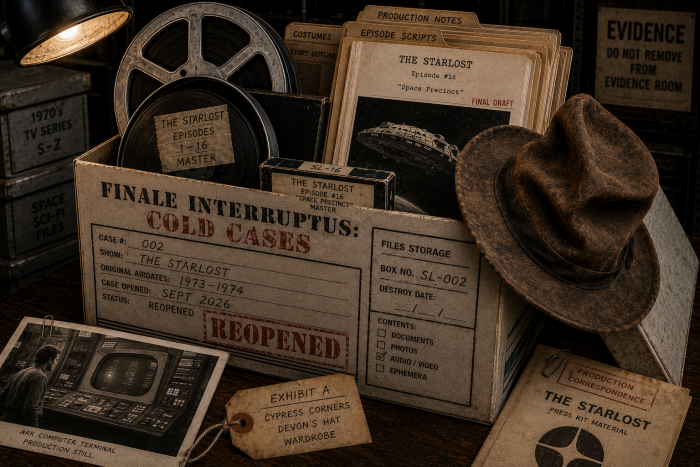
Every television series begins with a promise.
Give us your time. Your attention. Your imagination. Follow these characters wherever their story takes them, and return each week to see what happens next.
In return, we'll tell you a story. And when it's over, we'll bring it to its proper end. We'll answer the questions, settle the conflicts, and give the characters—and the audience—a chance to say goodbye.
Most series keep that promise. Some don't.
And some broke it so long ago that their unfinished stories have been gathering dust for decades.
Heroes were left lost in time. Families remained stranded on distant worlds. Fugitives kept running. Invaders were never defeated. Quests begun in black and white—or in the first years of color television—simply stopped when the network turned out the lights.
The evidence is old now. The videotapes are fading. The film cans are rusting. The witnesses have scattered. But the questions remain.
Some endings have been missing for a very long time.
These are the Cold Cases.
PART ONE: THE SHIP THAT FORGOT IT WAS A SHIP
Devon has a problem. He lives in Cypress Corners, an isolated farming community whose people follow traditions that have governed their lives for generations. It is a small, closed world where everyone knows his place, technology is virtually nonexistent and questions about what might exist beyond the community are discouraged. Devon asks questions anyway.
He is in love with Rachel, but their community's rules forbid them from marrying. When Devon challenges those rules, he begins pulling at a thread that eventually unravels everything he understands about his world. Because Cypress Corners isn't a village somewhere on Earth. It isn't even on a planet. It's inside a spaceship.
The Ark was built centuries earlier as a vast generation ship carrying humanity toward a new home. It is so enormous that its passengers live inside separate biospheres—self-contained worlds designed to preserve different cultures and environments during the voyage. Over the generations, many of those communities have forgotten the truth. The people inside them no longer understand that there are other worlds beyond their walls, much less that all of those worlds are traveling together through space. Cypress Corners is one of them.
Devon discovers technology left behind by the Ark's builders and encounters the ship's computer system, which tells him what nobody in his community knows: something has gone catastrophically wrong. The Ark suffered an accident more than a century earlier, its crew is dead, and the vessel is no longer following its intended course.
Here the details matter. Devon, Rachel and Garth actually reach the Ark's main bridge in the opening story. They find the skeletal remains of the crew and discover that the bridge is wrecked and its controls are useless. The Ark is on a collision course with a star. Their hope is not to find the bridge they have never seen; it is to cross the immense ship to a backup bridge that may still be capable of controlling it.
That revelation transforms what initially looks like the story of one young man rebelling against the rules of an isolated community into something vastly larger. Devon isn't merely trying to escape Cypress Corners anymore. He has to save the world. Actually, he has to save scores of them.
Rachel eventually joins him, as does Garth, the man Cypress Corners had intended Rachel to marry. Together they leave the only world they have ever known and begin traveling through the Ark. Somewhere at the far end of that enormous ship may be the backup controls necessary to correct its course and prevent catastrophe.
That is the engine behind THE STARLOST, the Canadian science-fiction series that aired from September 22, 1973, through January 5, 1974. But for our purposes, it is also something more important: a promise. THE STARLOST can send its three travelers into a different biosphere every week, each containing another civilization, mystery or danger. Beneath every one of those adventures is the reason Devon left Cypress Corners in the first place.
The Ark is out of control. Its passengers are in danger. The main bridge is dead. Someone has to reach the backup bridge and save everyone aboard.
Sixteen episodes later, Devon, Rachel and Garth were still looking. Then THE STARLOST disappeared. More than half a century has passed since anyone checked the Ark's trajectory. It's time we reopened the file.
PART TWO: A UNIVERSE UNDER ONE ROOF
Once Devon, Rachel and Garth leave Cypress Corners, THE STARLOST reveals the real genius of its premise. The Ark isn't simply a very large spaceship. It's a universe.
The vessel was designed to carry humanity across the stars by dividing its population among enormous self-contained biospheres. Each could preserve a different environment, community and way of life while the Ark made its centuries-long journey. Then the accident happened. With the crew dead and the ship's central systems crippled, the biospheres continued functioning on their own. Generations passed. Communities became isolated. History turned into legend, knowledge disappeared, and in some cases the inhabitants forgot there was anything beyond the walls surrounding them.
Humanity didn't merely become lost in space. It became lost from itself.
That gives Devon and his companions a potentially endless series of worlds to explore without ever leaving the Ark. Open another hatch and they might encounter a civilization considerably more technologically advanced than Cypress Corners. Pass through another corridor and they could find a society that has developed under completely different rules. Some communities possess pieces of knowledge the travelers need. Others have problems of their own. Still others have become dangerous precisely because they have spent centuries developing in isolation.
The Ark is simultaneously a spaceship, a collection of lost civilizations and a laboratory containing different answers to the question of what human beings might become when separated from one another long enough. For a weekly television series, that's an extraordinary storytelling machine. It is also a convenient one: every new civilization is already aboard the same vessel. Devon, Rachel and Garth simply have to keep walking.
But there is a danger hidden inside that format. The Ark can become so interesting that everyone forgets why they're exploring it. That cannot be allowed to happen in a Cold Case.
Devon didn't leave Cypress Corners because he wanted to see what was in the next biosphere. Rachel didn't follow him because she developed an enthusiasm for anthropology. Their journey has a destination and a deadline. The Ark is in trouble, the main bridge cannot save it, and the backup bridge lies somewhere across a vessel hundreds of miles long.
That means every encounter potentially matters. A technologically advanced society might know something about the Ark. A functioning computer might contain information about its systems. Another group of survivors might know how to reach parts of the vessel that have been inaccessible for generations. Somewhere, perhaps, is a route to the backup bridge.
This is what separates THE STARLOST from a series whose characters merely wander from adventure to adventure. The wandering is not the mission. The wandering is supposed to get them somewhere.
And hanging over all of it is the most unsettling aspect of the premise: the vast majority of the people whose lives depend upon Devon succeeding don't even know they need to be saved. Imagine discovering that your town is inside a vehicle, that the vehicle has been moving for centuries, that the people who were driving it are dead, and that almost everyone aboard has forgotten there were controls in the first place.
That's the Ark. Through its corridors walk three people from one of the most technologically primitive communities aboard it, carrying knowledge that makes them simultaneously among the least qualified and most important people on the ship. They know the truth. Now they have to find somebody—or something—that can help them do something about it.
Every time Devon, Rachel and Garth enter another biosphere, the same question follows them through the door: Are they getting any closer to saving the Ark?
Before we can answer that, however, we need to open another file. The one marked: HARLAN ELLISON.
PART THREE: HARLAN ELLISON BUILDS AN ARK
Before THE STARLOST became a Cold Case, it was supposed to be something unusually ambitious for 1970s television. And the man making the promise was Harlan Ellison.
By 1973, Ellison hardly needed an introduction to science-fiction readers. He was an acclaimed short-story writer and anthologist who had also spent years fighting his way through television, contributing scripts to THE OUTER LIMITS, THE MAN FROM U.N.C.L.E., BURKE'S LAW and, most famously, STAR TREK. His original script for “The City on the Edge of Forever” had won both a Writers Guild of America Award and a Hugo Award.
Now Ellison had the opportunity to create a science-fiction television series of his own. The concept that became THE STARLOST had an enormous advantage built into it: he could create an entire universe without requiring his characters to travel between planets. He would put the universe inside one ship.
Earthship Ark would carry separate human cultures inside enormous biospheres, each developing in isolation after catastrophe disabled the vessel. Devon, Rachel and Garth would travel through those societies on what Ellison's original series bible explicitly called “The Search.” Ellison described THE STARLOST as something closer to a novel told in installments than conventional episodic science fiction. The exotic societies, adventure and spectacle were supposed to be the surface; underneath them would be three young people discovering their world, themselves and cultures dramatically different from their own.
The surviving series bible makes his ambitions remarkably clear. This wasn't supposed to be ray guns and monsters with a new rubber forehead every week. Ellison wanted ideas. The biospheres could let writers examine religion, politics, technology, prejudice, social organization and the ways civilizations evolve when separated from one another. The Ark wasn't merely a convenient collection of sets. It was a device for examining humanity.
And Ellison wasn't the only serious science-fiction name attached to the project. Ben Bova, then editor of ANALOG SCIENCE FICTION AND FACT, became the show's technical adviser. Douglas Trumbull, already celebrated for his visual-effects work on 2001: A SPACE ODYSSEY and as director of SILENT RUNNING, was involved as an executive producer and with the planned Magicam effects system.
On paper, that's an extraordinary combination: Harlan Ellison, Ben Bova, Douglas Trumbull, a generation ship containing isolated civilizations, and an overarching quest capable of carrying the series forward from week to week.
Ellison even wrote the pilot himself. He called it “Phoenix Without Ashes.” The script introduced Devon and Cypress Corners, revealed the true nature of the Ark and sent its protagonists into the ship. Whatever eventually happened to the television series, Ellison's original version did not simply disappear. It survived, was later adapted by Edward Bryant into the novel PHOENIX WITHOUT ASHES, and Ellison's original teleplay—not the substantially altered version that reached television—won a Writers Guild of America Award.
That gives this Cold Case something most abandoned television series don't have. We can compare the body with the victim's photograph. We know what Ellison said THE STARLOST was supposed to be. We have his series bible, his original pilot and his own lengthy account of what happened during production. We have Bova's recollections as well. The evidence box is unusually full.
According to Ellison's April 1973 series bible, he wanted writers coming aboard THE STARLOST to approach that universe with three instructions: Think fresh. Think different. Dare. “The rest of us,” Ellison wrote, “will try and make your dreams come true.”
That may be the most painful sentence anywhere in the file. Before THE STARLOST aired its first episode, Harlan Ellison had invoked the name he used when he wanted to disown altered work. Both the series creator credit and his pilot writing credit would identify him as: Cordwainer Bird.
To understand why, we have to examine what happened between the Ark Ellison built on paper and the one that finally appeared on television.
PART FOUR: ENTER CORDWAINER BIRD
There are pseudonyms writers use because they want privacy. Cordwainer Bird was not one of them.
Harlan Ellison used the name when he believed something he had written had been altered so badly that he no longer wanted his real name attached to it. Seeing Cordwainer Bird in the credits was not an attempt to hide Ellison's identity. It was a distress signal. And before THE STARLOST reached television, the Bird was already aboard the Ark.
The trouble included the way the series was going to be produced. Ellison had conceived an enormous spaceship containing biospheres capable of becoming different worlds. Building those environments every week would be expensive, so the production counted heavily on a technology called Magicam.
The system associated with Douglas Trumbull was intended to synchronize cameras filming actors against blue screen and miniature backgrounds, allowing performers and cameras to appear to move through large model environments. In theory, THE STARLOST could create enormous futuristic spaces without constructing enormous futuristic sets. In practice, the system was not ready to carry a weekly television production, and the show fell back on much more limited blue-screen techniques and cramped physical sets.
There were other problems. THE STARLOST had been developed with ambitions for American network television, but the project ultimately emerged as a Canadian-produced series distributed in syndication in the United States. Budgets, production methods and creative expectations changed with it.
Ellison watched his pilot change, too. “Phoenix Without Ashes” became “Voyage of Discovery,” the episode that introduced television viewers to Devon, Rachel, Garth and the Ark. Ellison believed the alterations damaged both the intelligence of the story and the internal logic of the world he had created. He invoked a contractual provision and had the pilot teleplay credited to Cordwainer Bird.
There was no quiet way to hide the rupture. Ellison's pseudonym appeared not merely on the pilot writing credit but as the credited creator of THE STARLOST itself. The man who had designed the Ark was publicly giving the Bird to the production built from it.
Ben Bova stayed long enough to become another unusually valuable witness. As technical adviser, he had been brought in to help THE STARLOST maintain scientific credibility. He later made clear how frustrated he became with scripts and production decisions that ignored or defeated the reason he was there.
And unlike most disgruntled television employees, Bova got a novel out of it. Published in 1975, THE STARCROSSED is a satire about the production of a disastrous science-fiction television series. Names and circumstances were fictionalized, but the connection to Bova's experience on THE STARLOST was no secret. Subtle, it wasn't.
That production history can easily overwhelm discussion of THE STARLOST itself. Ellison was one of science fiction's great raconteurs as well as one of its great combatants, and the story of the show's collapse is more entertaining than most production memos. But Cold Cases require us to separate the autopsy from the obituary.
Whatever happened behind the scenes, sixteen episodes of THE STARLOST were produced. Keir Dullea became Devon, Gay Rowan became Rachel, and Robin Ward became Garth. The Ark survived the production battle long enough to reach television.
Harlan Ellison may have abandoned the ship. Devon couldn't. The Ark was still headed toward destruction, and someone still had to save it.
So the question becomes whether the television series Ellison disowned continued pursuing the mission he created—or whether, somewhere amid all the compromises, THE STARLOST lost that too.
PART FIVE: SIXTEEN EPISODES, NO BACKUP BRIDGE
Once THE STARLOST gets Devon, Rachel and Garth out of Cypress Corners, the series settles into the format its premise was designed to provide. There is always another door. Behind it might be another biosphere, another isolated community or another surviving piece of the Ark's technology.
In “The Goddess Calabra,” they encounter a society built around an unusual relationship between its people and environment. In “The Pisces,” they discover a smaller spacecraft whose inhabitants have their own connection to the Ark. “Children of Methuselah” presents a society of children who have remained young for centuries. In “The Alien Oro,” the travelers encounter an actual extraterrestrial visitor aboard the Ark.
The possibilities keep expanding. So does the problem. THE STARLOST is very good at giving Devon, Rachel and Garth places to go. It is considerably less successful at getting them where they're supposed to be going.
The original mission remains theoretically intact. Devon knows the Ark is in danger and continues searching for a way to save it. Computers and surviving technology occasionally provide information, and some encounters appear capable of contributing pieces to the puzzle. But the structure of weekly television begins exerting its own gravitational pull: a new biosphere presents a problem, the travelers become involved, they help solve it, and then they move on.
There is nothing inherently wrong with that. It is exactly the storytelling engine Ellison designed into the Ark. But the Ark was also supposed to provide those stories with direction. If Devon visits sixteen societies because each brings him closer to the backup bridge, we're watching a journey. If he visits sixteen societies and remains essentially where he started, we're watching an anthology with three recurring guest stars.
THE STARLOST spends much of its single season somewhere between those two things. Occasionally, the travelers encounter something that seems capable of changing their situation. “Children of Methuselah” even appears to offer the backup bridge, only for that hope to prove false. Other episodes involve Ark-wide systems, self-destruction, propulsion and threats to the ship itself.
But no breakthrough completes the mission. The backup bridge remains unfound. The Ark remains out of control. The collision course remains unresolved.
That gives THE STARLOST an unusual kind of dramatic frustration. Tony Newman and Doug Phillips in THE TIME TUNNEL were helpless because the machine kept throwing them somewhere else. Devon is free to go where he wants. The problem is that his world is so unimaginably large that freedom doesn't help very much.
There are miles of corridors, scores of isolated societies and generations of people who have forgotten they are aboard a spacecraft. Somewhere beyond all of them are the backup controls Devon needs to reach. Every week spent solving somebody else's problem is another week in which the Ark continues moving toward its own.
By the middle of the season, the question facing the audience is no longer merely whether Devon can save the ship. It's whether THE STARLOST intends to let him make measurable progress toward doing it.
Then comes another complication. The series doesn't receive a second season. There will be no additional year for scattered discoveries to begin fitting together, no season-long approach toward the backup bridge. THE STARLOST gets sixteen produced episodes.
That makes Episode 16 extraordinarily important to our investigation. If the people making the series knew the end was approaching, this was their final opportunity to advance the mission. If they didn't, then we may be looking at exactly what we found in THE TIME TUNNEL: not a finale, just the last episode anybody happened to make.
The final transmission from the Ark is titled “Space Precinct.” Let's see where they left everybody.
PART SIX: “SPACE PRECINCT”
The final produced episode of THE STARLOST does not begin with Devon, Rachel and Garth marching together toward the backup bridge. In fact, it begins with a fracture in the group: Garth decides to return to Cypress Corners.
That choice could have carried enormous finale weight if the episode had been designed as a conclusion. Instead, Garth becomes entangled with an Ark police organization and an interplanetary conflict. The story turns into another local adventure—an unusual one, but not an attempt to resolve the central crisis of the series.
As Episode 16, “Space Precinct” becomes evidence. And the first thing that evidence tells us is that nobody appears to be trying to end THE STARLOST.
There is no rush toward the backup bridge, no attempt to gather the discoveries of the previous fifteen episodes into a larger solution, no revelation that changes what Devon understands about the Ark's predicament, and no final confrontation with the problem that launched the journey. Most importantly, the Ark isn't saved.
Television history contains plenty of finales that audiences dislike. Some are rushed. Some resolve years of storytelling in ways viewers find unsatisfying. Some deliberately leave questions unanswered. “Space Precinct” isn't one of those. It isn't attempting to conclude THE STARLOST at all.
That distinction matters. Nothing about the episode says: This is where Devon's story ends. Instead, it behaves like a series that expects more stories to follow.
The central problem introduced in “Voyage of Discovery” remains unresolved. The Ark is still in danger. Its biospheres are still filled with people who generally have no idea what is happening to them. The backup bridge has not been found. The ship has not been brought under control. Devon has not completed the mission that caused him to leave Cypress Corners.
That is precisely the kind of evidence that separates a Cold Case from an ending that merely leaves something unexplained. THE PRISONER can end with “Fall Out” and leave viewers arguing for generations about what it means; the ambiguity is part of the work. THE STARLOST doesn't present us with an ambiguous answer. It never reaches the answer.
There is an important difference between a story that ends by refusing to tell us whether its heroes succeeded and a story that disappears while its heroes are still trying. “Space Precinct” is the latter.
If another episode had followed, the larger quest could simply have resumed. But there was no completed Episode 17. The cameras stopped, and the mission remained unfinished.
That gives us the first half of our verdict. THE STARLOST did not end. It stopped.
But there is still evidence capable of changing how we understand the case. Two additional scripts, “God That Died” and “People in the Dark,” are documented as written but unfilmed. And beyond those lies Ellison's original conception of “The Search.” Perhaps somewhere in that material is the destination.
So before we declare the ship permanently lost, we need to find out where it was supposed to be going.
PART SEVEN: WHAT WAS SUPPOSED TO HAPPEN?
This is usually the point in a Finale Interruptus investigation where we start looking for the missing ending: an unproduced script, a story outline, an interview in which a producer explains what Season Two would have revealed, or a series bible containing the destination toward which everything was moving.
With THE STARLOST, we have something both better and worse. We have Harlan Ellison's original plans. What we don't have is a completed ending.
Ellison's conception of the Ark was enormous by design. The ship contained a vast number of biospheres, giving the series a supply of worlds to explore. Devon, Rachel and Garth would travel among them while pursuing the larger effort to save the vessel. That search was real, but it was also the engine intended to keep the series running.
The surviving bible describes a continuing journey and proposes societies and situations the travelers might encounter. What it does not provide is a neat final chapter in which Devon reaches the backup bridge, grabs the controls and pulls the Ark away from destruction. That doesn't mean Ellison intended the Ark to crash. It means he was creating an ongoing television series, not a limited series with its last episode already written.
This distinction matters. When we investigated THE TIME TUNNEL, we found evidence of proposed stories for a second season but no indication that Tony and Doug were about to return home permanently. THE STARLOST presents a similar problem. Its premise establishes an objective, but the objective also gives the series a reason to continue.
Save the Ark too soon and you end THE STARLOST. Never save it and eventually the audience may begin wondering whether the destination exists at all.
We also know that at least two more episodes existed on paper. “God That Died” and “People in the Dark” were written but not filmed. Their existence proves the production had material beyond “Space Precinct”; it does not give us a finale or evidence that the Ark was about to be saved.
Nor can we simply take Ellison's original intentions and assume they remained the roadmap after he left. Once Cordwainer Bird appeared in the credits, there were effectively two STARLOSTs in the evidence box: the series Harlan Ellison designed and the television series that actually got made.
That leaves us with an uncomfortable conclusion. We know Devon's mission, why he left Cypress Corners and what would constitute success. What we cannot establish is exactly how—or when—the writers would eventually have allowed him to achieve it.
There is no recovered final script in which the backup bridge doors open, no definitive outline explaining how the Ark avoids destruction, and no lost finale waiting in an archive to tell us where Devon, Rachel and Garth ultimately ended up.
Perhaps, had THE STARLOST continued, Devon would eventually have found the backup bridge. Perhaps the search would have lasted several seasons. Perhaps saving the Ark would have revealed an even larger problem. Perhaps the format would simply have kept the travelers moving from biosphere to biosphere for as long as stations kept buying episodes.
Anything beyond that is speculation. Cold Cases don't convict on speculation.
The surviving evidence tells us something frustratingly simple: THE STARLOST knew what its heroes were trying to accomplish. It just never told us whether they accomplished it.
Which means it's time to close the evidence box and render a verdict.
PART EIGHT: THE ARK IS STILL FALLING
More than half a century after THE STARLOST disappeared from television, the evidence is remarkably clear. This wasn't a series that reached its destination and left viewers debating what happened afterward. It never reached the destination.
Devon began the story as a young man trapped inside Cypress Corners, a community so isolated that its inhabitants had forgotten the world outside their walls. Then he learned the truth: his village was inside a biosphere, the biosphere was inside the Ark, and the Ark was in trouble.
That discovery gave Devon a mission larger than anything he could have imagined when he first challenged the rules of Cypress Corners. Rachel went with him. Garth went with him. Together they reached the ruined main bridge, learned that the Ark was headed toward disaster, and set out across the ship in search of the backup bridge that might still save it.
They found other societies, advanced technology, remnants of the civilization that had built and operated the ship, and people who knew things they didn't know. What they didn't find was the end of the journey.
After sixteen produced episodes, the backup bridge remained beyond their reach. The Ark remained uncontrolled. The danger that launched the series remained unresolved. Then the cameras stopped following them.
Behind the scenes, THE STARLOST had suffered a catastrophe of its own. Harlan Ellison conceived an unusually ambitious science-fiction series and became so unhappy with the produced pilot that Cordwainer Bird took his place in the writing credit. Magicam failed to deliver the production revolution on which the show's visual ambitions depended. Technical adviser Ben Bova became disillusioned and later transformed the experience into the satire THE STARCROSSED.
The series that survived those battles made it to television, but only for sixteen produced episodes. Two more stories existed on paper, but neither was filmed, and neither supplies the missing ending.
We found no filmed conclusion and no definitive roadmap taking Devon, Rachel and Garth all the way to the backup bridge. Ellison's surviving plans show that “The Search” was intended to continue, with the Ark's biospheres providing worlds enough for many more adventures. They do not provide us with the final adventure that would have completed the mission.
That prevents us from manufacturing an ending THE STARLOST never had. But it doesn't prevent us from reaching a verdict.
For anyone wanting to reopen the evidence personally, THE STARLOST is currently available to stream in the United States through Cultpix.
The promise was made in the first episode. The Ark was in danger. Devon learned the truth. He set out to save it. The series ended before he could.
ORIGINAL MISSION: Reach the backup bridge, regain control of the Ark and prevent its destruction.
EPISODES PRODUCED: 16.
BACKUP BRIDGE REACHED: No.
ARK BROUGHT UNDER CONTROL: No.
ARK SAVED: No.
CASE STATUS: UNRESOLVED.
VERDICT: COLD CASE CONFIRMED.
When we opened the first Cold Case, we found Tony Newman and Doug Phillips trapped somewhere in history, still waiting for Project Tic-Toc to bring them home. This time the scale is considerably larger.
Scores of biospheres. Entire civilizations. Generations of human beings living inside worlds whose walls they don't know are walls. No functioning main bridge. No one at the controls.
And somewhere in the endless corridors between those worlds are three travelers who left home because they were among the few people aboard who knew home was in danger.
Devon, Rachel and Garth are still searching. The backup bridge is still somewhere ahead of them. And the Ark is still falling.
Last known trajectory: Collision course.
CASE CLOSED? Not even close.
COLD CASE #002 remains open.


FEATURED ALBUM

Songs of faith, family and moving forward.


