

Featuring stories from Eric Shanower, Troy Riser, Michael Tierney, and seventeen other masters of the form, FANTASTIC VOYAGES is all about doors --
Comic-Con Used to Be About Tomorrow
FTC Statement: Reviewers are frequently provided by the publisher/production company with a copy of the material being reviewed.The opinions published are solely those of the respective reviewers and may not reflect the opinions of CriticalBlast.com or its management.
As an Amazon Associate, we earn from qualifying purchases. (This is a legal requirement, as apparently some sites advertise for Amazon for free. Yes, that's sarcasm.)
Submitted by Bill Casticart on Mon, 07/27/2026 - 11:07
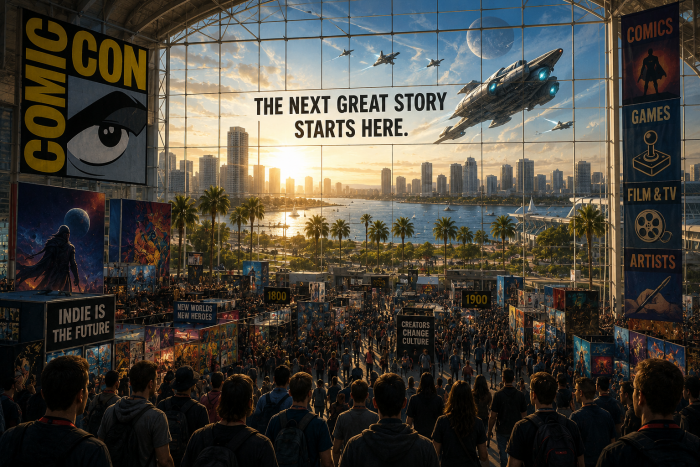
Comic-Con once felt like a preview of the future.
Every summer, fans descended on San Diego hoping to discover something they'd never seen before. Somewhere on the convention floor, there might be an unknown comic creator, an independent filmmaker, or a television series nobody was talking about yet—but soon would be.
Discovery was part of the ticket price.
Today, Comic-Con is still exciting. But more often than not, it's exciting because the future looks remarkably familiar.
Fans were treated to updates on Avengers: Doomsday, Ghost Rider, Black Panther, Blade Runner 2099, Carrie, The Rings of Power, Toy Story, Transformers, Futurama, and even Spaceballs.
There's only one problem with that sentence.
Almost every title in it has been around for years.
Without anybody announcing it, Comic-Con has drifted into a different role. It no longer feels like the place where tomorrow arrives first. Increasingly, it's where yesterday gets a fresh coat of paint.
That isn't automatically a bad thing. Great stories deserve to endure. Sherlock Holmes, Dracula, Robin Hood, and Tarzan have all outlived the generations that created them because each generation found something new inside them.
The concern isn't that Hollywood revisits old ideas.
It's that revisiting old ideas has become the safest idea.
Studios understandably gravitate toward recognizable brands. Familiar characters lower financial risk. Sequels and reboots come with built-in audiences. In an industry where a single film can cost hundreds of millions of dollars, caution is easy to justify.
But caution rarely changes culture.
Think about the teenager walking into Comic-Con for the first time this year. What brand-new character did they discover that their parents had never even heard of?
There are still answers to that question, but they're getting harder to find.
The independent spirit that built Comic-Con hasn't disappeared. It's just no longer occupying center stage. Wander away from the biggest studio presentations and you'll still find creators pitching original comics, first novels, tabletop games, and films they're financing one fan at a time. The next great franchise is probably somewhere in those aisles.
It just isn't getting the biggest headlines.
Perhaps that's inevitable. Entertainment has become a global business built around dependable intellectual property. Investors like certainty. Studios like predictable returns. Original ideas, by definition, come with uncertainty.
Yet uncertainty has always been where the magic begins.
It's easy to forget that every legendary franchise was once an unknown quantity. Batman had to win readers over. Star Wars wasn't a guaranteed phenomenon; it was a risky space fantasy that many believed would fail. Teenage Mutant Ninja Turtles began as an independently published black-and-white comic. Even The Walking Dead started as a creator-owned gamble. None of them were built around existing brands. They became the brands everyone now wants to imitate.
Comic-Con used to celebrate that kind of gamble. It reminded us that the next cultural phenomenon might be hiding in a booth we'd almost walked past.
I hope that spirit never disappears completely.
Because while it's always fun to welcome old heroes back, it's even more exciting to shake hands with the ones we'll still be talking about twenty years from now.

FEATURED ALBUM

Songs of faith, family and moving forward.
Latest Release


