

R.J. Carter has released the first official video single from his forthcoming album, Another Second Chapter, with a lyric video for “The Boy I Told Goodbye.”
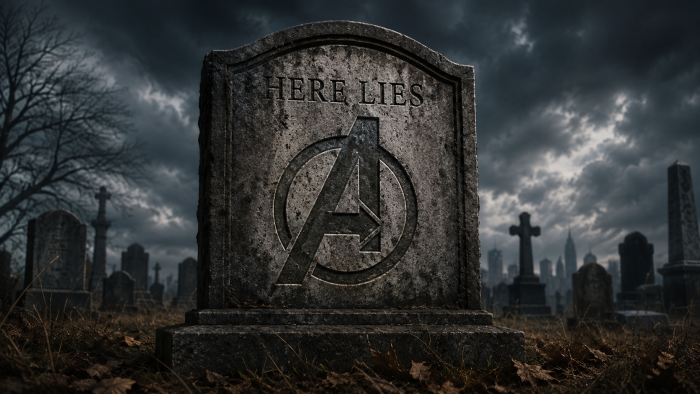
Marvel May Be Killing an Avenger. Does Death Mean Anything in Comics Anymore?
FTC Statement: Reviewers are frequently provided by the publisher/production company with a copy of the material being reviewed.The opinions published are solely those of the respective reviewers and may not reflect the opinions of CriticalBlast.com or its management.
As an Amazon Associate, we earn from qualifying purchases. (This is a legal requirement, as apparently some sites advertise for Amazon for free. Yes, that's sarcasm.)
Submitted by RJ Carter on Thu, 08/13/2026 - 08:25
“It can’t be! Not you! You’re… you’re dead!”
I wrote those words twenty-four years ago, not as dialogue but as a joke about dialogue — the sort of breathless exclamation comic-book readers had already seen often enough that death itself was becoming less a dramatic event than a temporary change in a character’s publishing status.
Yesterday, Rich Johnston at Bleeding Cool reported that Marvel is teasing the death of an Avenger in the wake of Avengers: Armageddon. That was enough to send me back to an article I originally wrote in 2002 for The-Trades.com, years before Critical Blast existed, asking whether comic-book death had already been rendered meaningless.
The immediate occasion for revisiting the subject is Marvel’s promotion for the post-Armageddon relaunch of Avengers. The new Avengers #1, from Chip Zdarsky and Marco Checchetto, is scheduled for November 4 and assembles Captain Marvel, Spider-Man, Daredevil, Wolverine, Luke Cage and one still-redacted member. More provocatively, preview material appears to indicate that an Avenger has died, while something ominous has happened to Tony Stark. Marvel is withholding the particulars, which is exactly what a publisher should do if it wants readers arguing about the possibilities for the next three months.
And here I am, arguing about them. Just not in quite the way Marvel may have intended.
I Have Seen This Funeral Before
Back in 2002, the examples already seemed overwhelming. Superman had died and returned. Reed Richards and Doctor Doom had died and returned. Norman Osborn had returned from a death that once seemed foundational to Spider-Man history. Aunt May had managed the trick as well. The question I asked then was simple: if readers are trained to expect resurrection, can a fictional death retain any power beyond the issue in which it occurs?
The intervening twenty-four years have not exactly strengthened the prosecution’s case for mortality.
Barry Allen was one of the examples I held up as evidence that superhero comics could let a major character die and allow the legacy to continue. Wally West had become the Flash, and Barry’s sacrifice in Crisis on Infinite Earths had acquired greater weight precisely because DC resisted undoing it. Barry eventually came back. Hal Jordan, whom I discussed as a character DC had technically kept dead by turning him into the Spectre, came back to life and reclaimed the Green Lantern identity. Jason Todd, whose murder by the Joker was once one of Batman’s defining failures, returned as the Red Hood. Bucky Barnes, whose death had been treated for decades as nearly as immutable as Uncle Ben’s, came back as the Winter Soldier.
The exceptions have become more interesting than the rule. Uncle Ben remains dead because Spider-Man’s origin collapses if he doesn’t. Gwen Stacy’s death remains one of the great dividing lines in Peter Parker’s life, despite comics finding innumerable ways to give readers Gwens from clones to alternate realities. The original Captain Marvel, Mar-Vell, has largely been permitted the dignity of remaining dead. These deaths endure because later stories depend upon the loss being real.
That is the part publishers too often forget. Death matters less because a character stops appearing than because everyone who survives has to continue without them.
Death as a Sales Tool
Nobody should pretend the economics are irrelevant. Superheroes are stories, but they are also intellectual property. A company can permanently retire a supporting character more easily than it can permanently retire a globally licensed icon whose symbol appears on shirts, toys, games and movie screens. Even when a successor assumes the costume, the original remains valuable enough that somebody will eventually pitch the return.
That creates a peculiar contract between publishers and readers. Marvel can tease the death of an Avenger and reasonably expect attention because readers care about these characters. At the same time, decades of reversals have trained those same readers not to believe the premise. We are invited to fear that someone is dead while simultaneously beginning the office pool on how long the death will last.
The mechanism has changed, but the skepticism hasn't. In 2002 I listed the familiar escape hatches: clone, robot, impostor, coma, time traveler, dream, illusion, alternate Earth. Today we can add multiversal counterpart, timeline restoration, cosmic resurrection protocol and whatever other mechanism a sufficiently determined writer can extract from a universe where gods, sorcerers, Infinity Stones and reality-altering mutants coexist.
None of this means a resurrection is automatically bad storytelling. Some returns have produced excellent stories. Jason Todd’s resurrection gave Batman a former partner who embodied an accusation Bruce Wayne could never comfortably answer. Bucky Barnes became a far richer character after his return than he had ever been as Captain America’s long-dead sidekick. Barry Allen’s return opened other possibilities even if one can reasonably argue about what was lost when his sacrifice ceased to be final.
The problem comes when death itself becomes promotional punctuation: a startling exclamation point inserted between relaunches.
So Who Dies This Time?
At the moment, we do not know. That is worth emphasizing. Marvel’s material is teasing a death, and the identity of the new team’s redacted sixth member remains concealed. The evidence may be exactly what it appears to be, or the eventual story may complicate the assumption. Speculation is part of the marketing campaign, and Marvel has successfully generated it.
But the identity almost doesn’t matter to the larger question.
If Marvel kills an Avenger in Armageddon and the death is well written, the issue may be moving. The surviving characters may grieve. Readers may grieve with them. The story can work perfectly well in the moment. What Marvel can no longer reasonably expect is for experienced readers to accept the word “dead” as a permanent condition merely because a body hits the floor.
That credibility was spent a little at a time, across decades, by both Marvel and DC. Each resurrection may have been defensible on its own. Collectively, they changed the language of superhero comics. “Dead” now frequently means “not currently available.”
The Ending Is What Gives the Story Weight
My 2002 column ended by invoking Fiddler’s Green from Neil Gaiman’s Sandman, a character who declines the opportunity to be restored because doing so would rob his death of meaning. I was struck then by the idea that an ending is not an insult to a beloved character. Sometimes it is the final thing that gives the character’s life shape.
I still believe that.
There is nothing inherently wrong with a continuing universe. Batman should have another case next month. Spider-Man should swing again. The Avengers should assemble whenever there comes a day unlike any other. Serial fiction depends upon continuation.
But continuation and consequence are not mutually exclusive. A universe that refuses to lose anyone eventually loses something else: the audience’s capacity to fear loss.
So Marvel may indeed be killing an Avenger this November. I am interested in finding out who, and more importantly, whether the story makes the death matter. I am considerably less interested in being told that this time — really, truly, cross-our-hearts — somebody is gone forever.
I’ve been reading comics too long for that.
In fact, I was writing about the problem twenty-four years ago.
Somehow, death has survived.
Its credibility hasn’t.


FEATURED ALBUM

Songs of faith, family and moving forward.


