


Some assignments are too dangerous for the law. Some enemies are too powerful for ordinary men. And some heroes have to die before they can begin.
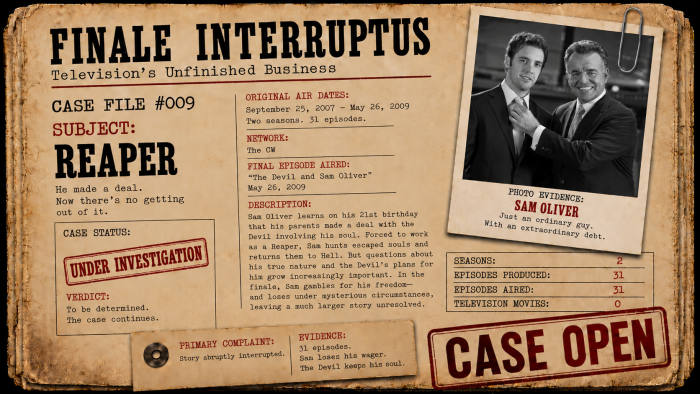
Finale Interruptus: Case File #009 - Reaper
FTC Statement: Reviewers are frequently provided by the publisher/production company with a copy of the material being reviewed.The opinions published are solely those of the respective reviewers and may not reflect the opinions of CriticalBlast.com or its management.
As an Amazon Associate, we earn from qualifying purchases. (This is a legal requirement, as apparently some sites advertise for Amazon for free. Yes, that's sarcasm.)
Submitted by Bill Casticart on Tue, 09/22/2026 - 05:00
Every television series begins with a promise. Give us your time. Your attention. Your imagination. Invite these characters into your home, follow their lives, and return each week to see what happens next.
In return, we'll tell you a story. And when it's over, we'll bring it to its proper end. We'll answer the questions, settle the conflicts, and give the characters—and the audience—a chance to say goodbye. Most series keep that promise. Some don't.
Some disappear between seasons, leaving their characters suspended in place and their audiences waiting for a conclusion that never arrives. Some endings are still missing. These are their case files.
THE WORST 21ST-BIRTHDAY PRESENT EVER
There are certain things you expect to learn when you turn 21. You can legally buy a beer. You should probably start thinking seriously about what you're going to do with your life. And if you've spent the years since high school working a dead-end job at a home-improvement store while living with your parents, perhaps it's finally time to formulate something resembling a plan. Sam Oliver gets something slightly more urgent. His parents sold his soul to the Devil.
Happy birthday, Sam.
That's the wonderfully simple premise with which REAPER arrived on The CW on September 25, 2007. Sam is a directionless young man working at the Work Bench, hanging around with his equally underachieving friends Sock and Ben, carrying a torch for coworker Andi, and generally demonstrating no particular urgency about becoming anything more than what he already is.
Then Satan shows up.
Sam learns that before he was born, his parents made a deal with the Devil. The bill has now come due, and Sam's soul belongs to Hell. But the Devil isn't ready to collect him. He's ready to employ him.
Souls have escaped from Hell, and somebody has to put them back. Sam is given supernatural "vessels"—usually objects that look as though Satan picked them up during a particularly deranged shopping trip—and ordered to capture the escapees and deliver them to a portal to Hell conveniently located at the local DMV. Suddenly Sam Oliver has a purpose. Admittedly, it isn't one he wanted.
REAPER could easily have been a straightforward supernatural action series. Instead, creators Michele Fazekas and Tara Butters built something much stranger and funnier: a supernatural adventure about people spectacularly unqualified to be supernatural adventurers.
They were fans of BUFFY THE VAMPIRE SLAYER, but they weren't interested in creating another Buffy. Their heroes weren't going to train until they became sleek, confident warriors. Sam, Sock and Ben were going to remain Sam, Sock and Ben.
They would stumble into danger, improvise terrible plans, occasionally discover that the terrible plan somehow worked, and then return to their jobs at the Work Bench.
Watching over all of it was the Devil himself—charming, impeccably dressed, weirdly paternal and capable of transforming from Sam's smiling mentor into something genuinely terrifying without changing his tie. At first, the arrangement seemed simple. Sam's parents made a deal. The Devil owned Sam's soul. Sam caught escaped souls for the Devil. That was the show. Except REAPER gradually began suggesting that the deal wasn't nearly that simple.
Because the longer Satan spent around Sam Oliver, the more an uncomfortable question began to emerge. Why was the Devil so interested in this particular kid?
PART TWO: WORKING FOR THE DEVIL
There are bad bosses. There are demanding bosses. There are bosses who call you on your day off, change the schedule without asking, expect unpaid overtime and somehow arrange the universe so that they're standing directly behind you the moment you complain about them. And then there's the Devil.
One of REAPER's smartest decisions was refusing to make Satan merely the monster at the end of the story. He was a regular character. He dropped into Sam's life whenever he pleased, usually smiling, frequently offering advice and almost always neglecting to mention some crucial detail that would have made Sam's latest assignment considerably less likely to kill him.
Ray Wise played him with enormous charm. This wasn't a horned demon barking orders from a throne surrounded by fire. The Devil wore expensive suits, smiled like a man who had already read the contract you hadn't, and seemed genuinely amused by almost everything humanity did.
Especially Sam.
Every escaped soul gave the series its weekly engine. The Devil would assign Sam a fugitive from Hell and provide him with a vessel capable of capturing it. The vessels could be almost anything, and that became part of the joke. Other supernatural shows handed their heroes ancient swords, enchanted amulets and sacred weapons forged by forgotten civilizations.
Sam might get a Dirt Devil.
Once captured, the soul had to be delivered to Hell through one of its portals. The portal Sam used was hidden inside the DMV, where Gladys—the apparently ordinary clerk behind the counter—was actually a demon. That joke tells you almost everything you need to know about REAPER. Of course the DMV is a portal to Hell.
Where else would it be?
But the escaped-soul stories were increasingly just the machinery that kept the larger story moving. Sam had friends.
Sock was the human embodiment of every bad idea that becomes a worse idea because nobody stopped him quickly enough. Ben was somewhat more sensible, which in this particular group was not an especially difficult achievement. Together they turned demon hunting into something that occasionally resembled three guys trying to move a refrigerator down a flight of stairs.
And there was Andi.
Sam's longtime crush and Work Bench coworker initially existed outside much of his supernatural life because Sam couldn't simply explain that his absenteeism was caused by Satan. Eventually she learned the truth and became part of the increasingly complicated reality surrounding him. That mattered because REAPER was slowly changing.
The first season could frequently function as a supernatural case of the week: identify escaped soul, figure out its powers, find the vessel, survive long enough to use it, take the captured soul to Gladys. But underneath that structure, the series kept asking questions about Sam. His father, John, knew more about the contract than he admitted. His mother knew more than she admitted. The Devil certainly knew more than he admitted.
Which meant almost everybody in Sam's life understood something about Sam Oliver that Sam Oliver didn't. Then the mythology began tightening around him. John appeared to die at the end of the first season.
Except he didn't stay dead.
The second season introduced Morgan, another young man who believed himself to be the Devil's son. That created an increasingly uncomfortable possibility: perhaps Sam wasn't merely an employee whose soul happened to belong to Satan. Perhaps there was something else connecting them. The Devil encouraged the rivalry.
Sam began displaying abilities that weren't easily explained by the terms of an ordinary infernal employment contract. Questions about his parentage became more important. His father's secrets became stranger. The circumstances surrounding the original deal became murkier. And REAPER knew exactly what it was doing to its audience. It wanted us asking the obvious question.
Is Sam Oliver the Devil's son?
For a while, even Sam had reason to wonder. But the question was actually a very good piece of misdirection. Because the real mystery wasn't whether the Devil was Sam's father. It was why the Devil wanted Sam to think he might be.
And by the end of the second season, Sam was no longer content simply to collect escaped souls and hope that someday he might stumble across a loophole in his contract.
He wanted out.
The Devil had spent two seasons teaching Sam the rules. Sam finally decided to use them against him. He was going to win his soul back.
PART THREE: WAIT—IS THE DEVIL SAM'S FATHER?
There are certain disadvantages to discovering that your parents sold your soul before you were born. One of the less obvious ones is that it makes family history extremely difficult to trust.
By the second season of REAPER, Sam had accumulated enough evidence to realize that the story he'd been given about himself had holes in it. His parents had lied. His supposedly dead father wasn't particularly good at staying dead. Sam himself was beginning to demonstrate abilities that didn't seem entirely human. And then there was Morgan. Morgan arrived with a claim that changed the shape of the mystery: he was the Devil's son.
That would have been troubling enough if Satan hadn't also begun treating Sam and Morgan like competitors.
The Devil encouraged Morgan's jealousy and repeatedly compared the two young men. Morgan increasingly regarded Sam as a rival for his father's affection, while Sam was forced to consider an explanation that had been sitting uncomfortably close to the surface almost from the beginning. What if the Devil wasn't merely his employer? What if the Devil was his father? It explained an awful lot.
The Devil had always taken an unusually personal interest in Sam. He didn't simply issue assignments and disappear. He counseled him. Tempted him. Manipulated him. Tested him. At times, he almost seemed proud of him. And the more Sam resisted him, the more interested the Devil became. Then there were Sam's powers.
The series had already established that escaped souls and demons possessed abilities ordinary humans did not. Sam's own developing supernatural abilities made it increasingly difficult to believe he was simply an unlucky human being trapped by a contract his parents had signed. Morgan seemed to provide the missing piece.
If Morgan was the Devil's son, and the Devil was measuring Morgan against Sam, then perhaps the competition was exactly what it appeared to be. Two sons. One father. One possible heir.
Except REAPER had spent too much time teaching us not to trust the Devil for the obvious answer to be the correct one.
Morgan eventually dies, and the supposed contest for Satan's favor dies with him. But the questions surrounding Sam remain. Then another impossible piece of evidence turns up. John Oliver. Sam had watched his father die. Yet John was still around.
Not metaphorically. Not as a ghostly memory. Not as a comforting hallucination produced by grief. Around.
John's inability to remain dead was one more clue that whatever happened before Sam's birth involved considerably more than two desperate parents signing away their future child's soul. Unfortunately, REAPER wasn't ready to tell Sam what it meant.
That is one of the things that makes this case particularly frustrating in retrospect. The show wasn't wandering aimlessly through mythology it hadn't thought about. Michele Fazekas and Tara Butters later discussed answers to several of these questions, and those answers reveal that the series was deliberately steering the audience toward the wrong conclusion. The Devil was not Sam Oliver's father. John Oliver was. But John wasn't exactly what Sam thought he was, either. We'll come back to that evidence. Because Sam didn't know it yet.
From his perspective, the immediate problem was much simpler. Whatever he was, whoever his father was, and whatever larger game the Devil was playing, Satan still owned his soul. And Sam had finally found a way to challenge that. The Devil loved games. The Devil loved wagers. Most importantly, the Devil believed he couldn't lose. Sam was about to bet his soul that he could.
PART FOUR: DOUBLE OR NOTHING
By the end of REAPER's second season, Sam Oliver had spent two years learning an important lesson about dealing with the Devil.
There is always fine print.
Every bargain has another condition. Every apparent kindness serves another purpose. Every escape route seems to lead eventually back to Satan. So Sam decides to stop looking for loopholes. Instead, he challenges the Devil directly. The contest is simple: a game of quarters. If Sam wins, he gets his soul back.
This is not exactly Daniel Webster arguing before a jury of the damned. There is no fiddle contest. Nobody is playing chess beneath a thunderstorm while the fate of mankind hangs in the balance. Sam Oliver is going to bounce quarters into a glass. It is absolutely perfect for REAPER.
Sam has practiced. More importantly, he's good. But the first contest ends in a draw—and under the Devil's rules, a draw means Sam loses.
Then Andi raises the stakes. She volunteers her own soul as collateral so Sam can have a rematch. That changes everything. Sam is no longer gambling only with his own damnation. If he loses again, the woman he loves belongs to the Devil too.
When the rematch begins, the impossible actually starts to look possible. Sam keeps making his shots. The Devil, for perhaps one of the few times in the entire series, is faced with the possibility that this ridiculous kid from the Work Bench might actually beat him.
Then Steve appears. Steve has undergone one of REAPER's strangest transformations. Once Sam's demon neighbor, he has earned his way into Heaven and become an angel—which should make him exactly the person Sam wants nearby when playing against Satan for possession of his immortal soul.
Instead, Steve interferes. At the critical moment, a supernatural disturbance knocks Sam's final shot away. He loses. The Devil wins. Sam still belongs to him. And now Andi does too.
Sam realizes what Steve has done and confronts him. Steve doesn't deny it. More importantly, he doesn't behave like a man who has betrayed his friend. He tells Sam that what happened was necessary. There is a plan. Sam is part of it. And Steve cannot tell him what it is. That's where REAPER ends. Not with Sam defeating the Devil. Not with Sam discovering the truth about his father. Not with the mystery of his own supernatural nature finally explained. Not even with the revelation of whatever Heaven apparently needs Sam Oliver to accomplish.
It ends immediately after telling us that there is an answer. May 26, 2009. Thirty-one episodes. Sam and Andi have both lost their souls. The Devil has won. An angel has deliberately helped him do it. And apparently God wanted it that way. Then The CW canceled the show. There are cliffhangers.
And then there are television series that spend two seasons assembling a puzzle, finally turn over the box so you can see that there really is supposed to be a picture on it— and take the puzzle away.
PART FIVE: WHAT THE HELL, STEVE?
If REAPER had ended with the Devil cheating, the situation would have been frustrating but understandable.
He's the Devil.
Cheating is practically in the job description. But the Devil doesn't cheat Sam out of his victory.
Steve does.
That distinction turns the final moments of "The Devil and Sam Oliver" from a conventional cliffhanger into something considerably larger. Steve isn't working for Hell anymore. He's working for Heaven.
The former demon has spent the second season trying to earn his way upstairs, and he ultimately succeeds. Steve is an angel when Sam makes his wager with the Devil. If anybody should be rooting for Sam Oliver to reclaim his soul from Satan, it ought to be him. Instead, when Sam is about to win, Steve intervenes. The significance isn't merely that Sam loses. It's that Heaven apparently needs him to lose.
When confronted afterward, Steve assures Sam that there is a reason for what he did. He tells him that he can't explain everything yet, but that Sam is part of something bigger. Suddenly the series has another player.
For two seasons, Sam has understood his life as a struggle between himself and the Devil. His parents made the deal. Satan owns his soul. Sam wants it back. Now Heaven has entered the game. And Heaven apparently doesn't want Sam free.
At least not yet.
That's an extraordinary place to stop a television series, because Steve's intervention changes the meaning of almost everything we've been watching. If Heaven has a plan for Sam, how long has it had one? Does the Devil know about it? Is that why Satan has always taken such an unusually personal interest in Sam? Are Sam's strange abilities connected to it? Does John Oliver know? And most importantly, what is Sam supposed to become? REAPER doesn't answer any of those questions onscreen. It doesn't get another episode.
But unlike many of the cases in the FINALE INTERRUPTUS files, this investigation doesn't end when the surviving footage runs out.
The people who made the show eventually talked.
Creators Michele Fazekas and Tara Butters later revealed that Steve's intervention wasn't intended to be an arbitrary cliffhanger that they would figure out if somebody ordered another season. There was a larger mythology behind it, and a third season would have begun pulling Sam deeper into a conflict that had been hiding underneath the series all along. The story was no longer simply about getting out of a contract with the Devil.
Sam himself mattered.
And Satan knew it.
The canceled third season would also have forced Andi much further into Sam's supernatural world. She had wagered her soul and lost it. One plan discussed by the creators would have put her to work at the DMV alongside Gladys, bringing a character who had once existed largely on the human side of Sam's life directly into the bureaucracy of Hell. The show's separate worlds were beginning to collapse into one another. Sam's friends knew the truth. Andi was now personally entangled with Hell. Steve had become an agent of Heaven.
John Oliver couldn't seem to stay dead. And the Devil was still smiling. REAPER had spent its first season pretending to be a show about three slackers catching escaped souls with ridiculous household objects.
By the end of its second, it had quietly assembled Heaven, Hell and Sam Oliver on the same chessboard. Then somebody knocked over the table. Which leaves the most important piece of evidence still sitting in the case file. Who, exactly, was Sam Oliver?
PART SIX: SEASON THREE WAS ALREADY WAITING
REAPER did not end because it had run out of story.
Quite the opposite.
By the time The CW pulled the plug, Michele Fazekas and Tara Butters had already begun thinking about what the third season would look like, and their later descriptions make the cancellation considerably more painful. Because the finale wasn't intended as an ending.
It was a doorway.
Andi's lost soul was going to have immediate consequences. Having volunteered herself as collateral in Sam's wager, she was now part of the infernal system instead of merely being the woman Sam was trying to protect from it. One possibility the creators discussed would have put Andi to work at the DMV with Gladys. Think about how much that changes the series.
The DMV had always been one of REAPER's best jokes: Hell's portal hidden inside the most soul-crushing bureaucracy mankind had already invented. Gladys sat behind the counter accepting captured souls while ordinary customers waited around her, presumably wondering why Window Six was taking so long. Putting Andi there would have transformed the joke into a major part of the story.
She would have had direct access to Hell's bureaucracy. She would have been working beside a demon. And instead of Sam disappearing from his normal life to perform his supernatural job, his normal life and supernatural life would have become increasingly difficult to separate. That seems to have been the direction Season Three was taking generally. The mythology was opening up. There could have been other Reapers. More of Hell's organization could have been explored.
Ray Wise later recalled talk of something that sounds like one of the great lost REAPER episodes: a convention for Reapers, with the Devil delivering the keynote address.
Of course he would.
You can practically see the ballroom. "Welcome, Reapers!" Complimentary continental breakfast from 7:00 to 9:00. Breakout session at 10:30: EFFECTIVE VESSEL MANAGEMENT. Satan takes the main stage at noon.
But underneath the comedy, the third season would have been dealing with the much larger question raised in the finale. Why did Heaven need Sam to remain in the Devil's service?
Steve had sabotaged the contest for a reason. Sam losing his soul wasn't a failure of Heaven's plan. It was apparently part of Heaven's plan.
That means the show's central objective—Sam getting his soul back—had suddenly become more complicated than Sam understood. Freedom might not have been the goal. Not yet.
The creators have said enough since the cancellation to establish that they weren't simply going to reset the board and send Sam after another escaped soul. They were going to start explaining why Sam Oliver mattered. And that explanation would have changed the relationship at the center of the entire series.
For two seasons, REAPER encouraged us to wonder whether the Devil might secretly be Sam's father. He wasn't.
The truth was stranger.
And depending upon which surviving piece of testimony we examine, even the people who created REAPER have given us two different versions of exactly how strange it was. The case has reached the point where the witnesses disagree.
PART SEVEN: WHO WAS SAM OLIVER?
Here is where the evidence gets messy.
After REAPER was canceled, Michele Fazekas and Tara Butters began talking about the mythology they never got to put on television. And in 2010, they supplied an answer to one of the show's biggest unanswered questions. The Devil was not Sam's father. John Oliver was. But John Oliver wasn't human. Or, more precisely, he wasn't entirely human anymore.
In that version of the mythology, John had originally been a demon. He fell in love with Sam's mother and wanted to become human so they could be together. As people in REAPER really should have learned by this point, he accomplished that by making a deal with exactly the wrong person.
The Devil.
John was transformed into something closer to human, but the transformation wasn't complete. Some of his demonic nature remained. That explained one of Season Two's most conspicuous mysteries.
John couldn't die.
It also explained Sam. Sam wasn't Satan's son. He was the child of a human mother and a father who had once been a demon. Whatever John had become, Sam had inherited something supernatural from him. Suddenly Sam's unusual abilities made sense. So did the Devil's interest in him.
And the entire Morgan storyline becomes a rather elegant piece of misdirection. REAPER spent much of its second season encouraging Sam—and us—to look at the wrong father.
Case closed.
Except three years later, the creators opened it again. During a 2013 reunion interview, Fazekas described the intended mythology somewhat differently. This time, John Oliver wasn't a demon. He was a fallen angel.
Sam's mother was still human, but that would make Sam half-human and half-angel rather than the son of a former demon. Those are not interchangeable explanations.
And because neither version ever made it to the screen, there is no aired episode we can pull from the evidence locker and use to settle the matter.
Perhaps the mythology evolved during the years after cancellation. Perhaps the fallen-angel explanation represented a later refinement of the same basic idea. Perhaps different versions had been considered while the show was still being produced. What we can say is that both accounts point toward the same larger answer.
Sam Oliver was never supposed to be an ordinary human whose parents happened to sign away his soul. There was something supernatural in his blood. John Oliver was the source of it.
And the Devil knew.
That last part matters more than whether John's original résumé listed "demon" or "fallen angel." Because it changes the question at the center of REAPER. For two seasons we thought Sam needed to discover why the Devil owned him. The unfinished story was preparing to reveal why the Devil wanted him.
Those are two very different questions.
And the answer to the second one explains why an angel would deliberately prevent Sam from winning his freedom. The Devil wasn't merely Sam Oliver's boss. He wasn't his father. He wasn't even simply his owner. He was afraid of what Sam might someday become.
PART EIGHT: THE DEVIL WAS AFRAID OF HIM
The Devil spends an extraordinary amount of time with Sam Oliver. More than the job seems to require.
He could hand Sam a vessel, point him toward an escaped soul and disappear until the assignment was finished. Instead, Satan keeps showing up. He talks to Sam. He advises him. He tempts him. He tests him.
He takes a strangely personal interest in the choices Sam makes and the kind of man Sam is becoming. For two seasons, REAPER gave us an obvious explanation for that behavior. The Devil owned Sam. Then it teased a more dramatic explanation. The Devil might be Sam's father. Neither was the whole answer.
According to Fazekas and Butters' post-cancellation explanation of the mythology, the Devil had another reason for keeping Sam close. Sam was potentially dangerous to him. The larger plan was that Sam could someday become instrumental in the Devil's downfall. That completely changes the relationship we've been watching. Satan isn't simply training his Reaper.
He's cultivating him.
If Sam has the potential to become a force capable of threatening the Devil, then the safest thing Satan can do is make certain Sam never becomes that person. Corrupt him. Compromise him. Make him comfortable with Hell. Teach him to accept infernal rules as simply another part of life. Convince him that resistance is pointless. Maybe even make him like the Devil.
And Satan is very good at being liked.
Ray Wise's performance becomes even more effective when viewed through that lens. His Devil doesn't spend every episode threatening Sam with eternal torture. Quite often, he behaves like the most confident, charismatic mentor Sam has ever had. He congratulates him. He challenges him. He offers worldly advice. He treats Sam as though the two of them have a special relationship.
Because they do.
Just not the relationship Sam thinks.
Now go back to the final game of quarters. Sam is about to beat the Devil. An ordinary 23-year-old slacker who once seemed content to spend his life stocking shelves at the Work Bench has reached the point where he is prepared to stand across from Satan and wager his soul on his ability to win.
And he's winning.
Then an angel stops him.
Steve doesn't sabotage Sam because Heaven wants the Devil to keep him. He sabotages Sam because whatever Sam is supposed to become apparently requires him to remain exactly where he is.
Close to Satan.
Learning.
Growing.
Resisting.
The Devil thinks he is corrupting Sam.
Heaven appears to think Sam is being prepared.
That is the television series REAPER was becoming when it ended. Not merely a comedy about a slacker whose parents sold his soul. Not merely a supernatural procedural about catching escaped souls. Not even merely the story of a young man trying to escape a contract with the Devil. It was becoming the story of why the Devil wanted that contract in the first place. And perhaps why Heaven needed him to keep it.
We know pieces of what would have happened next. We know Andi's lost soul would have pulled her deeper into the supernatural world. We know the mythology of Reapers and Hell would have expanded. We know John Oliver's nature was supposed to explain Sam's. We know the creators had an answer—albeit one they later described in two different ways—to the mystery of Sam's parentage. Most importantly, we know Sam's story was going somewhere.
Toward a confrontation with the Devil that mattered far more than bouncing quarters into a glass.
But television never got there.
There was no third season. No revelation of Heaven's plan. No final explanation of John Oliver. No resolution for Andi's soul. No answer to what Sam would ultimately become. And no final confrontation between the Devil and the young man who might someday destroy him. REAPER didn't end with its hero defeated. It ended at the moment we discovered his defeat might actually be part of the plan. Thirty-one episodes. Two seasons. One soul still owned by the Devil.
And one Devil who may have had considerably more reason to fear its owner than its owner had to fear him.
CASE STATUS: UNRESOLVED.
The Devil got Sam Oliver's soul.
The CW got the rest of his story.


FEATURED ALBUM

Songs of faith, family and moving forward.


